How to Rank in AI Search Engines: The Ultimate Practical Guide
How to Rank in AI Search Engines: The Ultimate Practical Guide
1. Introduction: The Shift to AI-First Search
Search used to feel like a trip to a library shelf. You typed a phrase, scanned ten blue links, opened a few tabs, compared pages, and built the answer yourself.
That habit is changing.
Now a person can ask ChatGPT, Google AI Overviews, Perplexity, Claude, Copilot, or another answer engine a full question and get a direct response. They might ask, “What CRM should I use for a small roofing company?” or “How do I fix a Shopify collection page that is not ranking?” The answer engine may return a summary, a few cited sources, related questions, product names, steps, and sometimes a map or shopping option.
This does not mean classic SEO is dead. It means the playing field is wider. Your page still needs to be crawlable, indexable, useful, and trusted. But the new prize is not only a blue link on page one. The new prize is being named, cited, summarized, and used as source material inside an answer.
That shift matters because AI search changes the path between question and decision. A person may never visit five websites. They may read one generated answer, click one source, and make a choice. In some cases, the assistant may compare options for them. In others, it may suggest the next action without sending much traffic at all.
AI search visibility is the work of making your brand, pages, experts, products, and ideas clear enough for answer engines to find, trust, and cite. It sits beside traditional SEO, content work, technical SEO, digital PR, and brand building. It does not replace them. It forces them to get cleaner.
The plain truth is this: answer engines prefer sources that are useful under pressure. They look for pages that answer the question, explain the topic clearly, show signs of trust, and match the intent behind the query. A thin page with a keyword sprinkled across it is weak. A clear page with proof, structure, examples, and outside validation is much stronger.
This tutorial gives you a practical way to build that kind of presence. You will learn how AI search engines pull information, what an AI citation is, how to audit your current visibility, how to create content that answer engines can cite, how to structure pages for machine reading, how to build authority around a topic, and how to track your progress over time.
You will also get a named system you can reuse: the C.A.R.E. Framework.
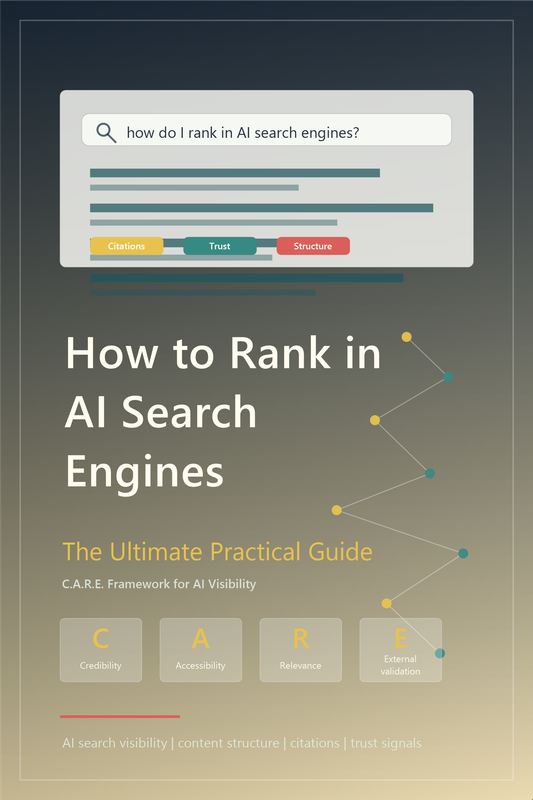
C.A.R.E. stands for:
- Credibility
- Accessibility
- Relevance
- External validation
Keep those four ideas in your head as you read. If your site struggles in AI search, the weakness is usually hiding in one of those areas.
2. Foundations: How AI Search Engines Actually Work
Before you try to rank in AI search engines, you need a working picture of what they do. You do not need to become a machine learning engineer. You only need enough understanding to make better choices with content, site structure, and authority building.
2.1 Traditional Search vs AI Search
Traditional search starts with a query and returns a list of pages. The search engine crawls the web, stores pages in an index, reads signals about meaning and quality, then ranks results for the user's query.
AI search often starts the same way, but the user experience is different. Instead of only showing links, the system may generate a direct answer. It may pull from search results, knowledge sources, product feeds, business profiles, maps, forums, reviews, and other content. Then it writes a response in plain language.
Think about the difference this creates.
With traditional search, the user does more of the synthesis. With AI search, the assistant does more of the synthesis. That means your content has to serve two readers at once:
- The human who wants a useful answer.
- The machine system that needs clear, extractable, trusted information.
If your page hides the answer under a long intro, vague claims, or messy formatting, the assistant may skip it. If your page gives a clean answer, backs it with detail, and sits inside a trusted web presence, it has a better chance.
Google's own public guidance for AI features says the basics still matter: helpful content, technical access, crawlability, indexability, and eligibility to appear with snippets. OpenAI's help material for ChatGPT search also points site owners toward crawl access, reliable information, and no guarantee of placement. That tells you something useful. AI search is new in feel, but it still depends heavily on the same web quality basics, plus clearer answers and stronger evidence.
2.2 Retrieval-Augmented Generation
Many AI search experiences use a pattern often called retrieval-augmented generation, or RAG.
Here is the plain version.
A user asks a question. The system turns that question into one or more searches. It retrieves pages, passages, documents, or structured facts. Then the language model uses that material to produce an answer.
If someone asks, “best project management software for a five-person design agency,” the system may search for:
- Best project management tools for small agencies.
- Project management software for design teams.
- Reviews of Asana, ClickUp, Trello, Notion, and Monday.
- Pricing pages.
- Comparison pages.
- Recent user feedback.
The answer engine is not only looking for one page that repeats the exact phrase. It is trying to gather enough confidence to answer the full question.
This is why some sources get cited and others vanish.
A page may be ignored because:
- It is not indexed.
- Important content is blocked from crawlers.
- The page is too thin.
- The answer is unclear.
- The page has weak trust signals.
- Competing pages answer the query with more depth.
- The source is not widely mentioned elsewhere.
- The content is outdated.
A page may be selected because:
- It gives a direct answer.
- It includes unique examples or numbers.
- It is written by a person or brand with visible expertise.
- It is structured in a way that passages can be pulled cleanly.
- Other trusted sources mention or link to it.
- It covers the topic from several related angles.
RAG also explains why query variety matters. A user rarely asks the same clean keyword you planned for. They ask long, messy, specific questions. Your content has to cover the real shape of those questions, not just one keyword phrase.
2.3 What Is an AI Citation?
An AI citation is a source link, mention, or reference used to support a generated answer.
There are two main forms.
The first is a direct citation. This is when the answer engine shows your page as a source. In ChatGPT search, a response may include linked sources. In Google AI Overviews or AI Mode, the answer may show supporting links. In Perplexity, source links are a core part of the interface.
The second is indirect influence. This is harder to see. Your brand, facts, product descriptions, author profiles, reviews, and third-party mentions may affect what the assistant says, even when it does not show your site as a visible source. If ten trusted pages describe your product as a strong option for a certain use case, answer engines may start to connect your brand with that use case.
That is why citations matter more than rankings in many AI search journeys.
A traditional ranking tells you where your page sits in a list. An AI citation tells you that your content helped shape the answer. If the assistant says, “For technical SEO audits, Site A and Site B are often strong choices,” being one of those named sources can matter more than being result number six in a classic search page.
The goal is not to chase every answer engine with tricks. The goal is to become the kind of source that a careful system would want to use.
3. The C.A.R.E. Framework for AI Visibility
To make AI search less fuzzy, use the C.A.R.E. Framework:
- Credibility
- Accessibility
- Relevance
- External validation
This framework gives you a simple way to audit any page, brand, or content plan.
Credibility
Credibility answers the question, “Why should anyone trust this?”
For AI search, credibility is built through proof. A page becomes more credible when it includes:
- Clear author information.
- Real experience.
- Original examples.
- Published dates and update dates.
- Sources for claims.
- Company details.
- Product details that match reality.
- Reviews, testimonials, case examples, or public results.
If you write a guide on accounting software, the content is stronger if it is reviewed by an accountant or written by someone with direct finance work. If you publish a guide on roof repair, the advice is stronger when it reflects real job-site details, costs, tools, weather issues, and safety risks.
AI search systems are not perfect judges of truth, but they are built to prefer signs of reliability. Empty claims are weak. Specific proof is stronger.
Accessibility
Accessibility answers the question, “Can machines and humans read this without friction?”
This includes technical access and content clarity.
Your page should be:
- Crawlable.
- Indexable.
- Fast enough to load without frustration.
- Useful without requiring hidden scripts for the main content.
- Organized with proper headings.
- Written in clear language.
- Marked up with helpful structured data when it fits.
- Free of broken internal links.
Many sites lose AI visibility before the content is judged because the page is hard to access. The page might block crawlers. The main text might sit behind tabs that do not render well. The site might use confusing canonical tags. The page might be buried so deeply that search systems do not see it as central.
Machine-readable does not mean robotic. It means clean.
Relevance
Relevance answers the question, “Does this match the user's real intent?”
A person searching for “how to rank in AI search engines” is probably not looking for a vague trend article. They want a process. They want tests, examples, page structure advice, authority work, and tracking ideas. If your page only says “AI search is changing SEO,” it misses the intent.
Good relevance comes from understanding the full question behind the query.
Ask:
- What is the user trying to decide?
- What level of knowledge do they have?
- What would make them trust the answer?
- What next step would they take after reading?
- What related questions will they ask next?
When your page answers the main query plus the next five natural follow-up questions, it becomes more useful for AI search.
External Validation
External validation answers the question, “Does the wider web confirm this source matters?”
This includes links, brand mentions, expert quotes, media coverage, podcast appearances, citations in industry articles, software directory profiles, review sites, social profiles, conference pages, and community discussions.
Unlinked mentions can still help entity recognition. If your brand is often mentioned with the same service, location, product category, or expert, search systems have more context. The web starts to teach machines who you are and what you should be associated with.
This is why AI search work cannot live only inside your blog. Your site matters, but so does the shape of your presence across the web.
Use C.A.R.E. like a diagnostic tool. When a page is not showing up in AI answers, ask:
- Is it credible enough?
- Is it accessible enough?
- Is it relevant enough?
- Is it validated by outside sources?
One weak area can hold back the whole page.
4. Step 1: Audit Your Current AI Visibility
You cannot improve what you have not checked. The first step is to see how AI search engines talk about your brand, your topics, and your competitors right now.
Do this like a real user would. Do not only search your brand name. Search the problems you solve.
4.1 Manual Visibility Testing
Open a few AI search tools and ask natural questions. Use your main service, product, niche, location, or topic.
For a local legal firm, prompts might include:
- “Who are the best estate planning attorneys in Austin for young families?”
- “What should I look for in an estate planning lawyer?”
- “Which Austin law firms help with wills and trusts?”
- “Compare estate planning options for a married couple with one child.”
For a SaaS company, prompts might include:
- “Best client portal software for accounting firms.”
- “What tools help agencies share project updates with clients?”
- “Compare client portal tools for small consulting teams.”
- “What should I use instead of email for client file sharing?”
For a content site, prompts might include:
- “Best beginner guide to indoor herb gardening.”
- “How do I grow basil indoors without grow lights?”
- “Why does my basil keep dying on a windowsill?”
- “What are trusted sources for indoor gardening advice?”
Record the answers in a spreadsheet or note file. Capture:
- Which brands are named.
- Which pages are cited.
- What wording the answer uses.
- Whether your site appears.
- Which competitor appears most often.
- Which type of source gets cited, such as guides, reviews, lists, forums, docs, or videos.
Run each query more than once over several days. AI answers can vary. You are looking for patterns, not one perfect snapshot.
Reflection check: if an assistant had to recommend three sources in your space today, would your site make the list? If not, the rest of this guide will show you where to work.
4.2 Competitor Citation Analysis
When a competitor is cited, do not just feel annoyed and move on. Treat it as free research.
Open the cited pages and ask:
- What format is being cited?
- Is it a guide, product page, study, list, comparison, or glossary?
- How direct is the answer?
- Does the page include original numbers, screenshots, expert quotes, or examples?
- Is the author visible?
- How fresh is the content?
- What internal links support the page?
- What outside sites link to or mention it?
You may notice patterns fast.
Maybe answer engines cite product comparison pages more than homepages. Maybe they cite official docs for technical questions. Maybe they cite review platforms for buyer questions. Maybe they cite long tutorials for learning questions. Maybe they prefer pages with short definitions at the top.
Your job is not to clone the competitor. Your job is to understand why the page is useful to the answer engine, then create a better source from your own knowledge.
For example, if a competitor ranks in AI answers for “best payroll software for restaurants,” their page may include:
- A clear definition of restaurant payroll needs.
- A comparison table.
- Pricing notes.
- Common compliance issues.
- Integration details.
- Short pros and cons.
- A visible update date.
If your own page is a 700-word sales page that says your product saves time, the gap is obvious. You need a richer page that helps the user decide.
4.3 Content Gap Analysis
Content gaps are not only missing keywords. They are missing answers.
Start with three lists:
- Questions your customers ask before they buy.
- Questions they ask while using your product or service.
- Questions they ask after something goes wrong.
Then compare those questions with your existing site.
Mark each question as:
- Fully answered.
- Partly answered.
- Not answered.
- Answered, but weak.
- Answered, but buried.
Weak content often has one of these problems:
- It gives a shallow answer.
- It repeats common advice with no examples.
- It avoids cost, risk, limits, or tradeoffs.
- It has no proof.
- It has no author context.
- It does not link to related pages.
- It has not been updated in a long time.
AI search rewards content that makes a topic clearer. If your page only sounds like everyone else, it gives the system no strong reason to use you.
A practical gap analysis might reveal that your “AI search ranking” page talks about keywords, but does not explain citations, crawler access, entity recognition, structured data, prompt testing, or topic clusters. That is not a keyword gap. It is a usefulness gap.
5. Step 2: Create AI-Citable Content
AI-citable content is content that an answer engine can confidently use to support a response.
It does not need to be fancy. It needs to be clear, useful, specific, and trustworthy.
5.1 What Makes Content Citable
The best citable content usually has at least one of these qualities:
- It defines a concept clearly.
- It explains a process step by step.
- It answers a common question directly.
- It includes original research, examples, or numbers.
- It compares options fairly.
- It explains tradeoffs.
- It comes from a credible author or brand.
- It is current.
Generic content is hard to cite because it does not add much. If your article says, “Create quality content and build authority,” an answer engine can find that on a thousand pages. If your article shows how to audit AI citations across ten prompts, classify missing answers, rewrite pages into answer-first sections, and track mentions over ninety days, it has more value.
Specificity creates trust.
Here is a weak answer:
“To rank in AI search, create helpful content and build links.”
Here is a stronger answer:
“To improve AI search visibility, test twenty real user questions across at least three answer engines, record which sources are cited, identify repeated source formats, rebuild your pages with direct answers, add author proof and schema where useful, then earn mentions from trusted industry pages that already appear in AI answers.”
The second answer is more citable because it gives a process.
5.2 Content Formats That AI Search Often Uses
Certain formats are naturally useful for answer engines because they reduce confusion.
Guides and tutorials work well for “how to” questions. They show a sequence. They explain mistakes. They give examples. A strong tutorial can answer the main question and several follow-up questions in one place.
Definitions work well for “what is” questions. A good definition should be short at first, then expanded with examples, use cases, and related concepts.
Comparison pages work well for decision questions. They help the assistant explain which option fits which situation. These pages need to be fair. If every comparison ends with “our product is best for everyone,” trust drops.
Lists work well when the user wants options. The key is to include selection criteria. A list without criteria is just a pile of names.
Original research works well because it gives answer engines something unique. Surveys, benchmark reports, pricing studies, experiments, and usage data can attract citations because other pages cannot say the same thing.
Templates and tools work well because they solve a practical problem. A checklist, calculator, audit worksheet, or prompt library can become a source other pages mention.
The best sites usually mix these formats. A single pillar guide is useful, but a full topic library is stronger.
5.3 Writing for AI and Humans
Writing for AI does not mean stuffing keywords into stiff sentences. It means writing with clarity.
A human wants the answer fast. A machine system needs to identify the answer fast. Those goals match.
Use this pattern often:
- Give the direct answer.
- Explain why it is true.
- Show an example.
- Add the tradeoffs.
- Point to the next useful step.
For example, under a heading like “Can AI search engines cite product pages?” you might write:
“Yes. AI search engines can cite product pages when the page directly answers the query, gives enough product detail, and is accessible to crawlers. Product pages are more likely to be useful when they include specs, use cases, pricing context, FAQs, reviews, and clear comparisons with alternatives.”
That is a strong answer-first paragraph. It does not waste time. It gives the machine a clean passage and gives the human a useful answer.
Avoid fluff. Avoid vague claims. Avoid long openings that say the world is changing for five paragraphs. The reader already knows something is changing. They need help.
One good test is to ask, “Could this paragraph be cited as a standalone answer?” If not, tighten it.
6. Step 3: Structure Content for Machine Readability
Great content can still underperform if the structure is messy. AI search systems work better when pages are organized clearly.
Your goal is to make the page simple to parse.
6.1 Content Architecture
Use one H1 for the page title. Use H2 headings for major sections. Use H3 headings for subtopics. Use H4 only when the page is deep enough to need it.
This sounds basic, but many pages get it wrong. They use headings for styling instead of meaning. They skip levels. They bury key answers inside walls of text. They put FAQs in accordions that may not be read well. They mix several intents on one page without clear labels.
For an AI search guide, a clean architecture might look like this:
- H1: How to Rank in AI Search Engines
- H2: What AI Search Engines Look For
- H2: How to Audit AI Visibility
- H2: How to Create AI-Citable Content
- H2: How to Structure Pages for Answer Engines
- H2: How to Track AI Citations
- H2: Common Mistakes
Each section should answer one clear part of the user's problem.
If a section gets too long, split it. If two sections repeat the same idea, merge them. If a heading is clever but unclear, rewrite it.
Machines do not reward cute labels if the meaning is hidden. Humans usually do not either.
6.2 Answer-First Formatting
Answer-first formatting means the page gives the direct answer near the top of each section, then expands.
Here is a simple format:
- Heading as a question or clear topic.
- One short paragraph with the direct answer.
- A deeper explanation.
- Bullets, steps, or examples.
- A note about mistakes or limits.
This works because many AI answers are built from passages. A passage that directly answers a question is easier to use than a passage that needs ten surrounding paragraphs to make sense.
For example:
Can Schema Markup Help AI Search Visibility?
Schema markup can help machines understand the type and purpose of a page, but it does not guarantee AI citations. Use schema to clarify content, such as FAQs, how-to steps, products, reviews, articles, authors, and organizations.
Then expand with details.
That structure gives both reader and system a clean starting point.
6.3 Structured Data Basics
Structured data is code that labels parts of a page in a machine-readable way. The most common format for SEO is JSON-LD.
Use structured data when it matches the content on the page. Do not add fake FAQ schema if the page does not show those questions to users. Do not mark up reviews you do not display. Do not mark every page as a how-to page.
Useful schema types may include:
- Article.
- FAQPage.
- HowTo.
- Product.
- Review.
- Organization.
- Person.
- LocalBusiness.
- BreadcrumbList.
Schema is not magic. It is a clarity signal. If your content is thin, schema will not save it. If your content is strong, schema can help search systems understand it with less guesswork.
For a tutorial, HowTo schema can label the steps. For a product page, Product schema can clarify pricing, brand, offers, and reviews. For an expert article, Person or author markup can support trust when it matches visible author information.
6.4 Internal Linking for Context
Internal links help search systems understand which pages matter and how topics connect.
A strong internal link plan does three things:
- It points users from broad guides to deeper pages.
- It links related questions together.
- It shows which page is the main authority on a topic.
Imagine you run a cybersecurity site. Your pillar page is “Small Business Cybersecurity Guide.” Supporting pages might cover password managers, phishing training, endpoint protection, backup plans, incident response, and cyber insurance.
Each supporting page should link back to the pillar page. The pillar page should link to each supporting page. Related supporting pages should link to each other when the connection helps the reader.
This creates a topic cluster. The cluster tells search systems, “This site covers the topic in depth, not just in one isolated post.”
Use descriptive anchor text. “Read our password manager checklist” is more useful than “click here.” Anchor text gives context.
7. Step 4: Build Topical Authority
Topical authority means your site is known for covering a subject well.
In AI search, this matters because answer engines often need confidence. If your site has one article about a topic, it may be useful. If your site has a full set of connected, high-quality pages around that topic, it becomes a stronger source.
7.1 Pillar Pages and Supporting Content
A pillar page covers the broad topic. Supporting pages answer narrower questions.
For example, a site about AI search could build this cluster:
- How to Rank in AI Search Engines.
- What Are AI Citations?
- How to Audit ChatGPT Search Visibility.
- How to Structure FAQ Pages for Answer Engines.
- How to Use Schema for AI Search.
- How Brand Mentions Affect AI Search.
- AI Search Tracking Checklist.
- Common AI Search Ranking Mistakes.
The pillar page gives the big picture. The supporting pages go deeper.
This matters because no single page can answer every question without becoming bloated. A cluster lets you cover the topic fully while keeping each page focused.
7.2 Semantic Coverage
Semantic coverage means you address the related ideas that a topic naturally includes.
For AI search visibility, related ideas include:
- Crawling.
- Indexing.
- Snippets.
- Citations.
- Entity recognition.
- Author trust.
- Structured data.
- Topic clusters.
- Reviews.
- Brand mentions.
- Content freshness.
- Query testing.
- Competitor sources.
A weak page might only discuss keywords and backlinks. A stronger page connects all the pieces.
This does not mean adding random terms. It means covering the subject the way a real expert would. If you were teaching a friend, what would they need to know to avoid bad decisions?
A good way to find missing subtopics is to collect questions from:
- Customer calls.
- Sales chats.
- Support tickets.
- Reddit threads.
- Community forums.
- People Also Ask results.
- AI answer follow-up prompts.
- Competitor FAQs.
Then group the questions by intent. Some are beginner questions. Some are buyer questions. Some are technical questions. Some are troubleshooting questions. Each group may deserve its own page or section.
7.3 Consistency and Publishing Rhythm
Authority is not built by publishing one huge article and disappearing.
You need a rhythm you can maintain. That might mean one strong article per week, two smaller updates per week, or one research report per month. The right rhythm depends on your team, topic, and quality bar.
The key is to keep the topic library alive.
Update pages when:
- Tools change.
- Prices change.
- Your product changes.
- Search features change.
- New user questions appear.
- A page starts losing citations.
- Competitors publish stronger resources.
Freshness is especially important in fast-moving topics like AI search. A guide from two years ago may still have useful basics, but it may miss new search features, crawler rules, or user habits.
Do not publish filler just to hit a schedule. Better to publish one useful page than five thin pages that teach nothing.
8. Step 5: Build External Signals That Influence AI Citations
Your own site is the home base. External signals are the proof that others recognize you.
AI search systems use the wider web to understand entities. An entity can be a person, brand, product, place, concept, or organization. The more consistent and trustworthy your outside presence is, the easier it is for search systems to understand what you are known for.
8.1 Digital PR and Media Coverage
Digital PR means earning coverage on sites your market already trusts.
This can include:
- Expert quotes in articles.
- Podcast interviews.
- Original research picked up by journalists.
- Guest commentary.
- Industry roundups.
- Award pages.
- Conference speaker pages.
- Local news coverage.
The best digital PR gives the web a reason to connect your name with a topic.
For example, if you sell bookkeeping software for restaurants, a strong PR angle might be a report on common payroll mistakes in independent restaurants. If restaurant publications mention your report, answer engines may start connecting your brand with restaurant payroll expertise.
Do not chase random links from weak sites. A single mention from a respected industry publication can mean more than dozens of low-quality placements.
8.2 Third-Party Content Placement
Third-party content placement means publishing or being featured on sites you do not own.
This includes guest articles, contributed expert answers, partner pages, software directories, trade association sites, and educational resources.
The goal is not to flood the web with copied posts. The goal is to place useful ideas where the right readers already spend time.
Good placements usually have:
- A clear topic fit.
- Editorial standards.
- Real readership.
- Author details.
- A natural brand mention or link.
- A reason for the page to exist beyond promotion.
If you write a guest article, make it specific. “How dental clinics can reduce missed appointments with better patient reminders” is stronger than “Why communication matters in business.”
Specific pages create stronger associations.
8.3 Brand Mentions and Entity Recognition
AI search engines need to know what your brand is, what it does, who it serves, and why it matters.
Consistent brand mentions help.
Check whether your brand information matches across:
- Your website.
- Google Business Profile.
- LinkedIn.
- YouTube.
- Software directories.
- Review platforms.
- Podcast bios.
- Guest author bios.
- Press pages.
- Local listings.
Use the same core description where it makes sense. If one profile says you are a “workflow platform for agencies,” another says you are “task software for freelancers,” and another says you are “client communication software,” the web may get mixed signals.
You can describe yourself in different ways for different readers, but the core identity should stay stable.
Also pay attention to people. If your founder, authors, or experts have strong public profiles tied to the same topics, that can support trust. A named expert with a history of useful work is easier to trust than a blank byline.
9. Step 6: Use Tools and Automation Wisely
Tools can help you move faster, but they cannot replace judgment. AI search visibility still depends on clear thinking, real experience, and quality control.
Use tools to find gaps, speed up checks, and keep pages current. Keep humans in charge of decisions.
9.1 AI Tools for Content Review
AI writing tools are useful for reviewing content, but they should not be the final brain.
You can use them to:
- Summarize competitor pages.
- Extract questions from sales calls.
- Group keywords by intent.
- Find missing subtopics.
- Rewrite confusing paragraphs.
- Create draft FAQs.
- Check whether a section answers a query directly.
- Produce title ideas.
- Turn a transcript into article notes.
The danger is bland sameness. If your team publishes unedited AI drafts, the content will often sound generic. It may miss real details. It may make claims that are not true. It may repeat advice that already exists everywhere.
Use AI tools as assistants. Add human experience, examples, edits, and proof.
One useful prompt for review is:
“Read this page as if you are an answer engine deciding whether to cite it. List the parts that directly answer the query, the parts that feel vague, the missing proof, and the sections that need clearer headings.”
Then review the output with your own judgment.
9.2 AI Agents and Workflows
AI agents can handle repeatable research and update tasks when the scope is clear.
For example, an agent can:
- Check whether key pages still mention current product names.
- Compare your FAQ page against twenty customer questions.
- List competitor pages cited by AI answers.
- Draft update notes for old articles.
- Scan your site for missing author bios.
- Find pages with thin sections.
- Build a first-pass internal link map.
The key is to define the work tightly.
Bad request:
“Improve our AI search presence.”
Better request:
“Review these ten pages for AI citation readiness. For each page, check whether it has a direct answer in the first two paragraphs, a visible author, update date, internal links to related pages, FAQ section, and at least one original example.”
The second request gives the agent a checklist. You can review the results and make decisions.
Automation should reduce busywork, not remove accountability.
9.3 Track AI Visibility
Tracking AI search is messier than tracking classic rankings because AI answers can vary by user, location, tool, prompt wording, and time.
Still, you can track useful patterns.
Build a simple AI visibility tracker with columns for:
- Date.
- Tool tested.
- Query.
- Your brand mentioned, yes or no.
- Your page cited, yes or no.
- Competitors mentioned.
- Sources cited.
- Answer summary.
- Notes on intent.
- Next action.
Test a fixed set of queries every two or four weeks. Include:
- Brand queries.
- Category queries.
- Problem queries.
- Comparison queries.
- Local queries if location matters.
- Buyer questions.
- Beginner questions.
Do not panic over one missing citation. Look for trends. Are you being mentioned more often? Are competitors appearing in the same answer types? Are your updated pages getting cited? Are answer engines using outdated descriptions of your brand?
Tracking is useful because it turns a vague feeling into a work list.
10. Step 7: Strengthen Trust with E-E-A-T
E-E-A-T stands for experience, expertise, authoritativeness, and trust. It is most often discussed in Google quality conversations, but the idea matters across AI search as well.
Answer engines need to decide which sources deserve confidence. E-E-A-T gives you a human way to think about that.
10.1 Build Author Authority
A strong author profile can make content more trustworthy.
Every serious article should answer:
- Who wrote this?
- Why are they qualified?
- What experience do they have?
- When was the article published?
- When was it last updated?
- Was it reviewed by someone with deeper expertise?
An author bio does not need to be long. It needs to be real.
For example:
“Maya Chen is a technical SEO consultant who has audited search architecture for B2B SaaS, ecommerce, and publisher sites since 2017. Her work focuses on crawl access, content structure, and AI search visibility.”
That is much stronger than:
“Maya loves helping brands win online.”
If the topic is sensitive, such as health, finance, or legal advice, review matters even more. A medical article should involve medical review. A tax article should involve tax expertise. A legal article should be careful about jurisdiction and limits.
10.2 Trust Signals
Trust signals are details that reduce doubt.
Useful trust signals include:
- Clear contact information.
- Real company address when appropriate.
- Transparent pricing when possible.
- Editorial policy.
- Correction policy.
- Review process.
- Customer reviews.
- Case examples.
- Clear refund or warranty terms.
- Security details for software.
- Privacy policy.
- Terms of service.
- Consistent branding.
Trust also comes from honesty.
If your product is not right for enterprise teams, say who it is best for. If your method takes three months, do not promise results next week. If a tactic has risks, explain them.
Answer engines are built to avoid unsafe or misleading advice. Pages that overpromise can look less reliable, especially in topics where bad advice can hurt people.
10.3 Consistency Across Platforms
Trust grows when your story is consistent.
If your website says you serve ecommerce brands, your LinkedIn says you serve local restaurants, and your directory profiles say you serve everyone, the web sends mixed context.
Review your core profiles once per quarter. Check:
- Brand name spelling.
- Product names.
- Service categories.
- Founder names.
- Author names.
- Locations.
- Phone numbers.
- Taglines.
- Short descriptions.
- Logos.
This may sound boring, but boring details often matter. Machines need stable facts to understand entities. Humans need stable facts to trust you.
11. Step 8: Advanced Methods for Competitive Advantage
Once your basics are strong, you can create assets that competitors cannot copy in one afternoon.
This is where AI search visibility becomes more durable. Anyone can publish a generic guide. Fewer teams can publish research, useful tools, strong templates, expert interviews, and public resources that earn mentions naturally.
11.1 Publish Original Research
Original research gives answer engines and other writers something unique to cite.
You can create research from:
- Customer surveys.
- Industry polls.
- Product usage patterns.
- Manual audits.
- Pricing studies.
- Benchmark tests.
- Public dataset reviews.
- Expert interviews.
For example, an agency could audit 500 local business websites and report how many have missing schema, slow pages, weak service pages, or unclear contact details. A payroll software company could survey restaurant owners about payroll errors, tip reporting, and scheduling issues.
Good research does not need to be huge. It needs to be honest, clear, and useful.
Include:
- What you studied.
- How you collected the numbers.
- Sample size.
- Time period.
- Limits.
- Key findings.
- Charts or tables if useful.
- Plain-language takeaways.
Do not hide the method. The method is part of the trust.
11.2 Create Tools and Resources
Tools and resources earn attention because they help people do something.
Ideas include:
- AI visibility audit checklist.
- Content refresh planner.
- Schema markup checklist.
- Citation tracking sheet.
- Topic cluster map.
- Prompt testing library.
- Cost calculator.
- Product comparison worksheet.
- Buyer interview script.
A tool does not have to be complex. A well-made spreadsheet can be more useful than a polished app nobody needs.
For AI search, a strong resource might be an “AI Citation Readiness Checklist” with sections for crawl access, direct answers, author trust, schema, internal links, third-party mentions, and freshness.
Resources work best when they connect back to your articles. The article explains the thinking. The resource helps the reader apply it.
11.3 Build a Recognizable Brand Entity
A brand entity is the web's understanding of who you are and what you are known for.
You build it through repetition, clarity, and proof.
Start by defining:
- Your exact brand name.
- Your main category.
- Your core use cases.
- Your primary experts.
- Your location, if local.
- Your products or services.
- Your proof points.
Then make sure those details appear consistently across the web.
For example:
“Northline Ledger is bookkeeping software for independent restaurants. It helps owners track payroll, tips, vendor bills, and monthly close tasks.”
That is clear. It connects brand, category, reader, and use cases.
Now imagine that description appears on the company site, software directories, guest bios, podcast notes, review pages, and partner pages. Search systems get repeated context from different places.
That is how a brand becomes easier to recognize.
12. Common Mistakes to Avoid
AI search visibility work fails when teams chase shortcuts and ignore the basics.
Here are the most common mistakes.
Writing Only for Keywords
Keywords still matter because they reveal language and intent. But writing only for keywords creates weak content.
A keyword-led page may repeat “AI search ranking” many times but never explain how to audit citations, structure answers, or build trust. That page may satisfy an old checklist, but it will not help a real reader much.
Write for the question, not just the phrase.
Ignoring Authority Signals
Some sites publish decent articles with no author names, no update dates, no sources, no company context, and no outside mentions.
That creates doubt.
If you want answer engines to cite you, make trust visible. Show who wrote the page, why they know the topic, and how the reader can verify the information.
Publishing Thin or Generic Content
Thin content is not only short content. A long article can still be thin if it says nothing new.
Generic content often has:
- Broad claims.
- No examples.
- No process.
- No proof.
- No tradeoffs.
- No real point of view.
If a section could appear on any competitor's site with the brand name swapped, it probably needs more specific detail.
Letting Content Go Stale
AI search changes fast. Tools change. Interfaces change. Crawler guidance changes. User habits change.
An old page can lose usefulness even if it once performed well.
Create a refresh schedule for your most important pages. Review AI search topics at least quarterly. For high-value pages, review monthly.
Overusing AI Drafts Without Editing
AI tools can produce a lot of text fast. That is useful for drafts, outlines, and review. But raw AI text often lacks experience.
Before publishing, add:
- Real examples.
- Screenshots when helpful.
- Current facts.
- Clear opinions.
- Warnings.
- Better structure.
- Human editing.
The final article should sound like someone who has done the work.
13. Practical Implementation Plan
Here is a grounded roadmap you can follow. Adjust the timing based on your site size and team.
Weeks 1 and 2: Audit Visibility and Find Gaps
Start by testing twenty to fifty prompts across your main topics.
Group prompts by intent:
- Learning.
- Buying.
- Comparing.
- Troubleshooting.
- Local search.
- Brand search.
For each prompt, record whether your brand appears, whether your site is cited, which competitors appear, and what sources are used.
Then audit your top pages through C.A.R.E.
For each page, score:
- Credibility from 1 to 5.
- Accessibility from 1 to 5.
- Relevance from 1 to 5.
- External validation from 1 to 5.
Low scores tell you where to work first.
At the end of week 2, you should have:
- A list of missed queries.
- A list of competitor pages cited often.
- A list of weak pages on your site.
- A list of missing topics.
- A short priority list.
Weeks 3 to 6: Create Foundational Content and Clean Structure
Now create or rebuild the pages that matter most.
Focus on:
- One pillar page for the main topic.
- Supporting pages for common questions.
- Comparison pages for buyer intent.
- Definition pages for core concepts.
- FAQ sections where they help.
- Clear author bios.
- Update dates.
- Internal links.
- Schema where it fits.
Do not try to fix every page at once. Start with pages tied to important queries and business outcomes.
For each page, use this checklist:
- Does the first section answer the main question directly?
- Are the headings clear?
- Does the page include examples?
- Does it explain tradeoffs?
- Does it show proof?
- Does it link to related pages?
- Can a machine extract a useful passage from it?
By the end of week 6, your site should have a stronger base for AI citations.
Months 2 and 3: Earn Mentions and Links
Once your core pages are strong, promote the best assets.
Pitch:
- Industry publications.
- Podcasts.
- Partner blogs.
- Comparison sites.
- Resource pages.
- Newsletter writers.
- Local media if relevant.
- Communities where your expertise helps.
Lead with something useful, not a request for a link.
For example:
“We analyzed 300 ecommerce return policy pages and found five patterns that reduce customer confusion. Would this be useful for your retail operations readers?”
That is stronger than:
“Please link to our guide.”
You can also update directory profiles, improve review platform descriptions, and make sure your experts have complete public bios.
Ongoing: Refresh, Monitor, and Improve
AI search visibility is not a one-time task.
Every month, review:
- Your tracking prompts.
- New citations.
- Lost citations.
- Competitor appearances.
- Outdated facts.
- Pages that need refreshes.
- New customer questions.
Every quarter, review:
- Topic clusters.
- Internal links.
- Author profiles.
- Brand profiles.
- Schema.
- Technical crawl access.
- Top external mentions.
This cycle keeps your content alive.
14. Case Study: A Small SaaS Company Builds AI Search Presence
Let us use a realistic example.
Imagine a SaaS company called DeskPilot. It sells client portal software for small accounting firms. The team gets traffic from traditional SEO, but AI search tools rarely mention the brand.
The Problem
When the team tests prompts like “best client portal software for accounting firms” and “how should accountants share files with clients securely,” answer engines cite larger competitors, software review sites, and a few accounting blogs.
DeskPilot has a homepage, a pricing page, and a few short blog posts. The content says the product is secure and saves time, but it does not explain accounting-specific workflows. The blog has no author bios. There is no comparison page. Directory profiles are outdated.
Using C.A.R.E., the team scores itself:
- Credibility: 2 out of 5.
- Accessibility: 4 out of 5.
- Relevance: 2 out of 5.
- External validation: 1 out of 5.
The site is accessible, but it lacks depth and outside proof.
The Plan
DeskPilot chooses one core goal: become a trusted source for accountants researching client portals.
The team creates:
- A pillar guide called “Client Portal Software for Accounting Firms.”
- A comparison page for popular client portal tools.
- A guide on secure file sharing for tax season.
- A checklist for choosing a client portal.
- A glossary page explaining client portal terms.
- An FAQ page based on sales calls.
Each page includes:
- Direct answers near the top.
- Real accounting firm scenarios.
- Security details.
- Pricing context.
- Clear author bio.
- Review date.
- Internal links.
- FAQ schema where appropriate.
The Execution
DeskPilot also updates outside profiles. The team rewrites software directory descriptions to say, consistently, that DeskPilot is client portal software for small accounting firms. They ask happy customers for honest reviews. They pitch a guest article to an accounting operations newsletter about tax-season file sharing mistakes.
Then they run the same AI visibility test every month.
After two months, answer engines still cite the large competitors more often, but DeskPilot starts appearing in answers for narrower questions:
- “client portal checklist for accounting firms”
- “secure file sharing during tax season”
- “client portal features accountants need”
After four months, one guide earns links from two accounting blogs. A software comparison site updates its DeskPilot profile. AI answers start mentioning DeskPilot in a few comparison prompts.
The Results
DeskPilot does not dominate every AI answer. That would be unrealistic.
But it improves in the right places. It wins visibility for specific accounting-firm questions. Its brand description becomes more consistent. Its sales team gets better educational pages to share. Its product is no longer invisible in AI-assisted research.
That is what practical AI search work looks like. Not hype. Not tricks. Better answers, better structure, better proof, and better outside recognition.
15. The Future of AI Search
AI search is moving from answers to actions.
Today, many users ask an assistant for advice. Soon, more users will ask assistants to compare vendors, draft emails, book appointments, create shopping lists, choose tools, prepare reports, and complete tasks across apps.
This will change how visibility works.
Personalized AI Responses
AI answers may become more personalized based on user context, location, history, preferences, budget, or work needs.
That means generic content will struggle even more. A broad page that says “best software for teams” may be less useful than pages that explain which product fits which type of team, budget, workflow, and constraint.
Create content that helps with real decisions.
Voice and Multimodal Search
Voice search pushes people toward natural questions. Multimodal search lets people use images, screenshots, maps, documents, and product photos as part of the query.
A user might show a broken appliance part and ask what it is. A shopper might upload a room photo and ask which paint color fits. A marketer might upload a traffic chart and ask why leads dropped.
This makes clear labeling, image context, alt text, product specs, and visual explanations more useful.
If your business depends on products, places, repairs, design, food, fashion, real estate, or local services, think beyond text. Use helpful images, diagrams, tables, and videos where they genuinely make the answer clearer.
AI Agents Making Decisions
AI agents may compare options and take action on behalf of users. For example, an agent might shortlist vendors, request quotes, book a consultation, or renew a subscription.
If that becomes common, your site needs to answer practical decision questions:
- Who is this for?
- What does it cost?
- What are the limits?
- What proof exists?
- How does someone start?
- What integrations exist?
- What policies apply?
- What support is available?
Vague brand pages will not help an agent make a confident choice.
From Traffic to Transactions
AI search may reduce some casual traffic. A user who only needed a definition may get it without clicking.
That can feel scary.
But serious decisions still need trusted sources. People still click when they need depth, proof, tools, pricing, forms, products, service details, or human help.
The goal is not only more visits. The goal is to be present when the answer is formed and when the decision is made.
That means your content should support both discovery and action. Teach clearly, then make the next step plain.
16. Conclusion
Ranking in AI search engines is not about tricking the machine. It is about becoming a better source.
The sites that win will usually do four things well.
They will show credibility through authors, proof, experience, and honest detail. They will make their content accessible with clean technical setup, clear headings, and readable structure. They will match relevance by answering real questions in the way people actually ask them. They will earn external validation through mentions, links, reviews, profiles, research, and useful resources.
That is the C.A.R.E. Framework.
If you feel behind, start small. Test twenty prompts. Find the sources that appear. Pick one weak page. Rewrite it with a direct answer, better examples, clearer headings, author proof, and internal links. Then build one supporting page. Then earn one outside mention. Then test again.
This work does not need panic. It needs patience and care.
AI search is still changing, but the core idea is steady: systems trust sources that help users understand and decide. If your site becomes one of those sources, you give yourself a real chance to be cited, mentioned, and chosen.
Build the kind of content you would be proud to hand to a smart friend who needs a clear answer. That is still the best path.
More Posts:
- How to Start Flipping Domains with Zero Experience Using AIFlipDomains
- Codex, Claude Code, and Copilot Were All Breached — Attackers Targeted Credentials, Not AI Models
- OpenMOSS Introduces MOSS-Audio: A New Open-Source Model for Speech and Sound Intelligence
- InvoiceFlow Review: The Best Invoice Tool for Beginners?
- Google Unveils Simula: A Reasoning-Centric System for Building Controllable, Scalable Synthetic Datasets Across Specialized AI Fields