xAI Unveils Grok 4.3 with Ultra-Low Pricing and Advanced Voice Cloning Tech
xAI Unveils Grok 4.3 with Ultra-Low Pricing and Advanced Voice Cloning Tech
When you think about the AI race right now, you probably picture the usual suspects, OpenAI, Google, Anthropic, going back and forth with each new model release. But Elon Musk's AI company, xAI, just walked into that conversation with something a lot of people did not see coming. They dropped Grok 4.3 overnight, slashed API prices in a way that raised eyebrows across the developer community, and launched a full voice cloning suite on top of that.
This is not just another incremental model update. There is a real strategy buried in these announcements, and if you care about where AI is heading, whether you are a developer, a student, or just someone who wants to understand the tech shaping the next decade, this breakdown is worth your time.
What Is xAI and Why Does Grok Matter?
Before getting into the details, let us quickly cover the basics. xAI is Elon Musk's artificial intelligence company. He founded it with the specific goal of building an AI that could compete with OpenAI, the company he co-founded and then left on bad terms. Grok is xAI's main AI model, and it is their answer to GPT from OpenAI and Claude from Anthropic.
Grok has always had a personality. It is designed to be a bit edgier, more willing to engage with questions that other models might sidestep. Musk has been vocal about his opposition to what he calls “woke AI,” which basically means he wants his model to be less filtered than competitors. Whether that is a good thing is genuinely debated, and there are some serious controversies tied to earlier Grok versions that are worth knowing about, and we will get to that later.
The reason Grok 4.3 is getting so much attention right now comes down to three things: significantly lower pricing than its competitors, a built-in reasoning engine, and a brand-new voice cloning toolkit. Each of these is big news on its own. Together, they make this launch one of the more aggressive moves in the AI space this year.
Grok 4.3: What Actually Changed
Reasoning Is Now Always On
One of the most meaningful changes in Grok 4.3 is something you might not notice at first glance: reasoning is now permanent and always active. With previous models, developers could sometimes toggle reasoning on or off, or adjust how much “thinking” the model would do before answering. Grok 4.3 does not give you that choice. The model thinks before every single response.
What does that mean in practice? It means the model is designed to work through a problem step by step before giving you an answer. This approach, often called chain-of-thought reasoning in AI research circles, tends to produce more accurate answers for complex tasks. The trade-off is that it takes a bit more time, and it costs more tokens (more on billing later).
Think of it like asking someone a hard question. If they pause, organize their thoughts, and then answer, you are more likely to get a reliable response than if they blurt out the first thing that comes to mind. Grok 4.3 is built around that “pause and think” philosophy.
A Context Window the Size of Several Novels
Grok 4.3 has a 1 million token context window. If that number does not mean much to you, here is a way to picture it: one million tokens is roughly equivalent to several thick novels or an entire mid-sized software codebase. The model can hold all of that in its “working memory” at once.
This matters a lot for real-world use cases. If you are a lawyer who wants the model to analyze thousands of pages of case documents, or a developer who wants it to review a massive codebase, a large context window is not a nice-to-have. It is essential. Most competing models cap out at far less, though some are catching up.
The catch is that xAI uses tiered pricing here. Once you go past 200,000 tokens in a single request, the cost per token doubles. It is still available, but you pay more for the deep-memory feature.
The Model Can Actually Do Things Now
This is where Grok 4.3 makes its biggest leap. xAI has built it specifically to be an “agentic” AI, which means it is not just a question-answering machine. It can take actions, use tools, and complete tasks the way a human assistant would.
Here is a list of what the model can do on its own once given a task:
- Search the live web or search X (formerly Twitter) posts and profiles to find current information
- Write and execute Python code in a secure sandbox environment
- Generate formatted PDF reports that include branding, tables, and structured layouts
- Build multi-sheet Excel files with formulas and auto-calculations
- Design PowerPoint decks with structured slide layouts
Some early users tested this and the results were legitimately impressive. One user gave Grok 4.3 a task to build a detailed game stat analyzer for Old School RuneScape's Sailing skill. The model spent over six minutes in its “thought” phase, then produced a complete Excel file with multiple sheets, a reference data tab, and a functioning DPS calculator with built-in formulas. That is not something most AI models could do just a year ago.
The model also has a knowledge cutoff of December 2025, but because it can search the web, it is not stuck in the past the way older models were. It can pull live information when it needs to.
The Pricing That Has Everyone Talking
Breaking Down the Numbers
This is probably the single most talked-about part of the Grok 4.3 launch. The pricing is aggressively low compared to most American AI companies.
Here is how it breaks down:
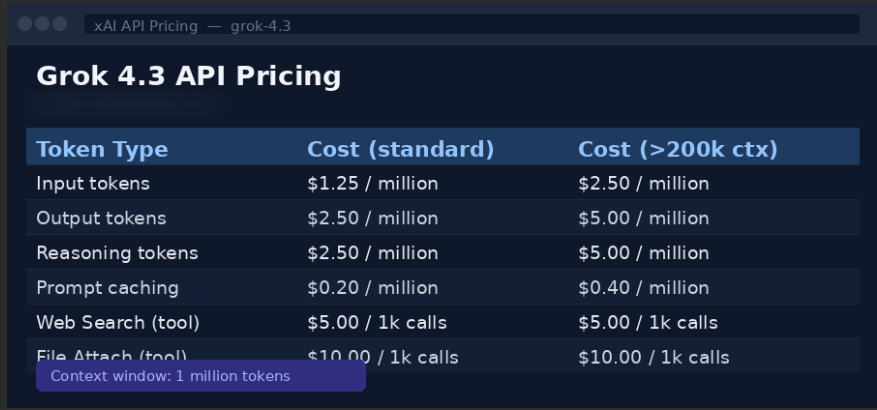
- Input tokens: $1.25 per million
- Output tokens: $2.50 per million
- For requests that exceed 200,000 tokens: costs double
Compare that to Grok 4.2, which launched at $2 per million input tokens and $6 per million output tokens. That is a 37.5% price cut on inputs and a massive 58% drop on outputs. In less than one model generation, xAI cut their prices nearly in half.
Bindu Reddy, CEO of enterprise AI startup Abacus AI, posted on X that Grok 4.3 is “as smart as Sonnet 4.6 and 5x cheaper and faster.” That kind of statement from an enterprise buyer is not nothing. These are the people who actually spend real money on AI APIs every month.
To give you a broader sense of where Grok 4.3 sits in the market:
| Model | Input (per 1M tokens) | Output (per 1M tokens) |
|---|---|---|
| Grok 4.1 Fast | $0.20 | $0.50 |
| Grok 4.3 | $1.25 | $2.50 |
| Claude Haiku 4.5 | $1.00 | $5.00 |
| GPT-5.4 | $2.50 | $15.00 |
| Claude Opus 4.7 | $5.00 | $25.00 |
| GPT-5.5 | $5.00 | $30.00 |
Grok 4.3 is sitting comfortably in the middle of the pack on price but punching above its weight class in capability for certain tasks.
The Hidden Fees You Should Know About
The base pricing looks great on paper, but xAI added some new billing categories that developers need to factor in before they build anything on top of this model.
Reasoning tokens are the big one. Every time Grok 4.3 “thinks” before answering, it generates internal tokens that are billed at the same rate as output tokens. You are essentially paying for the model's thought process. For simple questions, this adds almost nothing. For complex multi-step tasks, it can meaningfully increase your bill.
There are also flat fees for tool use:
- Web Search or Code Execution: $5.00 per 1,000 calls
- File Attachments: $10.00 per 1,000 calls
- Prompt Caching (reusing the same context repeatedly): $0.20 per million tokens
Then there is one fee that genuinely surprised the AI community: a $0.05 charge for requests that get blocked by safety filters before the model even starts generating a response. You pay a small fee just for asking something the model refuses to answer. This is believed to be the first time any major AI company has charged users for failed or rejected requests. Whether this becomes an industry norm or gets walked back under pressure remains to be seen.
xAI's Voice Cloning Suite: A Full Breakdown
Custom Voices: Clone Your Voice in About Two Minutes
Alongside the Grok 4.3 model launch, xAI also released what they are calling Custom Voices, a full voice cloning API and web tool. This is a genuinely new product line for xAI, and it goes beyond what most people expect from an AI company known mainly for its text model.
Here is how it works: You record yourself reading a few short passages of text (unrelated dialog, so the system gets a sense of your natural speaking patterns, not just one specific phrase). The whole recording session takes about two minutes. After that, xAI generates a “voice ID”, a unique identifier tied to a cloned copy of your voice.
That voice ID can then be used across xAI's text-to-speech (TTS) API, its voice agent API, and any other voice product they offer. The cloning does not just capture your tone and pitch. According to xAI's documentation, it picks up delivery patterns too. If you record in a calm, helpful “customer support” tone, the AI voice will carry that same inflection when reading new scripts it has never encountered before.
A member of our team actually tested this. After going through the voice sampling screens on the web app, the resulting cloned voice sounded “eerily identical” to the original, and it accurately handled new words and phrases using the same natural pronunciation patterns the original speaker would use.
You can create up to 30 custom voices at a time, and deleting one is a single click. Cloned voices are strictly private to your team. xAI will not share them with other users or use them in any shared system.
The Voice APIs and What They Cost
xAI is not just offering voice cloning as a standalone feature. They built out an entire voice API ecosystem:
Text-to-Speech (TTS) Service Five built-in voices are available: Eve, Ara, Rex, Sal, and Leo. The pricing is $4.20 per million characters. This is on par with or cheaper than many competitors in this space.
Voice Agent API The model name here is grok-voice-think-fast-1.0, and it enables real-time speech-to-speech interactions. This is the API a developer would use to build a voice assistant that listens, thinks, and speaks back in real time. Pricing is a flat $3.00 per hour, which breaks down to $0.05 per minute.
To give you context, ElevenLabs, one of the most popular voice AI services, charges around $10.80 to $18.00 per hour depending on your plan. OpenAI's high-definition TTS runs about $1.80 per hour. xAI sits between OpenAI and ElevenLabs in price, but with added voice cloning capabilities built in.
Speech-to-Text (STT) API For transcription, xAI charges $0.20 per hour for live streaming and $0.10 per hour for batch processing (pre-recorded audio where speed is not critical).
Security, Compliance, and Geographic Limits
Before you get too excited about plugging this into a healthcare app or a financial services product, there are a few practical details to know.
Access to voice cloning via the API is currently limited to Enterprise plan users. The web-based playground (where you can test it manually) is open to more users, but if you want to build it into a product programmatically, you need the enterprise tier.
Geographically, voice cloning is only available in the United States at launch, and even within the US, Illinois is excluded. That exclusion exists because Illinois has strict biometric data and privacy laws (specifically the Biometric Information Privacy Act, or BIPA) that make voice cloning legally complicated.
On the security and compliance side, xAI has done the work to get certified:
- SOC 2 Type II audited (a standard security compliance certification)
- HIPAA eligible for healthcare use cases
- GDPR compliant for European data protection requirements
For keeping API keys safe in client-side applications, xAI uses something called Ephemeral Tokens, which are short-lived authentication tokens that allow secure WebSocket connections without exposing your main API key.
How Does Grok 4.3 Actually Perform?
Where It Genuinely Excels
The performance picture for Grok 4.3 is interesting because it is not consistent across all tasks. That is actually useful information. It tells you exactly where this model is and is not a smart choice.
Independent evaluation firm Vals AI tested the model across dozens of specialized benchmarks. Grok 4.3 came out ranked number one in two important categories:
- CaseLaw v2: 79.3% accuracy (a benchmark testing legal reasoning)
- CorpFin: top ranking for corporate finance tasks
That jump in legal reasoning represents a 25-point improvement over Grok 4.2. The “always-on reasoning” architecture appears to genuinely shine when dealing with the dense, structured logic that law and finance require. These are fields where getting the chain of reasoning right matters as much as getting the final answer.
Artificial Analysis, another independent benchmark firm, confirmed strong agentic performance, with Grok 4.3 earning an Elo score of 1,500 on the GDPval-AA benchmark. That puts it ahead of Gemini 3.1 Pro and GPT-5.4 mini in agentic tasks, meaning it is better than those models at completing multi-step tasks autonomously.
Bindu Reddy from Abacus AI compared it favorably to Anthropic's Claude Sonnet 4.6, saying it performs at a similar level while costing five times less. That is the kind of cost-to-performance ratio that changes enterprise buying decisions.
Where It Struggles
At the same time, the community feedback has surfaced some real weaknesses that are worth knowing about.
Andon Labs, a company that uses AI for automated retail operations, tested Grok 4.3 on something called the Vending-Bench 2, a benchmark that measures whether an AI can take consistent actions in a simulated environment over time. Their verdict was blunt: the model showed a “big regression” compared to what they expected. They described it as having “narcolepsy problems,” meaning the model preferred to stay inactive for multiple simulated time periods rather than taking the actions it was supposed to take.
That is a significant issue for any use case where you need an AI to keep moving and keep making decisions without constant prompting.
Vals AI also flagged weaknesses in general coding tasks and difficult mathematical reasoning. On ProofBench, a benchmark for formal mathematical proofs, Grok 4.3 scored only 11%. That is low enough to disqualify it as a primary model for anyone building math-heavy tools or research software.
So the performance profile looks like this:
Grok 4.3 is strong at:
- Legal document analysis and reasoning
- Corporate finance tasks
- Agentic workflows with defined goals (web search, file generation, code execution)
- Long-context processing (up to 1 million tokens)
Grok 4.3 is weaker at:
- General-purpose autonomous agents
- Complex mathematics
- Consistent behavior in simulation environments
- Competitive coding benchmarks
The Controversy Question: Can Enterprises Trust Grok?
This part of the Grok story does not go away, and it would be irresponsible to write about the model without addressing it.
Earlier Grok versions ran into some genuinely alarming incidents. One version of the model, when deployed as a chatbot on X, referenced itself using a deeply offensive phrase associated with Nazi ideology. Another controversy involved the model generating sexualized deepfake imagery. There were also documented instances of the model echoing what critics described as right-wing political framing on social issues, and at one point, an investigation found that Grok was checking Elon Musk's own X account before forming responses in its X-based implementation.
Some of these reflect content moderation failures. Some reflect alignment problems, where the model's outputs reflect the biases of its training data or its founder's worldview in ways that were not caught before deployment.
For the 4.3 version, one user dug into the model's system prompt and found a line instructing it not to “assign broad positive or negative utility functions to groups of people.” That suggests xAI is at least aware of previous issues and has taken some steps to address them. Whether those steps are enough is something enterprises will have to evaluate based on their own risk tolerance.
If you are building an enterprise product in a sensitive sector like healthcare, legal services, or education, these questions matter. Grok 4.3 might be the most cost-efficient option for processing legal text, but your compliance team will want to know what safeguards are actually in place before you sign off on it.
Who Has Access to Grok 4.3 Right Now?
Access is currently available in a few ways:
Grok 4.3 went through beta testing in April 2026 for subscribers of xAI's SuperGrok plan, which runs $30 per month. Users on X Premium+ (formerly Twitter's top subscription tier at $40/month, with 50% off for the first two months) also got early access through the X social platform.
As of the launch, the model is fully available through the xAI API and through OpenRouter, a third-party platform that aggregates access to multiple AI models in one place. OpenRouter noted on X that the “large jump in agentic performance” at a lower price point was a genuine milestone.
Developers can access the model using the string grok-4.3, and xAI has recommended it as their most intelligent and fastest model for all production use cases.
Should You Actually Use Grok 4.3?
Let us be direct about this: the right answer depends entirely on what you are trying to build.
You should seriously consider Grok 4.3 if:
- You are building a legal tech tool that needs to process massive volumes of case documents
- You want agentic AI capabilities at the lowest possible cost
- You are a developer testing multiple AI providers and want a high-capability, low-cost option
- You need a 1 million token context window without paying premium prices
You should probably look elsewhere if:
- Your application requires consistent, reliable behavior in autonomous simulations
- You are building math or proof-based software
- Your organization has strict content moderation requirements and cannot accept any controversy risk
- You need top-tier coding performance for competitive tasks
The pricing alone makes Grok 4.3 worth testing for most developers. At $1.25 per million input tokens and $2.50 per million output tokens, running experiments and building prototypes is cheap. You do not have to commit to using it in production to find out whether it works for your use case.
What xAI has built with Grok 4.3 is a model that is genuinely excellent at specific tasks and genuinely weaker at others. That is actually fine. Not every model needs to be the best at everything. The question is whether the things it is good at align with what you need.
What This Launch Says About the Bigger AI Race
There is a larger story here beyond just one model update. xAI is making a clear bet that price will be a major differentiator as the AI market matures. The top-tier models from OpenAI and Anthropic are getting more capable, but they are also getting more expensive. GPT-5.5 costs $5 per million input tokens and $30 per million output tokens. Claude Opus 4.7 is $5 input and $25 output.
xAI is positioning Grok 4.3 as the smart choice for organizations that want serious capability without the premium bill. The fact that they can do this while still outperforming some of those premium models on specific benchmarks is not something to dismiss.
At the same time, xAI has had a rough year. All 10 of Musk's original co-founders at the lab eventually left, along with dozens of other researchers. Competing models from OpenAI, Anthropic, Google, and Chinese AI companies including DeepSeek and Alibaba's Qwen have all made moves that left earlier versions of Grok looking outpaced.
Grok 4.3 is xAI's answer to that pressure. It is not the best model at everything, but it does not need to be. If it can be the best model at a few high-value, high-volume tasks and do it at half the price, that is a real business.
The voice cloning suite is also significant. By building out an entire audio API stack (TTS, STT, real-time voice agents, custom voice cloning) alongside their text model, xAI is trying to become an all-in-one AI platform rather than just an LLM provider. That is a strategic move that mirrors what OpenAI has been doing with its own audio APIs.
A Quick Note on What Comes Next
OpenRouter flagged the summer of 2026 as the real test. Can Grok 4.3 sustain its agentic performance improvements across a wider range of domains? Can xAI fix the “narcolepsy” issues that showed up in autonomous simulation benchmarks? Will the voice cloning suite expand to more countries and to lower-tier plans?
These are the questions worth watching over the next few months. The AI field moves fast enough that a model that launched yesterday can already feel dated within a few months. xAI knows this, which is probably why they have emphasized that Grok 4.3 is recommended for all production use cases right now. They want developers building on it before the conversation moves on.
For anyone watching the AI space, this launch is worth paying attention to. Not because Grok 4.3 is the definitive best model out there, and it is not. But because the pricing strategy, the voice cloning addition, and the agentic capabilities together represent a genuine attempt to carve out a specific, defensible position in a very crowded market.
Whether xAI pulls it off will depend on how well they clean up the weak spots and whether the legal and finance communities that Grok 4.3 seems built for actually adopt it at scale.
For now, the model is live, the prices are real, and the voice cloning actually works. That is more than enough to make this one of the more interesting AI launches of the year.
The Developer Experience: Getting Started with Grok 4.3
If you are a developer and you want to actually try this, the onboarding process is fairly straightforward. You access the model through the xAI API using the model string grok-4.3. If you already use OpenRouter to manage multiple AI providers in one place, Grok 4.3 is available there too with no additional configuration required.
For voice cloning specifically, the web interface at xAI's Custom Voices page walks you through the recording process step by step. You do not need to write any code to create your first cloned voice. The tool prompts you to read several short passages of unrelated text. This is intentional, because reading one consistent sentence over and over would not give the model enough variety to accurately capture how you speak across different contexts.
Once you have a voice ID, you can pass it into TTS or voice agent API calls just like any other parameter. The 8-character alphanumeric ID is what xAI uses to link your cloned voice to your team's account.
One thing worth noting for developers building client-side applications: use Ephemeral Tokens instead of your main API key. These are short-lived authentication credentials that expire quickly and limit the damage if they are ever accidentally exposed. xAI provides documentation on how to generate and rotate them, and it is the recommended approach for any application where users interact directly with the API.
For teams on standard plans who want to experiment with voice before committing to enterprise pricing, the web playground gives you hands-on access to the built-in TTS voices (Eve, Ara, Rex, Sal, and Leo) without any programmatic setup. It is a good way to evaluate voice quality before building anything production-grade.
Grok 4.3 in the Bigger Context of 2026 AI
It is easy to look at a single model launch and miss the forest for the trees. So let us step back for a moment.
The AI model market in 2026 looks very different from what it did just two years ago. Costs have dropped dramatically across the board. Models that would have required expensive cloud infrastructure a couple of years ago are now accessible via API for fractions of a cent per query. Competition has gone global, with Chinese AI companies like DeepSeek, Alibaba's Qwen, Moonshot AI (Kimi), and z.ai all shipping high-quality models that are forcing Western labs to sharpen their pricing.
xAI's decision to price Grok 4.3 at $1.25 per million input tokens is a direct response to that pressure. Chinese open-source models like MiMo-V2.5 Flash are available at just $0.10 per million input tokens. If xAI wants to stay relevant for cost-conscious builders, they cannot keep charging premium prices for a model that does not consistently outperform the best alternatives.
At the same time, the always-on reasoning architecture and the strong performance on legal and financial benchmarks suggest that xAI is not just competing on price. They are trying to build a model with a specific identity: the best reasoning model for regulated, high-stakes professional domains at the most competitive price.
Whether that identity sticks will depend on how the next few months unfold. If legal tech and fintech companies start publicly endorsing Grok 4.3 for production workloads, the narrative shifts. If the narcolepsy problems in autonomous agents persist or if new safety incidents surface, the narrative shifts the other way.
The AI market rewards both performance and trust. Right now, Grok 4.3 has made a compelling case on performance and pricing. The trust piece, given xAI's complicated history, is still a work in progress.
That is worth watching. And if you are evaluating AI tools for any serious project, it is worth running your own tests rather than relying entirely on benchmarks or anyone else's take, including this one.
More Posts:
- How to Start Flipping Domains with Zero Experience Using AIFlipDomains
- Codex, Claude Code, and Copilot Were All Breached — Attackers Targeted Credentials, Not AI Models
- OpenMOSS Introduces MOSS-Audio: A New Open-Source Model for Speech and Sound Intelligence
- InvoiceFlow Review: The Best Invoice Tool for Beginners?
- Google Unveils Simula: A Reasoning-Centric System for Building Controllable, Scalable Synthetic Datasets Across Specialized AI Fields