Claude’s New Infinite Context Window Could Change How You Work Forever
Claude's New Infinite Context Window Could Change How You Work Forever
Imagine that you have been working on a massive research project for three weeks. Every day you open your AI assistant, dump in a wall of notes, and watch it struggle to keep up. By the time you get to day two of a project, it has already forgotten what you told it on day one. You have to re-explain your goals, re-paste your documents, and re-set the context all over again. It is annoying, repetitive, and honestly one of the biggest things holding AI tools back from being truly useful.
Anthropic just took a big swing at fixing that problem.
Claude, Anthropic's AI model, has received a substantial upgrade. The headline feature is something called an infinite context window, but that is just one piece of a much bigger picture. When you zoom out and look at all the updates together, what you are seeing is a clear shift in the direction of AI tools. They are moving away from being smart chatbots and toward being something closer to long-term, autonomous collaborators.
If you are a student, a developer, a content creator, or someone who just uses AI tools to get things done, this matters. Here is a plain-English breakdown of what changed, what it means, and why it could actually impact how you work every single day.
What Even Is a Context Window?
Before diving into why this update is significant, it helps to understand what a context window actually is.
Every AI model has a limit to how much information it can hold in its “working memory” at one time. That limit is the context window. Think of it like a whiteboard. You can write a bunch of notes on it, the AI can read and respond to all of them, but once the whiteboard gets full, older notes start getting erased to make room for newer ones.
For most AI tools today, that whiteboard is pretty small in the grand scheme of complex, ongoing work. If you are writing a short email or asking a one-off question, it is more than enough. But if you are trying to work through a multi-day software project, analyze a large dataset, or manage any kind of long-term task, you hit the edges of that whiteboard fast.
Once the context window fills up, the AI loses track of earlier information. It cannot remember decisions you made two days ago. It cannot see the full picture of a complex problem. You end up spending more time managing the AI's memory than actually doing the work.
Claude's infinite context window is designed to eliminate that ceiling entirely.
The Infinite Context Window: What It Actually Means
The term “infinite” sounds dramatic, but the practical meaning is genuinely important. Claude can now process and retain vast amounts of information over extended periods without losing track of earlier content. You can feed it a full research paper, a codebase, a months-long email thread, or an entire project history, and it keeps all of it accessible throughout your conversation or workflow.
For everyday users, this translates into a few concrete changes:
- No more re-explaining yourself. If you told Claude about your project goals last Tuesday, it still knows about them today.
- Deeper, more accurate analysis. When Claude can see the whole picture instead of just a slice, its answers get better and more relevant to your actual situation.
- Continuity across complex tasks. You can work through a project over days or weeks without resetting the entire context each time you open a new session.
For developers and researchers, the implications go even further. Historical datasets can be analyzed in their entirety. Long-running code projects can be reviewed as a whole. Documentation and specifications can be kept in context alongside the actual work, so Claude understands not just what you are building but why.
The traditional context window was one of the most consistent frustrations for anyone trying to use AI for serious, sustained work. This upgrade removes that bottleneck in a real and meaningful way.
Multi-Agent Coordination: Claude as a Team, Not Just a Person
One of the other big additions in this update is something called multi-agent coordination. This one is worth understanding because it changes how Claude approaches large, complex tasks.
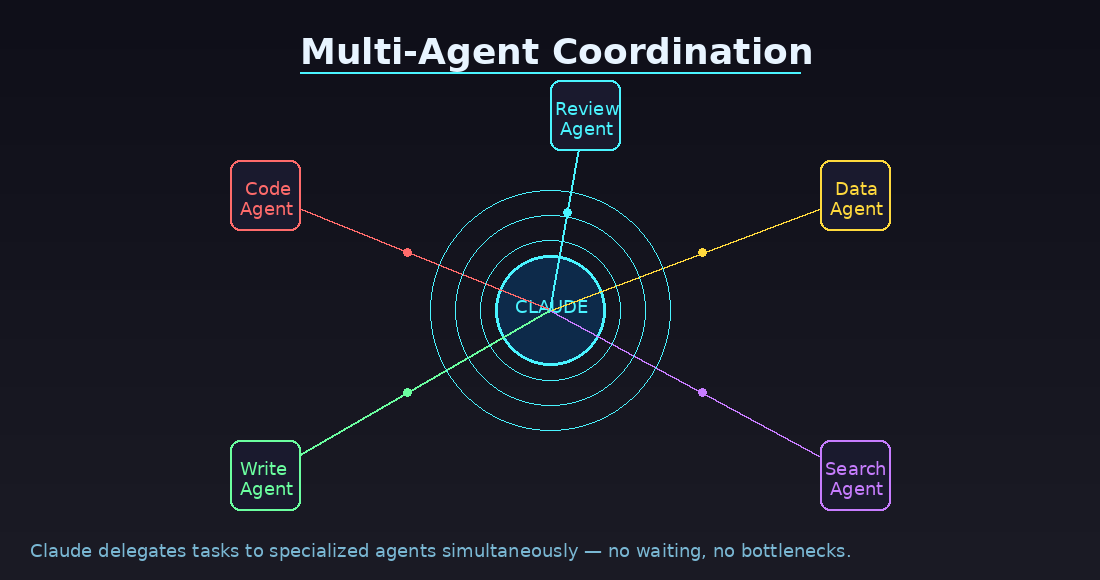
The basic idea is that Claude can now spin up multiple specialized “agents,” which are essentially subprocesses that each handle a specific part of a task. Instead of one version of Claude trying to do everything at once, different agents can work on different pieces of a problem simultaneously.
Here is a simple example. Say you ask Claude to help you build a web app. With multi-agent coordination, one agent might be writing the backend code, another might be reviewing security vulnerabilities, another might be writing documentation, and another might be testing functions, all at the same time. When they are done, Claude synthesizes everything and delivers the result.
This is significant for a few reasons:
Speed. Parallel execution means tasks that would have taken a long time to complete one step at a time can now move much faster.
Specialization. Each agent can be optimized for its specific role, making the outputs more accurate and reliable than a single generalist approach.
Scale. Complex projects that involve multiple workstreams no longer require you to manually break things down and manage them yourself.
For developers working on large-scale software projects, this is a game-changer. For researchers running multi-part analyses, it cuts down the manual coordination work significantly. And even for everyday users tackling complicated planning tasks, having Claude intelligently delegate and coordinate work behind the scenes makes the experience dramatically smoother.
The “Dreaming” Feature: An AI That Actually Learns from Experience
Here is a feature that does not get talked about enough in the coverage of this update: something Anthropic is calling “Dreaming.”
The name is a bit whimsical, but the function is genuinely interesting. Dreaming allows Claude to review its own past interactions, analyze what worked and what did not, and refine its approach for future tasks based on that self-review.
Think of it like this. Imagine you have an assistant who, at the end of each day, sits down and reviews everything they did that day. They notice which tasks went smoothly, which ones had friction, and what they would do differently next time. Then they show up the next morning with those lessons already built into how they work.
That is what Dreaming does for Claude. Over time, it becomes more adapted to the kinds of tasks you give it, getting more effective the more you use it.
This is a shift away from static AI behavior and toward something that feels more genuinely dynamic. Rather than always starting from the same baseline, Claude builds on its own performance history. For anyone using Claude consistently for creative work, software development, or ongoing research, this means the tool should get noticeably better over time in ways that are tuned to your specific use cases.
Real-Time Self-Correction: Fewer Mistakes, Better Outputs
Alongside Dreaming, Anthropic has also introduced iterative self-correction, which does exactly what it sounds like. Claude can now identify errors in its own outputs in real time and fix them before delivering the final result.
This matters more than it might seem at first glance. Anyone who has used AI tools regularly knows that one of the most frustrating parts of the experience is catching mistakes after the fact. You get a confident-sounding answer, you act on it, and then you realize somewhere down the line that it was wrong. With self-correction built in, Claude is checking its own work as it goes rather than just delivering the first draft of whatever it produced.
The practical benefit is more reliable outputs, especially in high-stakes scenarios like code review, data analysis, or detailed research. You still want to review what Claude produces, but the baseline accuracy improves meaningfully when the model is actively catching and fixing its own errors.
Watch: What This Update Actually Looks Like in Practice
This video from World of AI walks through how Claude's new features work in real-world workflows, which is worth watching if you want to see the capabilities in action rather than just reading about them:
Click to watch on YouTube
Webhook Integration: Connecting Claude to the Rest of Your Stack
For developers and technical users, there is another quietly important addition: webhook support.
Webhooks are a way to connect different tools and systems together so that when something happens in one place, it automatically triggers an action in another. With Claude now supporting webhooks, you can wire it into your existing workflows, tools, and platforms far more seamlessly than before.
That means Claude can become a functioning part of your automation stack instead of sitting off to the side as a separate tool you have to manually interact with. It can receive data from external systems, process it, and pass results along, all without requiring you to babysit the integration every step of the way.
If you are building data pipelines, running automation workflows, or managing complex toolsets across multiple platforms, this is a practical upgrade that saves a lot of friction.
The Infrastructure Behind All of This
None of these feature upgrades would matter if the underlying infrastructure could not support them at scale. Anthropic clearly understood this, because the infrastructure improvements are just as significant as the feature additions.
Doubled API Rate Limits
All paid plans now come with API rate limits that are twice what they were before. This is a practical benefit for developers building applications on top of Claude. Higher rate limits mean you can run larger-scale workflows without hitting throttling issues, which is one of those things you do not think about until it becomes a problem and then it becomes a big problem.
Massive Compute Expansion
Through a partnership with SpaceX, Claude now has access to 220,000 Nvidia GPUs and 300 megawatts of energy capacity. Those numbers are hard to contextualize in everyday terms, but the short version is that it represents an enormous amount of raw processing power dedicated to running Claude's operations.
More compute means faster responses, better performance on complex tasks, and the ability to handle a much higher volume of demanding requests at the same time. As the features get more ambitious, the infrastructure needs to keep up, and this expansion gives Anthropic the runway to deliver on that.
Strategic Partnerships
Collaborations with Google, Amazon, and Microsoft provide additional infrastructure support and scalability. These are not just branding announcements. They represent real integrations with cloud and data infrastructure that Claude runs on, giving it a more robust and globally distributed foundation than it had before.
When you are building a tool designed to handle long-running, complex workflows at scale, the reliability and global reach of the underlying infrastructure matters a great deal. These partnerships help ensure Claude is not just capable on paper but consistently performant in the real world.
Enhanced Engineering Judgment: A Smarter Technical Partner
One of the more understated improvements in this update is what Anthropic calls enhanced engineering judgment. Claude can now analyze software architectures more effectively and provide more reliable technical recommendations.
If you are a developer, this is meaningful in a concrete way. There is a real difference between an AI that gives you technically correct answers and one that gives you contextually smart answers. The first can tell you that a piece of code will run. The second can tell you whether it is the right architectural decision for your specific system, at your specific scale, given your specific constraints.
That second kind of help is what engineers and architects actually need from a collaborator. Claude's improvements in this area push it further in that direction, reducing the cognitive overhead of complex technical decision-making and making it a more trustworthy sounding board for real engineering problems.
Where Is All of This Heading?
Anthropic has been pretty direct about where they see Claude going: toward being a fully autonomous software engineering system that can manage complex, long-term tasks with minimal human oversight.
That is a significant vision, and it is worth sitting with for a moment.
The updates in this release, taken together, are not just incremental improvements to a chatbot. Infinite memory, parallel agent coordination, self-learning through Dreaming, real-time error correction, and a massive infrastructure backbone are collectively pointing toward something that looks less like a tool and more like a collaborator with genuine staying power.
The upcoming Claude 5 lineup and continued improvements to models like Haiku and Sonnet are expected to push these capabilities further. Anthropic seems focused on three long-term pillars: memory, scalability, and autonomy. Each of the features in this update connects to at least one of those pillars.
It is also worth noting that this direction raises real questions about how AI fits into professional work. If Claude can autonomously manage complex software projects, where does human oversight fit? How do you maintain accountability for outputs when the system is self-correcting and self-learning? These are not reasons to avoid the tools, but they are conversations worth having as the technology matures.
What This Means for You Right Now
If you are 18 to 22 and figuring out how AI fits into your work, studies, or side projects, here is the practical takeaway from all of this.
The barrier that made AI tools genuinely frustrating for complex, ongoing work is starting to come down. The infinite context window alone removes one of the most consistent pain points of using AI for anything more than quick, isolated tasks.
Multi-agent coordination means that when you give Claude a big, complicated project, it can actually handle the complexity intelligently instead of requiring you to manually break everything into bite-sized pieces.
And the infrastructure improvements mean the tool is going to be more reliable and responsive as more people push it harder.
You do not need to be a developer to benefit from this. If you are a student working on a semester-long research project, a creator managing a content pipeline, or someone building something new and figuring it out as you go, these features reduce the overhead of getting useful help from AI significantly.
The tools are maturing. The capabilities are starting to match the ambition. Whether you are jumping in now or watching from a distance, it is a good time to understand what is actually changing and why.
Conclusion: This Is Not Just an Update, It Is a Direction
It would be easy to read through a list of AI features and feel a bit numb to it. There is so much noise in this space, and a lot of announcements promise more than they deliver.
But when you look at what Anthropic is actually shipping here, there is a coherent vision behind it. Every feature in this update addresses a real limitation that made Claude less useful for serious, sustained work. The infinite context window removes the memory ceiling. Multi-agent coordination removes the single-threaded bottleneck. Self-correction removes the reliability ceiling. Dreaming starts building something that actually improves with use.
Taken individually, each of these is a meaningful upgrade. Taken together, they sketch a picture of what AI-powered work could look like in the next few years.
Claude is not there yet. No AI tool is. But the gap between “impressive demo” and “reliable daily collaborator” is getting smaller with updates like this one. If you are paying attention to where work is going, that trajectory is worth keeping an eye on.
Sources: World of AI
More Posts:
- How to Start Flipping Domains with Zero Experience Using AIFlipDomains
- Codex, Claude Code, and Copilot Were All Breached — Attackers Targeted Credentials, Not AI Models
- OpenMOSS Introduces MOSS-Audio: A New Open-Source Model for Speech and Sound Intelligence
- InvoiceFlow Review: The Best Invoice Tool for Beginners?
- Google Unveils Simula: A Reasoning-Centric System for Building Controllable, Scalable Synthetic Datasets Across Specialized AI Fields