OpenAI Launches $100 ChatGPT Pro Plan with 5x Higher Codex Limits Than Plus
OpenAI Launches $100 ChatGPT Pro Plan with 5x Higher Codex Limits Than Plus
If you spend any real time building software with AI tools, you have probably noticed that the race between OpenAI and Anthropic has gotten a lot more personal lately. It is no longer just about which company has the smarter model. Now it is about who gives developers the better deal on actually using those models day to day.
On April 9, 2026, OpenAI dropped a new pricing tier right in the middle of its lineup: a $100 per month ChatGPT Pro plan, sitting squarely between the $20 Plus plan most casual users know and the premium $200 Pro plan that was already out there. The whole pitch? You get five times more usage on Codex, OpenAI's agentic coding tool, compared to what Plus subscribers get.
That might sound like a simple pricing move, but there is a much bigger story going on here. A strategic one. And if you care about where AI tools are heading, especially for coding and software development, this is worth paying close attention to.
What Is This New $100 Plan, Exactly?
Let's get the basics out of the way first.
OpenAI already had a pretty full menu of plans before this launch. You had the free tier, then Go at $8 a month, then Plus at $20 a month, and then the existing Pro plan at $200 a month. On the business side, there's Edu, Business at $25 per user monthly (which used to be called Team), and Enterprise priced separately.
The new $100 plan, officially called ChatGPT Pro 5x, slots in between Plus and the $200 Pro tier. The math is pretty transparent: Plus costs $20, and five times that is $100. OpenAI is basically selling you five times the Codex capacity for five times the price.
Sam Altman, OpenAI's co-founder and CEO, confirmed the launch in a post on X, saying the new tier was being rolled out “by very popular demand” and that it was “very nice to see Codex getting so much love.”
So what is Codex, for those who are not deep into this world yet?
A Quick Word on Codex
Codex is OpenAI's AI system built specifically for coding tasks. The name actually covers a few things at once: there is a suite of coding-specific language models, and there is also an agentic application and harness (think of it like an AI coding assistant that can actually run tasks and execute code, not just suggest it).
Agentic means the AI can take multi-step actions on its own, doing things like writing code, testing it, fixing bugs, and repeating that loop without you having to prompt it at every step. This is what people in the tech world call “vibe coding” when they build software using plain language and AI instead of writing every line of code by hand.
Codex has been a pretty big deal for developers who want to automate chunks of the software building process. The demand for it, especially from serious developers and coding teams, is clearly high enough that OpenAI decided a dedicated mid-tier plan for heavy Codex users made sense.
The Usage Limits Breakdown
Here is where things get a bit technical, but bear with it because the actual numbers matter.
The usage limits for Codex depend on two main things: which underlying AI model you are using, and whether your tasks are running locally on your own machine or up in OpenAI's cloud infrastructure. OpenAI measures usage in a rolling five-hour window, and there may also be additional weekly caps on top of that.
There are two types of tasks:
- Local Messages: tasks that run on your own machine or servers
- Cloud Tasks: tasks that run on OpenAI's infrastructure
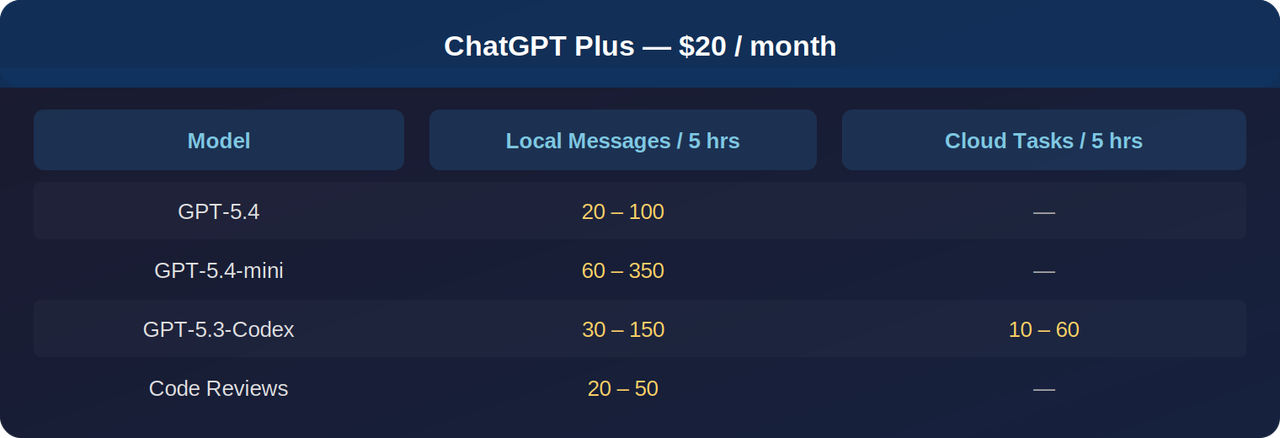
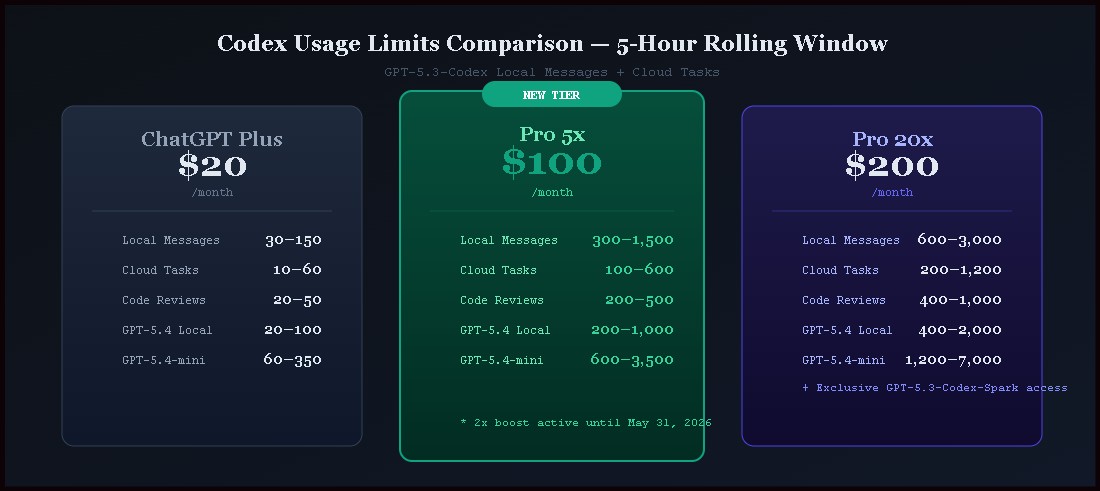
Here is how the three plans compare:
ChatGPT Plus ($20/month)
ChatGPT Pro 5x ($100/month)
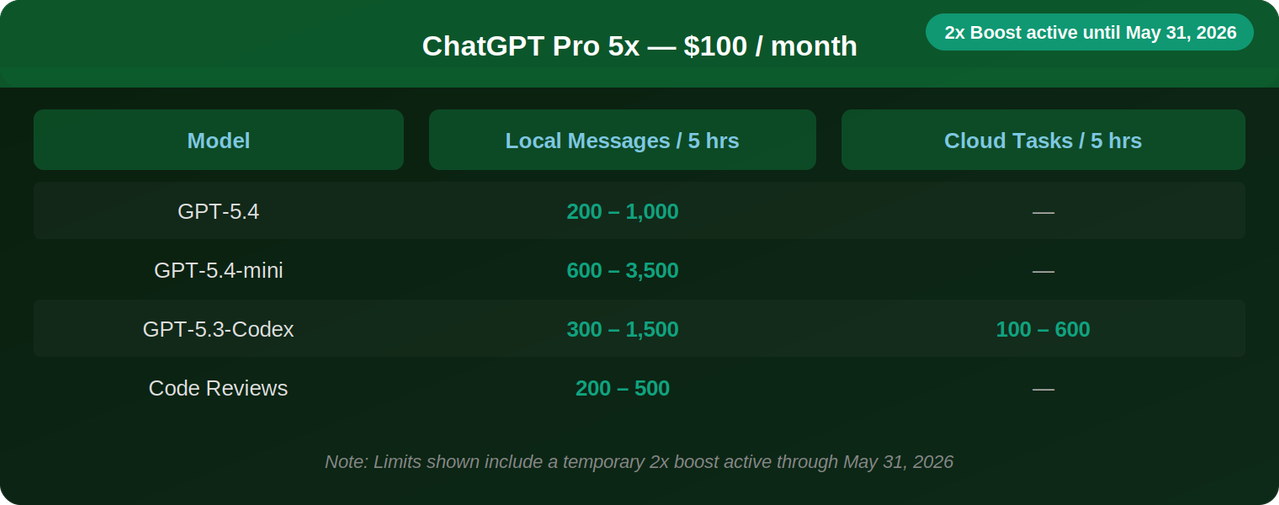
Note: The limits displayed for the Pro 5x plan include a temporary 2x usage boost that runs through May 31, 2026.
ChatGPT Pro 20x ($200/month)
GPT-5.4: 400 to 2,000 local messages every 5 hours. GPT-5.4-mini: 1,200 to 7,000 local messages every 5 hours. GPT-5.3-Codex: 600 to 3,000 local messages and 200 to 1,200 cloud tasks every 5 hours. Code Reviews: 400 to 1,000 every 5 hours. Exclusive access: Includes GPT-5.3-Codex-Spark in a research preview, available only to $200 Pro subscribers. OpenAI says this model has its own separate usage limits that may shift depending on demand.
One thing worth knowing: the actual number of Codex messages you burn through in any session depends heavily on what you are asking the AI to do. As OpenAI states in its help documentation, small scripts and simple functions might barely touch your allowance, while larger codebases, longer running tasks, or sessions that require holding a lot of context will eat through your quota noticeably faster per message. So the ranges OpenAI gives are not fixed limits, they are the range you might land anywhere within depending on what you are building.
Why Did OpenAI Even Build a $100 Plan?
The honest answer is: demand. A lot of Codex users were clearly running into the walls of the $20 Plus plan but also did not need or want to jump straight to $200 a month. Five times the capacity for five times the price makes the math clean and the value case obvious.
Sam Altman's post on X was unusually casual about it. He called the new tier something being launched “by very popular demand,” which suggests OpenAI was watching usage data and saw a significant group of developers consistently maxing out on Plus.
But here is the part that people are talking about more quietly. The same day OpenAI announced the new Pro plan, the company's official account on X also said that they were “rebalancing Codex usage in Plus to support more sessions throughout the week, rather than longer sessions in a single day.”
That phrasing sounds gentle, but what it actually means is that OpenAI is also cutting back how much Codex usage Plus subscribers can pack into a single day. So one hand is giving the new $100 plan, while the other is quietly adjusting what the $20 plan covers in terms of daily depth. If you were one of those Plus users who relied on long, marathon Codex sessions in a single sitting, this could push you toward the new tier even if you were not planning to upgrade.
The Anthropic Factor: What Is Actually Going On Here
To understand why OpenAI made this move when they did, you need to zoom out a little and look at what has been happening between OpenAI and Anthropic over the past few months.
Anthropic's Revenue Surge
Anthropic, the company behind the Claude AI models, has been growing at a genuinely striking pace. Just days before OpenAI's pricing announcement, Anthropic revealed that its annualized run-rate revenue had crossed $30 billion. To put that in context, OpenAI's most recently reported annualized revenue figure sat at around $24 to $25 billion. Anthropic caught up and then some, and that has clearly registered inside OpenAI.
A lot of that Anthropic growth comes from two products in particular: Claude Code, an autonomous coding assistant, and Claude Cowork, which helps with broader professional workflows. Both have become the benchmark tools for serious developer teams who want AI embedded in their coding pipelines at scale.
The OpenClaw Situation
Here is where the story gets really interesting.
There is a tool called OpenClaw, which is a third-party AI coding harness. A harness, in this context, is basically a wrapper application that lets you plug in an AI model and use it for coding tasks in a more customized way than the standard chat interface allows.
OpenClaw was built by a developer named Peter Steinberger and had a substantial following among power developers, many of whom were running it on top of Anthropic's Claude models through their monthly Claude subscriptions. For those users, paying $20 or $200 a month for a Claude subscription and then using that subscription to power OpenClaw was a great deal. It was essentially an all-you-can-eat setup for heavy coding use.
On April 4, 2026, five days before OpenAI's pricing announcement, Anthropic changed the rules. The company officially cut off the ability to use Claude subscription plans as the intelligence layer for third-party agentic harnesses like OpenClaw. If you want to use Claude models with OpenClaw going forward, you now have to pay for API access or buy extra usage credits separately. That is a significant cost increase for heavy users who were riding the subscription model.
Anthropic's reasoning was not complicated to see: when power users and third-party tools like OpenClaw consume far more tokens than the average subscriber, the economics of a flat monthly subscription fee stop working in Anthropic's favor. The subscription was being used far beyond its intended scope for some of these use cases.
OpenAI Saw an Opportunity
So where does OpenAI fit into all this?
Peter Steinberger, the creator of OpenClaw, was hired by OpenAI back in February 2026 to lead their personal agent strategy. Since joining, he has been openly vocal about the fact that OpenAI's models and Codex tool do not carry the same restrictions that Anthropic has now put in place.
By bringing Steinberger on board and then launching a high-volume, mid-priced tier right as Anthropic was cutting off OpenClaw users from easy subscription access, OpenAI is making a very direct play. The message is: those developers who lost easy, high-volume Claude access through OpenClaw? OpenAI is ready to be their new home. The timing is not a coincidence.
What This Means for Developers Who Are Choosing a Plan
If you are a developer who uses AI coding tools regularly, this new tier changes the calculus of which plan makes sense.
The Plus plan at $20 a month has always been the obvious starting point for anyone doing light to moderate AI-assisted coding. But if you have been hitting walls, getting cut off mid-session, or finding that the limits reset before you finish a complex job, the $100 tier is now a direct answer to that.
Here is a practical way to think about which plan fits where:
- Plus ($20/month): Good for solo developers doing occasional AI-assisted coding, students learning to build, or anyone whose projects are relatively self-contained. If you are doing a few hours of coding work a week with AI tools, this is probably enough.
- Pro 5x ($100/month): Aimed at developers who code with AI tools most days, freelancers who deliver code-heavy projects to clients, and small teams where one person is doing the heavy AI lifting. If you are regularly running out of messages before a job is done, this is the one to consider.
- Pro 20x ($200/month): For full-time vibe coders, professional AI tool builders, and anyone running production-level tasks through Codex at scale. This tier also gives you early access to GPT-5.3-Codex-Spark, which is currently in a research preview and is only available at this tier.
One thing worth keeping in mind: OpenAI says the 2x usage boost currently showing in the Pro 5x limits is temporary and ends May 31, 2026. So the 200 to 1,000 local messages per 5 hours you see for GPT-5.4 today will actually come down after that date. The real baseline for the $100 plan, once the promotion ends, will be 100 to 500 local messages every 5 hours. That is still five times what Plus offers, but it matters to know that the current displayed limits are inflated.
The Bigger Picture: AI Pricing Is Getting Competitive in a Real Way
It is worth stepping back and thinking about what this moment actually signals.
Not long ago, the AI subscription market was pretty simple. OpenAI had ChatGPT. Anthropic had Claude. Both had a free tier and a $20-ish monthly plan, and most people picked one and stuck with it. The models were different but the pricing structure was essentially the same.
What we are seeing now is something more complicated. Both companies are building out vertical pricing structures tuned to the intensity of how you use the tools. The flat $20 plan is no longer the ceiling or even close to it for serious users. The actual cost of serious AI-assisted work is climbing toward $100 to $200 a month per person, and that is before you factor in API usage or enterprise contracts.
That shift has real implications for anyone budgeting for AI tools, whether you are a student, a freelancer, or someone making decisions for a small startup.
The other thing happening here is that OpenAI and Anthropic are no longer just competing on model quality. They are competing on infrastructure, pricing flexibility, and which tool fits most naturally into how serious developers want to work. Anthropic has clearly won a chunk of that audience with Claude Code. OpenAI is fighting back not just with a new price point, but with a signal about access. Codex is available for heavy use without the policy restrictions that Anthropic has now imposed, and that is a concrete differentiator.
Is the $100 Plan Actually Worth It?
That depends entirely on how you use it.
If you are someone who uses Codex for maybe a few sessions a week, each lasting an hour or two, and you are mostly running small to medium scripts, the $20 plan is probably still fine. The limits on Plus are more generous than they might seem for light to moderate use. Simple functions and short scripts barely move the needle on your allowance.
But if you are the kind of developer who opens a codebase first thing in the morning and stays in a Codex session for hours, running the AI through complex refactors, large codebases, or extended context-heavy tasks, you have probably already felt the friction of Plus running thin. That is exactly the user profile OpenAI built the $100 plan for.
The temporary 2x boost that runs through May 31 is a smart move to get people to sign up and build a habit before the limits settle at their actual baseline. Once you are used to having 200 to 1,000 messages per 5-hour window, going back to 100 to 500 still feels like a lot more space than the 20 to 100 you started with on Plus.
Whether the price is worth it is also partly a question of what your time is worth. If you are shipping code professionally and a Codex session cuts through three hours of manual debugging in 40 minutes, the math on $100 a month pays for itself pretty quickly.
What to Watch for Next
The AI pricing wars between OpenAI and Anthropic are not done. If anything, this move suggests both companies are going to keep iterating their pricing structures to compete for the developer community.
A few things worth watching in the months ahead:
The May 31, 2026 end date for the Pro 5x usage boost is the first near-term marker. When those limits drop, it will be a real test of whether developers who signed up for the $100 plan actually got the value they were looking for or feel like they were bait-and-switched.
It is also worth seeing how Anthropic responds. The decision to cut off Claude subscription use for third-party harnesses like OpenClaw was partly an economic move, but it also had the effect of nudging a portion of their power user base toward OpenAI. If that churn shows up in Anthropic's numbers, they may look at pricing adjustments of their own.
And Peter Steinberger's role at OpenAI on personal agent strategy is worth following. OpenClaw had a dedicated and vocal community, and how OpenAI absorbs that audience into its own product experience will say a lot about where Codex and the broader ChatGPT ecosystem goes next.
Final Thoughts
OpenAI's $100 ChatGPT Pro plan is not just a new line on a pricing page. It is a targeted move in a very active competition for the developers who build things with AI tools every day.
The five times usage capacity compared to Plus makes the value case clear for anyone who has been bumping up against limits. The timing, right as Anthropic tightened its own policies around subscription-based AI access for heavy users and third-party tools, is not an accident.
If you are sitting on Plus right now and regularly feel like you are running out of room before your work is done, this tier was built for you. If you are on the fence, the temporary 2x boost running through May 2026 means the $100 plan offers even more headroom right now than it will at its baseline. It is worth at least running the math on your own usage before that window closes.
The broader story here is that AI tools for serious work are maturing past the $20-a-month phase. The real question now is where the ceiling lands, and who offers the best combination of access, model quality, and pricing flexibility for the work you actually do.
Who Benefits Most Right Now
Let's be honest about who this plan is actually going to help in a meaningful way.
If you are a 22-year-old working on your first real software project, trying to ship something for your portfolio, or learning how to build apps using AI tools, the $20 Plus plan is almost certainly fine for where you are at. You are not going to hit the ceiling unless you are doing some seriously extended sessions every single day.
But if you are past that stage, maybe you are freelancing and taking on coding contracts, or you are part of a small founding team trying to move fast on a product, or you are doing something like automated testing, code review pipelines, or large-scale refactors, the $100 plan is worth genuine consideration.
The real sweet spot for this tier is the professional solo developer or the small team where one or two people are doing the bulk of AI-assisted work. For a freelancer charging clients $50 to $150 an hour for development work, $100 a month is a rounding error if Codex is helping them ship faster and take on more projects.
It is also relevant for people who build internal tools inside companies. If your job is to write scripts, automation, or backend logic for internal systems, and your company is not yet on an Enterprise plan, the $100 tier gives you significantly more room to work without needing to justify a full enterprise contract to your finance team.
A Note on How Codex Handles Big Jobs
Something that does not get talked about enough in the coverage of these pricing tiers is how the usage actually scales with task complexity, because that changes the math quite a bit.
OpenAI's own documentation acknowledges that a small script or a simple function call might only consume a fraction of your message allowance. But a large, interconnected codebase where Codex needs to hold a lot of context, trace dependencies across multiple files, and run multiple iterations to get something right will burn through messages significantly faster.
What that means in practice is that the ranges OpenAI posts are not a firm cap. The 200 to 1,000 messages for GPT-5.4 on the $100 plan is a range, not a guarantee of exactly 1,000 messages. Complex tasks tip you toward the lower end of what is available. Simple, scoped tasks give you more room.
For developers building complex applications, this is worth thinking about carefully before assuming the $100 plan will cover everything. If your work tends toward large codebases and extended sessions, the $200 Pro 20x tier might still make more sense for you on a per-task basis, even though it costs twice as much.
More Posts:
- What Is Search Box Optimization (SBO) and Why It’s the Next Big Thing in Digital Marketing
- How One AI Platform Is Replacing 10 Separate Tools (And Why Creators Are Taking Notice)
- Anthropic Unveils Claude Opus 4.7
- OpenAI Unveils GPT-Rosalind, a Restricted-Access Life Sciences Model Alongside an Expanded Codex GitHub Plugin
- ElevenLabs Voice Isolation Explained, Full Tutorial and Review