Artemis III: Three Spacecraft, One Rehearsal
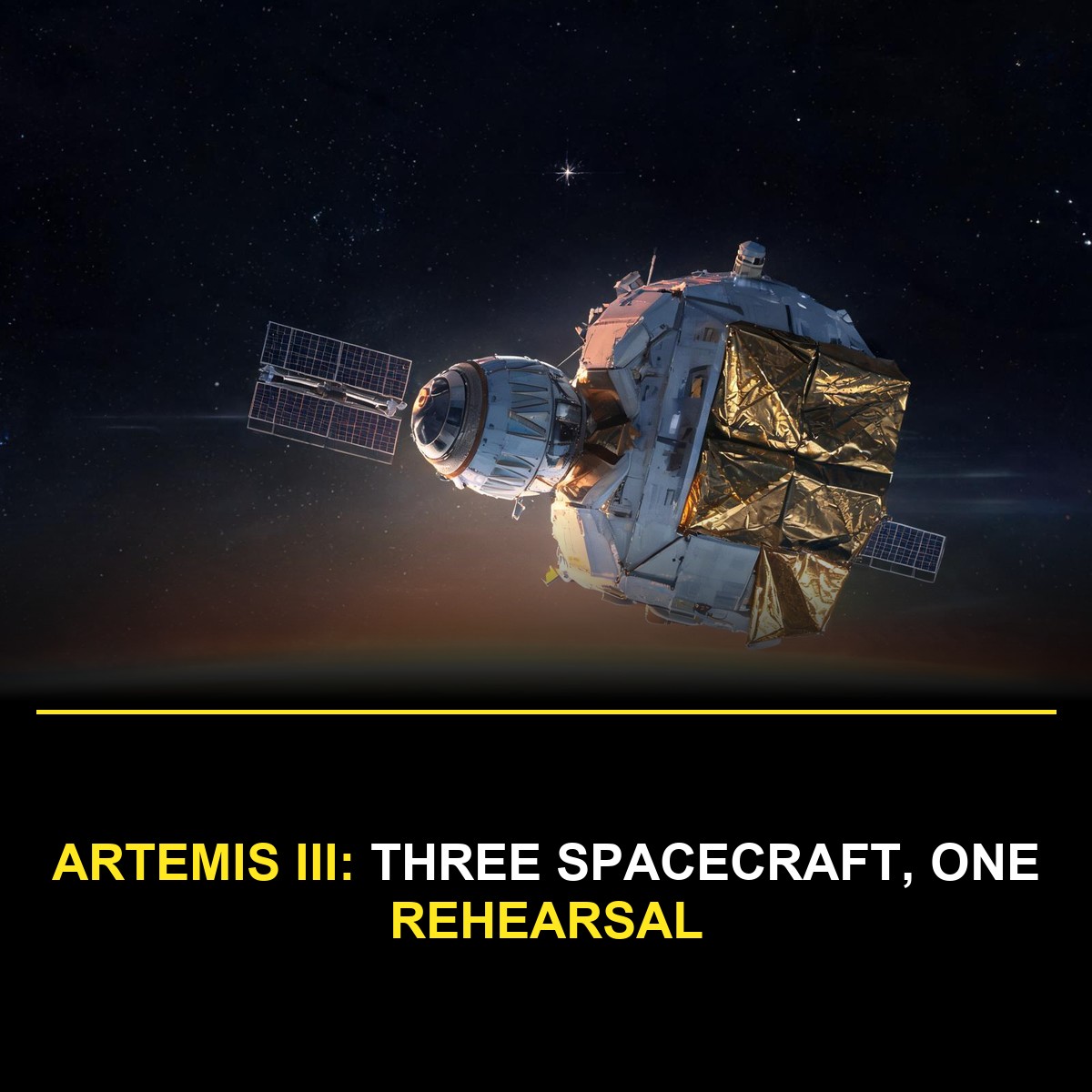
Artemis III will not go to the Moon. That is the point. In 2027, four astronauts will launch into low Earth orbit to practice docking with two different commercial lunar landers, live inside one of them for two days, and rehearse the procedures that a crew will need when NASA attempts a landing near the lunar South Pole in 2028.
The Artemis III mission is the most complex test flight the agency has attempted: three spacecraft on three different heavy-lift rockets, launched within days of each other, choreographed through three separate orbital regimes and two docking operations with two completely different vehicle architectures. Randy Bresnik, Frank Rubio, Andre Douglas, and the European Space Agency's Luca Parmitano will fly it, spending fourteen days in orbit before splashing down in the Pacific off the coast of California.
Artemis III is also the clearest statement yet of how NASA has restructured its lunar program after years of schedule pressure. Instead of flying a landing on hardware that was not ready, the agency inserted a rehearsal, and the rehearsal carries almost every risk the landing would carry except the final descent.
This article explains what the mission will actually do hour by hour, why the orbital choreography is harder than it looks, what the two lander demonstrations prove, how the flight was redesigned, and what has to go right before anyone walks on the Moon again.
The Artemis III crew and the shape of the mission
Four astronauts, fourteen days, one Orion spacecraft, and two commercial landers that will be launched separately and waited for.
For Artemis III, Bresnik brings Marine Corps test pilot experience and prior spaceflight. Rubio holds the American record for the longest single spaceflight after an unintended year aboard the International Space Station. Douglas is a geologist and astronaut whose selection was driven partly by lunar field science. Parmitano represents the European Space Agency, which contributes service module hardware and crew in exchange for seat opportunities on lunar missions.
The Artemis III mission profile is unusual from the first minute. Blue Origin launches a test version of its Blue Moon Mark 2 lander into a circular orbit about 273 miles up, where it can wait for up to thirty days, giving NASA schedule flexibility that a single-launch mission would not have. Only after that vehicle is confirmed healthy does Orion launch on the Space Launch System from Kennedy Space Center, days later.
Orion then enters an elliptical orbit of roughly 18 by 1,122 miles, uses its service module to circularize near 345 miles for thermal stabilization, and gradually closes on the waiting Blue Moon. Two days of system checkout and proximity operations precede the first docking, and the trajectory work involved is the part of the mission least visible to the public and most demanding for flight controllers.
Why Artemis III needs three rockets instead of one
The multi-launch architecture is not a stylistic choice. It is what the hardware requires, and it creates the coordination problem that makes Artemis III valuable.
The Artemis III architecture exists because a lunar lander big enough to carry crew to the surface and back is too heavy to launch together with Orion on a single rocket. The Apollo architecture solved this with a dedicated Saturn V for each piece. The Artemis architecture solves it with commercial landers launched on their own vehicles and Orion launched on SLS, meeting in orbit, which is cheaper per mission and far more complex operationally.
The Artemis III complexity is the training objective. Jeremy Parsons, NASA's Artemis program manager, framed it directly: three spacecraft on three different rockets, tested together, something the agency has never attempted, with every lesson feeding the 2028 landing. That sentence describes a mission whose primary product is operational experience rather than a destination.
The orbital mechanics explain the sequencing. Blue Moon goes to a higher circular orbit where it can loiter for a month. Orion starts low and elliptical, circularizes higher for thermal control, then climbs. Starship launches later, because its on-orbit lifetime is much shorter, and parks lower at about 206 nautical miles where communications coverage is best. Each vehicle sits in the regime its design favors, and Orion travels between them.
That design choice multiplies the number of critical events. Every rendezvous requires the right phasing, the right approach corridor, and the right communications link, and each of those is a chance for a missed opportunity that costs days of replanning. A mission that docks twice with two different vehicles in two different orbits is a stress test of ground teams as much as of hardware.
Inside Blue Moon: the first crewed commercial lander
The first docking is the Artemis III central objective, and the two days that follow are where the most valuable data gets collected.
Blue Origin's test article incorporates much of the avionics, software, flight-control systems, cabin technology, and life support planned for operational lunar missions. When the crew opens the hatch and enters, they will evaluate the cabin environment, the controls, and the life-support systems firsthand, and the team will verify that the spacecraft holds atmosphere and pressure as designed.
That Artemis III evaluation cannot be done on the ground. A lander cabin on a test stand has gravity, ambient pressure, and a cable harness; the same cabin in orbit has microgravity, thermal extremes, and a closed-loop life-support system running on its own power. Crews consistently report that living in a spacecraft reveals design problems no review board catches, from handhold placement to airflow noise to the ergonomics of reaching a switch while strapped in.
The docking itself is equally instructive. Orion will connect to a port beside Blue Moon's crew cabin, a geometry driven by the lander's layout, and engineers will assess how the two spacecraft's software, guidance, communications, and procedures perform together in real conditions. Flight controllers get their own rehearsal, coordinating across NASA, Blue Origin, and the multi-center teams that support both vehicles.
By the time Orion undocks, NASA will have completed its first evaluation of a commercial lunar lander with crew aboard. That milestone has been anticipated since the agency chose the commercial lander strategy, and it is the moment the strategy stops being a procurement plan and becomes a flown capability.
Starship: a two-hour docking with no hatch opening
The Artemis III Starship demonstration is shorter and, in some ways, more technically interesting, because it tests an entirely different interface.
SpaceX launches a Starship Version 3 test article from Florida later in the mission, into a lower orbit at about 206 nautical miles, carrying an added docking system mounted at the forward end. Orion rendezvous and docks with it in a test expected to last up to two hours. The crew does not enter Starship; the objective is validating how the two vehicles behave as a docked stack.
The Artemis III Starship engineering questions are specific: controllability of the combined vehicle, communications through two independent systems, integrated software performance across two companies' flight code, and the dynamics of docking and undocking with a much larger partner. Starship dwarfs Orion, so the mass ratio and the resulting attitude control problem are unlike anything in the International Space Station docking record.
The geometry makes the comparison complete. Orion docks to a side port on Blue Moon, then later aligns its forward docking system with the nose of Starship, so a single mission exercises two different approach geometries and two different docking mechanism arrangements. That is the kind of variety that normally requires multiple missions, compressed into fourteen days.
The absence of a hatch opening is a deliberate scoping decision. Entering Starship would add life-support verification, cabin certification, and a much longer schedule to a mission that already carries two docking campaigns, and the habitation question is already answered by the Blue Moon phase. NASA chose depth on one vehicle and breadth across two, which is the right allocation for a rehearsal.
The ground segment is half the mission
A crewed multi-vehicle test like Artemis III is as much a rehearsal for mission control as for the astronauts, and Artemis III is designed to stress the ground teams deliberately.
Flight controllers will coordinate across NASA centers, Blue Origin, and SpaceX simultaneously, with different companies responsible for different vehicles in the same operational timeline. The International Space Station model, where a single prime contractor operates the vehicle and international partners contribute modules, does not apply here. Artemis III has two commercial landers from two competitors, each with its own control room, telemetry format, and flight rules, and Orion in the middle.
That coordination problem is why the mission's communications architecture matters as much as its docking hardware. Voice loops, telemetry routing, and anomaly procedures must work across organizational boundaries that ground tests can simulate but not fully replicate, because the pressure of a real timeline changes how teams behave. Controllers practicing a two-hour docked test with Starship are learning how to make decisions when three companies' engineers are on the loop and the clock is running.
The recovery segment is part of the same rehearsal. Orion splashes down in the Pacific off California, and NASA personnel with the United States Navy recover the crew and capsule, a sequence that has been practiced but never with a mission that also returns experiment samples and hardware for inspection. Every hour between splashdown and the first data review is an hour the agency has learned to compress.
The mission also generates the documentation that future crews will fly by. Procedures written on the ground are hypotheses; procedures executed in orbit become doctrine, and the revisions that come out of Artemis III will be the ones a landing crew relies on in 2028.
Five extra days of science and suit testing
After the second undocking, the Artemis III crew keeps working, with up to five additional days in orbit before the crew configures for reentry.
The test objectives in that window are a catalog of things that matter later. Crews will evaluate the Orion Crew Survival System suits, run docking sensor tests, take acoustic and thermal measurements, and conduct human-factors assessments. Several investigations build on Artemis II data, and one proof of concept examines how astronauts perform health assessments when they cannot communicate directly with mission control, a capability that matters on the lunar surface where the round-trip light time and the geometry of a landing site can interrupt contact.
The Artemis III manifest also carries a cellular biology experiment, plant seeds, and Earth and solar observation tasks. Researchers will use the flight to test concepts for returning lunar samples to Earth, evaluating how future samples could be transported, received, and moved into curation facilities after landing, while also assessing Orion's environment for contamination risks that would affect sample integrity.
The sample-return rehearsal is easy to overlook and important to the 2028 goal. A lunar sample is only as valuable as its chain of custody, and a plan that works in a cleanroom on Earth may fail when the container arrives on a recovery ship after a Pacific splashdown. Practicing the logistics before there are samples to lose is exactly the kind of preparation that separates a program from a stunt.
Mission planners built flexibility into the timeline for the same reason. If a docking runs long or a system misbehaves, the extra days can absorb the slip or redirect toward other objectives, which is what operational maturity looks like in a schedule.
The Artemis III redesign that made the rehearsal necessary
Artemis III did not start as a low Earth orbit mission, and understanding why it became one explains the program's current shape.
The original plan called for Artemis III to be the first crewed landing, using Starship as the lander after a series of uncrewed demonstrations. Those demonstrations slipped, as large new vehicles tend to do, and by early 2026 NASA revised the flight sequence, redesignating Artemis III as a crewed demonstration in low Earth orbit and moving the landing to a later mission. The agency's current plan targets a South Pole landing in 2028.
The revision was criticized as a delay and defended as risk management, and both descriptions are accurate. Flying a crewed landing on a lander that has not completed its uncrewed test campaign would be reckless; inserting a rehearsal costs a mission but buys the operational data that makes the landing credible. The choice also spreads development across two lander providers, which hedges the schedule risk that a single-provider strategy would carry.
The rehearsal's value compounds beyond 2028. Rendezvous and docking procedures, multi-vehicle communications architecture, mission control coordination across commercial partners, and crew procedures for transitioning between spacecraft are all reusable. NASA is effectively building a lunar operations toolkit in Earth orbit, where mistakes are survivable, before taking it to a place where they are not.
For readers tracking the broader space infrastructure buildout, the communications network that will carry these missions is examined in our Ka-band relay analysis, the deep-space distance framing that makes lunar operations look easy by comparison is covered in our Voyager 1 light-day piece, and the compute infrastructure behind mission modeling is unpacked in our Vera Rubin analysis.
What has to go right on Artemis III, and what happens if it does not
The Artemis III risk register is long, and the honest version of the mission's value depends on acknowledging it.
The first risk is launch coordination. Blue Moon must be healthy on orbit before Orion launches, and Orion's launch window is set by the waiting vehicle's condition rather than by a planetary requirement, which gives flexibility but also means a lander problem cascades into a crewed launch delay. Three rockets in a short period is a schedule that tolerates little.
The second is rendezvous performance. Orion must find and close on two different vehicles in two different orbits using its own sensors and the ground team's guidance, and while the procedures are well understood from station operations, the vehicles and the software are new. A missed rendezvous would cost days and possibly the Starship phase.
The third is life support in a new cabin. Two days inside Blue Moon is the mission's highest-consequence test, because a life-support anomaly with crew aboard is exactly the scenario the rehearsal exists to prevent later. The team will verify atmosphere and pressure before the hatch opens, and the crew will monitor the cabin continuously while inside.
The fourth is the docking dynamics with Starship. Docking to a vehicle of that mass has no direct precedent, and the controllability data from the two-hour test will shape how NASA plans the operational lander rendezvous at the Moon.
If Artemis III succeeds, NASA gets a validated multi-vehicle operations concept, two commercial landers with crew-qualified interfaces, and a crew experienced in the exact procedures the landing requires. If it partially succeeds, the agency gets the data anyway, because a rehearsal that fails in Earth orbit has done its job.
Questions readers are asking
Is Artemis III going to land on the Moon?
No. Artemis III is a crewed demonstration mission in low Earth orbit, testing rendezvous, docking, and habitation with commercial lander test articles. The crewed lunar landing is planned for 2028.
Who is flying it?
NASA astronauts Randy Bresnik, Frank Rubio, and Andre Douglas, plus ESA astronaut Luca Parmitano, on a mission planned for 2027 lasting about fourteen days.
Why are there two landers?
Blue Origin's Blue Moon Mark 2 and SpaceX's Starship Version 3 represent two different architectures, and testing both in one mission gives NASA interoperability data across providers while hedging schedule risk.
What happens after the docking tests?
Up to five additional days of science and technology work, including suit evaluations, docking sensor tests, a sample-return logistics rehearsal, biology and plant experiments, then reentry and splashdown in the Pacific off California.
Sources
- NASA feature on the Artemis III mission profile: https://www.nasa.gov/missions/artemis/nasas-artemis-iii-mission-to-test-future-moon-lander-operations/
- NASA Artemis program overview: https://www.nasa.gov/artemis/
- Blue Origin Blue Moon lander program: https://www.blueorigin.com/blue-moon
- SpaceX Starship program: https://www.spacex.com/vehicles/starship/