Ka-Band Relay: NASA Bets 1.07 Billion on Commercial Space
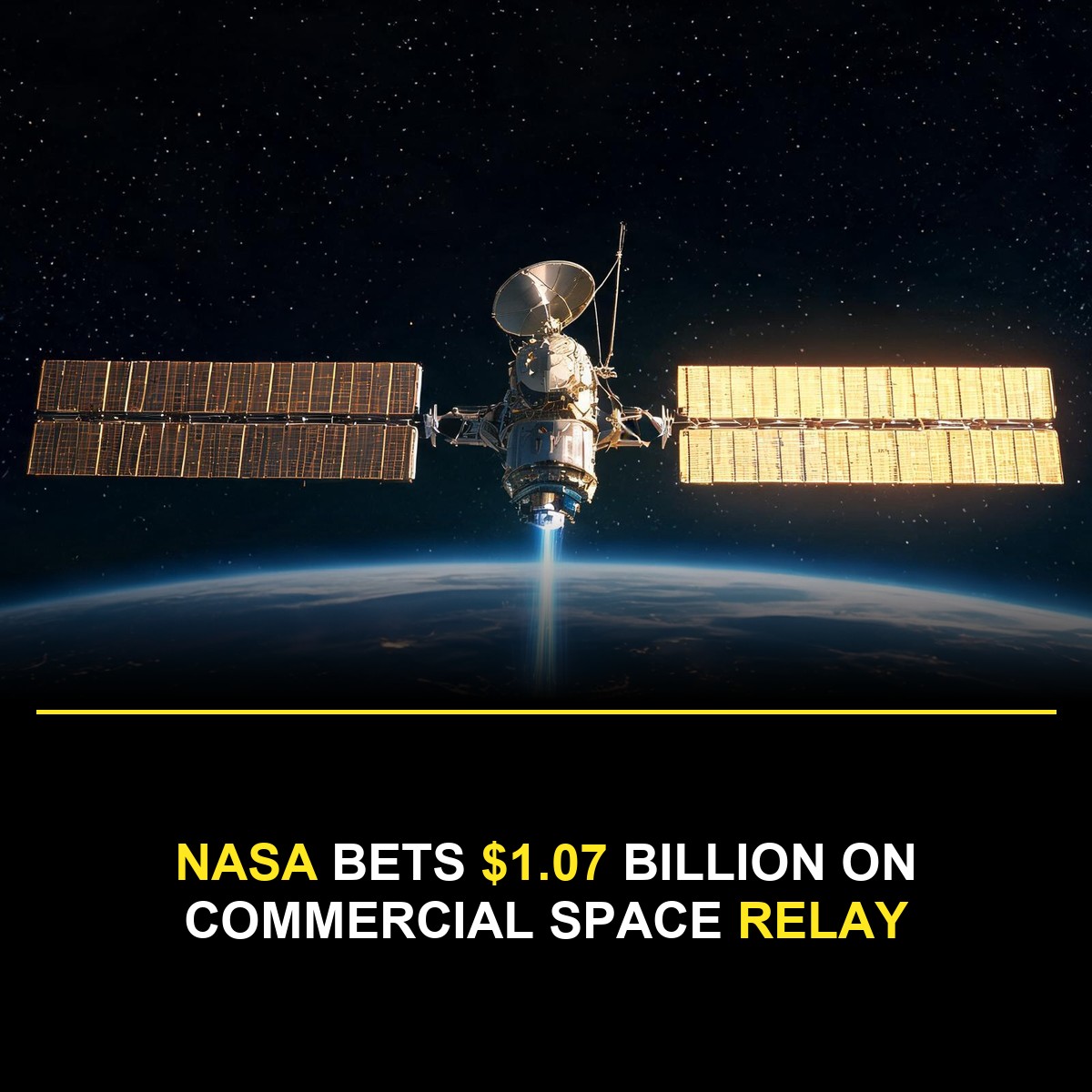
NASA has selected three companies to build commercial replacements for the Ka-band satellite relay network that has connected its spacecraft to the ground for four decades, and the contract structure reveals as much as the dollar figure does. Viasat, Global Enterprise Solutions, and Astranis will develop Ka-band space relay capability under awards with a combined potential value of 1.07 billion dollars, with one requirement that shapes everything: the new services must work with spacecraft already in orbit, without touching their flight hardware.
The awards, announced November 4 under the Next Space Technologies for Exploration Partnerships-3 Broad Agency Announcement Appendix E, are firm-fixed-price contracts running through May 2027 initially, with priced options to continue work through 2029. They operationalize a decision NASA made two years ago: the Tracking and Data Relay Satellite fleet, the backbone of low-Earth-orbit communications since 1983, stops accepting new missions and eventually retires, replaced by commercial services where NASA becomes one customer in a marketplace rather than the owner of the network.
This article explains what TDRS does and why the Ka-band transition must happen, how the three winners split the work, what backward compatibility with existing spacecraft means technically, and what the transition says about the economics of government infrastructure in the commercial space era.
What TDRS does and why the fleet must retire
The Ka-band relay transition begins with the Tracking and Data Relay Satellite system, the reason a spacecraft in low-Earth orbit can talk to the ground almost continuously, and its replacement problem is physics before it is procurement.
A spacecraft in low orbit passes over any single ground station for minutes at a time. TDRS solved this by placing satellites in geostationary orbit, where they hang fixed over the equator, relaying data between the moving spacecraft below and the ground stations they never lose sight of. The result was near-continuous coverage: the Hubble Space Telescope streams science through it, the International Space Station supports crew communications and operations through it, and Earth-observation satellites return their data through it rather than storing observations until the next ground pass.
The fleet, however, is aging past its design life, forcing the Ka-band transition. The last TDRS launch, the thirteenth, flew in 2017, and the operational constellation consists of spacecraft whose generations span decades of technology. Building a fourteenth generation made little sense once a commercial satellite industry, supercharged by the broadband constellation boom, could offer equivalent relay services at market prices, and NASA decided in 2022 to phase the system out, stopping new mission onboarding in late 2024 while current users continue operating on the legacy fleet.
The transition problem is the hard part. Existing spacecraft were designed around TDRS's specific frequency, protocol, and pointing architecture. Hubble cannot take a hardware upgrade; the ISS schedule does not pause for a Ka-band communications migration; Earth science missions planned around TDRS-compatible radios cannot feasibly be modified in flight. That constraint is precisely what the new Ka-band awards address: Ka-band relay concepts compatible with current missions in space, ensuring service continuity without requiring modifications to onboard systems.
The three winners and their assignments
The Ka-band awards split 1.0656 billion dollars across three companies with distinctly different approaches to the same compatibility requirement.
Viasat received the largest Ka-band award at 460.9 million dollars. The company operates one of the world's largest commercial Ka-band satellite fleets and has spent the past two years preparing a commercial alternative demonstration for the TDRS mission profile, making it the natural favorite for continuity services at scale. Its existing ViaSat-3 generation, high-throughput geostationary capacity, is the closest thing to TDRS's architecture that commercial satellite operations currently offer.
Global Enterprise Solutions, part of SES Space & Defense, received 340.4 million dollars for its Ka-band concept, SES brings the O3b mPOWER constellation's medium-Earth-orbit architecture and deep experience delivering government communications services, adding a different orbital geometry and enterprise-grade service discipline to the portfolio of candidate solutions.
Astranis received 264.3 million dollars for the smallest share of the Ka-band work, The company is the newcomer with a different playbook: small, dedicated geostationary satellites built quickly and cheaply for specific customers, rather than the flagship-class spacecraft the incumbents fly. Its model, an orbit-raising smallsat repointed at a government relay mission, is the closest the awards get to a purpose-built TDRS successor.
NASA's stated aim through the Ka-band awards is end-to-end solutions, space, ground, launch, operations, and integration elements, with the agency participating as one of many customers in the commercial marketplace. That phrasing is the strategic core: the government is no longer the prime customer defining requirements and owning assets, it is an anchor tenant whose presence de-risks a commercial service that other customers, defense, allied agencies, commercial operators, will also use.
Why Ka-band specifically
The choice of Ka-band frequencies is the engineering hinge of the whole acquisition, and it is worth unpacking for readers outside the communications field.
Ka-band, the 26.5 to 40 gigahertz range, carries far more data per unit of spectrum than the lower bands that older satellite services used, which is why the commercial broadband industry standardized on it and why a relay service built on commercial Ka-band infrastructure can offer throughput that legacy relay architectures struggled to match. The commercial ecosystem, ground terminals, modems, flight-qualified radios, and the operator workforce, has scaled around Ka-band for a decade, so building the successor service there buys the entire mature supply chain rather than a bespoke government niche.
The trade-offs are real. Ka-band signals attenuate more in heavy rain, demanding site diversity and link margin engineering, and the frequency requires tighter pointing accuracy on both ends of the link. Commercial operators have solved both problems across thousands of deployed terminals, which is exactly the point: the government is buying solutions to problems the market has already paid to solve.
The compatibility mission adds the twist: legacy spacecraft designed for TDRS's frequencies must be served, and the awards describe Ka-band relay capability that is compatible with current missions, which implies user-service interfaces that translate between what old spacecraft transmit and what new infrastructure receives. Whether that translation happens on the relay satellite, in ground processing, or through bridging hardware on the spacecraft side is the architecture question each winner answers differently, and the concept phase exists to compare those answers before the flight demonstration commits one.
Backward compatibility is the technical mountain
The requirement that makes these Ka-band contracts hard is invisible in the press release: new relay services must speak to spacecraft designed twenty or thirty years ago.
TDRS compatibility runs deep. Missions built around its S-band and Ku-band user services, its specific modulation and coding, its pointing and acquisition procedures, and its unique single-access return architecture cannot be patched from the ground. The new Ka-band services must therefore reproduce, in commercial hardware, the exact interface a legacy spacecraft presents, which means the winners are not just building relay satellites but reverse-engineering and re-implementing a government system's behavior in commercial form.
The NEXUS acquisition name, Network Extension for User Continuity and Sustainability, states the Ka-band mission plainly: continuity first, sustainability second. The customers who cannot migrate are the priority, the ISS among them, and the service must appear to those spacecraft as a seamless continuation of the network they were built for. The flight demonstration option in the contracts, moving from concept development and risk reduction to in-orbit demonstration by 2029, exists because this compatibility claim can only be proven with a real spacecraft.
The economics deserve attention too. Firm-fixed-price contracting shifts risk to the vendors: they absorb cost overruns, and the option structure lets NASA decline to continue if milestones slip. For the winners, the strategic value exceeds the contract value: becoming the certified successor to TDRS establishes a government communications franchise with decades of follow-on revenue, which is why three operators with different architectures all competed seriously for work whose headline numbers are modest by satellite-constellation standards.
Who depends on the network being replaced
The scale of the transition is best measured by counting the customers, and the legacy TDRS user list reads like a catalog of NASA's most visible missions.
The International Space Station is the anchor user, relying on the relay network for continuous voice, video, telemetry, and command support across its ninety-minute orbits, a service no ground-station-only architecture can replicate. The Hubble Space Telescope has streamed its science through the relay system for more than three decades, returning observations whose value depends on downlink capacity that the network provides. Earth-observation fleets, heliophysics missions, and technology demonstrators across low-Earth orbit ride the same infrastructure, and the accumulated user community represents spacecraft whose remaining operational lifetimes span, in some cases, another decade or more.
That user base is why continuity, not capability, defines the acquisition. A new relay service could offer ten times the throughput and still fail the mission if a 1990s-era spacecraft cannot complete the acquisition sequence to use it. The compatibility requirement is, in effect, the user community writing its constraints into the contract: serve the fleet as it exists, not as a redesign might wish it to be.
The alternative, modifying spacecraft, was considered and rejected as infeasible at scale. Flight software updates are possible on some missions; radio hardware changes are not, and the cost and risk of touching operational spacecraft whose science value depends on stability outweighs any efficiency the migration might offer. The result is the backward-compatibility mountain the winners must climb, and the reason the concept phase, risk reduction, and in-orbit demonstration structure exists at all.
For the missions themselves, the transition will be invisible when it works, which is the highest compliment an infrastructure replacement can earn. Data flows, schedules hold, and the operators notice only that the network beneath them has changed owners.
The commercial transition pattern, again
These awards complete a transition arc that the space industry has been tracing for two decades, and the pattern is now unmistakable.
Government builds infrastructure, commercial capability matures around it, and the government becomes a customer. Cargo resupply followed it, crew transport followed it, and Earth observation is following it; communications relays were the last great government-owned monopoly in orbit, and they are now entering the same cycle. In each case the government kept ownership during the immature phase, when no commercial alternative existed, and divested once a market could carry the load, retaining buying power rather than operating burden.
The TDRS case adds a twist the earlier transitions lacked: the installed base. Cargo and crew could adopt new interfaces because their vehicles were new programs. Relay communications must serve spacecraft that cannot change, which is why NASA is paying a premium, a billion dollars for concepts and demonstrations rather than operational services, to bridge the gap between architectures. The bridge period, from these awards through the 2029 options, is the industry's proving ground for that compatibility claim.
What the winners are really competing for is the post-TDRS market. The same Ka-band relay services that serve legacy NASA missions will serve new missions, defense customers, allied space agencies, and commercial constellations needing relay capacity. NASA's billion dollars buys continuity for Hubble and the station, and it underwrites the market formation for a service class that the entire orbital economy will use, which is the same pattern the commercial cargo program used to seed today's launch industry.
For readers following the infrastructure story from the other direction, the ground-side buildout serving AI-era connectivity is examined in our Vera Rubin bandwidth analysis, the satellite-to-phone frontier that rides the same spectrum is covered in our Cloud Computer analysis, and the AI-driven economics reshaping infrastructure of every kind are unpacked in our AI gateway comparison.
What the winners said and what happens next
The Ka-band selection landed with quiet confidence across all three companies, and the near-term milestones are now fixed on the calendar.
The period of performance began on November 4 and runs to May 3, 2027, the window in which each winner matures its concept, retires its riskiest unknowns, and prepares for the option decisions. The priced options through 2029 cover the transition from concept to in-orbit flight demonstration, meaning the decisive proof point, a legacy-compatible commercial relay serving a real NASA spacecraft, is scheduled within roughly three years. Agency procurement discipline, firm-fixed-price with option gates, means each phase must earn the next, and the winners' engineering reveals will arrive through that cadence rather than in a single unveiling.
For the three winners, the near-term work differs by starting point. The incumbent operator integrates the mission into a fleet that exists; the medium-Earth-orbit player designs the relay layer for a constellation architecture; the smallsat builder launches a dedicated spacecraft on a compressed timeline. All three converge on the same acceptance test: a spacecraft designed around TDRS, unable to be modified, handed a commercial service it cannot tell apart from the government network it was built for.
The wider market watches the same demonstration for a different reason. A proven commercial Ka-band relay service changes procurement math for every new spacecraft program, government and commercial alike, because new missions can then design around a service that exists rather than a government network that is closing to them. The successor market is much larger than the legacy-continuity market, and the billion dollars NASA is spending is the formation cost of that larger market.
The risks worth watching
A billion-dollar infrastructure transition carries failure modes, and four are worth tracking as the contracts progress.
Technical compatibility is the first: the reverse-engineering of legacy interfaces in commercial hardware is genuinely difficult, and a compatibility failure at the flight-demonstration stage would force redesign or extension of the legacy fleet, with schedule and cost consequences that fixed-price contracts would push onto the vendors.
Schedule is the second. The 2029 demonstration window is tight for spacecraft development, especially for the smallsat approach whose entire value proposition is speed, and any slip compounds because the aging legacy fleet does not wait. Retired relay satellites cannot be un-retired cheaply.
Market formation is the third. The commercial service only sustains itself if the post-transition market materializes: new NASA missions, defense customers, and commercial operators buying relay capacity. If anchor-tenancy ends and the expected customers do not arrive, service continuity for legacy spacecraft becomes a subsidy question rather than a market one.
Concentration is the fourth. Three winners across different architectures is genuine competition today, but consolidation in the satellite industry is chronic, and a future where one operator controls the government relay service would recreate the monopoly the transition is meant to dissolve, this time in private hands. The contract structure, multiple vendors, fixed prices, option gates, is designed against that outcome, but structure is not destiny.
None of these risks argues against the transition; the aging fleet makes it necessary. They define what successful execution looks like: compatibility proven on orbit, schedule held, market formed, competition preserved.
Questions readers are asking
Why is NASA retiring TDRS?
The fleet is aging past design life, with the newest satellite launched in 2017, and a commercial satellite industry now exists that can offer equivalent relay services. NASA stopped onboarding new missions in late 2024 and will fly out the legacy fleet while commercial services mature.
What will the three companies actually deliver?
Ka-band relay service concepts compatible with existing NASA spacecraft, covering space, ground, launch, operations, and integration elements, advancing from concept development to a potential in-orbit flight demonstration through 2029.
Can Hubble and the ISS really switch to commercial relays without modification?
That is the contract's central requirement: services compatible with current missions without modifications to onboard flight hardware. Proving it with a real spacecraft is exactly what the flight demonstration option funds.
What happens if the commercial services fall short?
The legacy TDRS fleet continues operating for its existing users, which is why NASA describes the transition as gradual. The fixed-price structure means vendors carry the delivery risk, and the option-based funding lets the agency stop if milestones are not met.
Sources
- NASA news release, Ka-Band Satellite Relay Awards: https://www.nasa.gov/news-release/nasa-announces-ka-band-satellite-relay-awards-for-space-communications/
- NASA Tracking and Data Relay Satellite program overview: https://www.nasa.gov/missions/tdrs/tracking-and-data-relay-satellite-tdrs-generations-of-spacecraft/
- NASA transition to commercial communications: https://www.nasa.gov/centers-and-facilities/goddard/nasa-to-embrace-commercial-sector-fly-out-legacy-relay-fleet/
- NASA SCaN program: https://www.nasa.gov/directorates/somd/space-communications-navigation-program/