Motorola Signature 27: 1,600 Dollars and It Will Not Fold
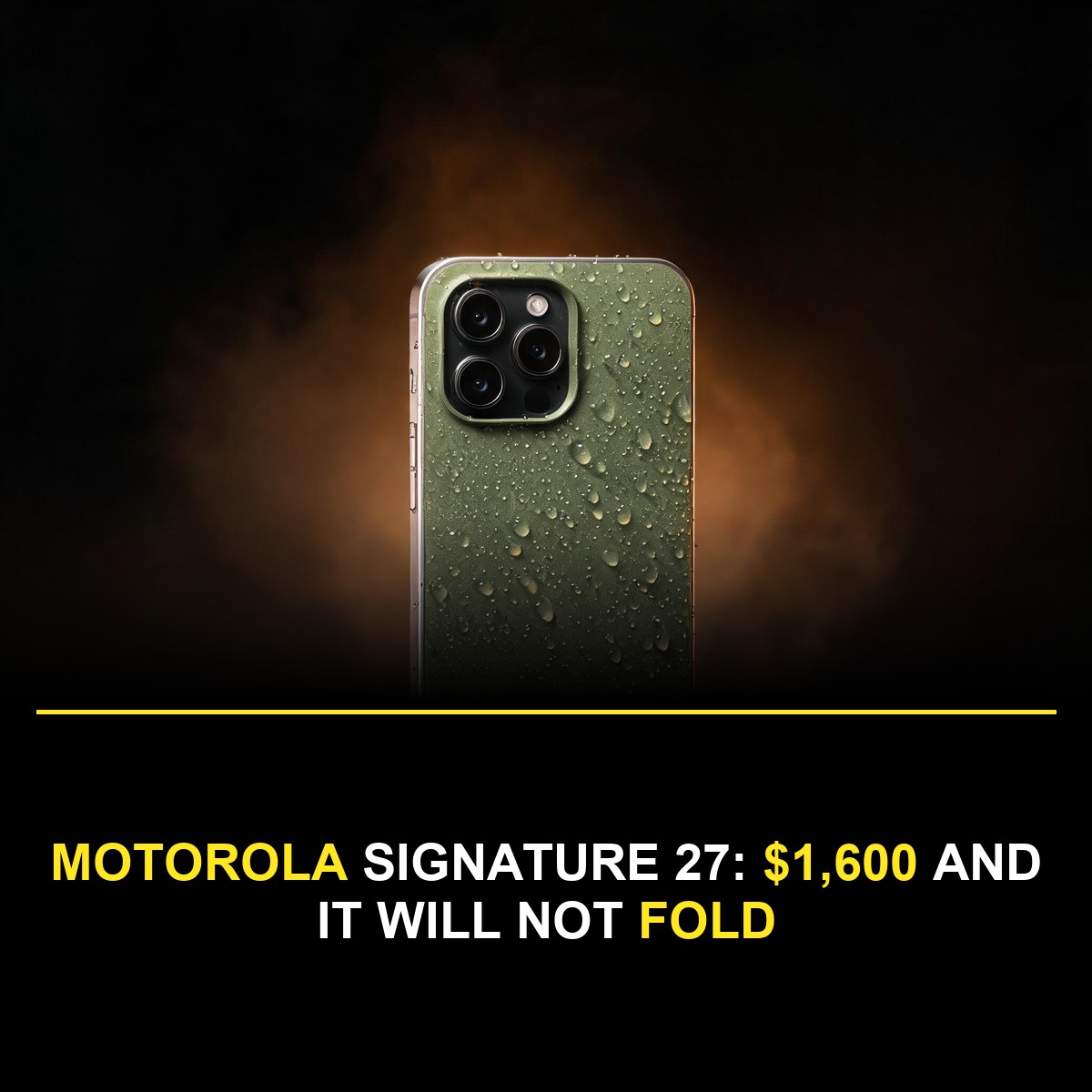
Motorola will sell you a $1,600 phone that does not fold. The Motorola Signature 27 was announced on November 5, preorders open November 19, and it goes on sale November 26, marking the company's first unapologetic ultra-premium slab in the United States since the Edge+ in 2020.
The Motorola Signature 27 price is the story because of what it implies. Sixteen hundred dollars is folding-phone money, or maxed-out iPhone and Galaxy money, and Motorola has spent a decade competing on value rather than on prestige. The Motorola Signature 27 asks buyers to accept a different premise: that a ceramic-and-aluminum slab with the brightest panel ever shipped, a 200-megapixel periscope, a 7,000-mAh silicon-carbon battery, and seven years of updates is worth more than a folding screen.
There is a plausible case, and there is a skeptical case, and both are supported by the same set of facts. This article covers what the hardware actually delivers, which of Motorola's claims survive scrutiny, why the company picked this moment to move upmarket, what the market shares say about whether it can work, and who should consider it.
What sixteen hundred dollars buys
The Motorola Signature 27 build is the first argument. Motorola Signature 27 uses ceramic and brushed aluminum with contoured edges and an integrated camera plane, a design language that echoes the iPhone 18 Pro's camera plateau rather than the company's own previous flagships. Two finishes are offered: Pantone Capulet Olive with a textile-inspired texture, and Pantone Coal Smoke with a tactical weave. The front glass is Corning Gorilla Glass Ceramic 3, and the body carries an IP68/69 rating, which covers dust, deep water immersion, and high-pressure water jets.
The Motorola Signature 27 display is the second argument and the loudest claim. The 6.8-inch Extreme AMOLED Duo panel peaks at 12,000 nits, uses tandem OLED technology that stacks two emissive layers, runs at 1.5K resolution with Dolby Vision, and carries Pantone Validated color calibration. Motorola also claims a 121 percent longer panel lifespan than conventional AMOLED and better energy efficiency, which matters more than the brightness figure for anyone who keeps a phone for years.
The silicon is the third. Motorola Signature 27 is among the first phones to ship with Qualcomm's Snapdragon 8 Elite Extreme Gen 6, announced in September and expected to power most 2027 Android flagships. Motorola pairs it with a thermal chamber 40 percent larger than its previous design, a specification that matters because sustained performance rather than peak benchmark scores is what separates a good phone from a hot one.
The rest of the package includes 12 gigabytes of RAM and 512 gigabytes of storage in the configuration announced for the United States, Wi-Fi 8 support, a 7,000-mAh silicon-carbon battery, 90-watt TurboPower charging, wireless charging without Qi2 magnets, and a speaker system co-engineered with Bang and Olufsen.
The Motorola Signature 27 12,000-nit claim, examined
Motorola calls the Motorola Signature 27 panel the brightest smartphone display on the market, and the number is technically accurate in a narrow sense that buyers should understand.
Peak brightness figures for phones are measured on small areas of the panel, often during HDR playback of specific content, and they do not represent what the display delivers across the whole screen for everyday use. Chinese manufacturers have advertised 10,000-nit and higher peaks for two years under the same measurement conventions, and reviewers have consistently found that full-screen brightness lands far below the peak figure.
What survives the scrutiny is more useful than the headline. Tandem OLED, the same architecture Apple brought to the iPad Pro and its touchscreen MacBook, genuinely improves efficiency and longevity because each layer runs at lower intensity for the same output. Motorola's claims of better power consumption and a longer panel lifespan follow from the physics rather than from marketing, and a display that stays bright and accurate for seven years is worth more than one that wins a spec-sheet contest.
The practical question for buyers is whether 12,000 nits changes outdoor readability. The answer is that most flagship panels already reach around 3,600 nits peak and are legible in direct sunlight, so the marginal benefit is small for normal use and larger for HDR video, where highlight detail benefits from headroom. Motorola Signature 27 buyers should treat the number as a hint about panel quality rather than a feature they will notice daily.
Motorola Signature 27 cameras: LOFIC, a 200-megapixel periscope, and a sensor that is not a camera
The Motorola Signature 27 camera system is where the phone makes its most technical argument, and the specifications are genuinely unusual for the brand.
The main camera is a 50-megapixel Sony Lytia L910, the first Sony sensor with LOFIC, or Lateral Overflow Integration Capacitor, technology. LOFIC adds a capacitor inside the pixel to hold overflow charge from bright areas, which preserves highlight detail in a single exposure instead of relying on multi-frame merging. The practical result is fewer blown skies and crushed shadows in high-contrast scenes, which is the most common failure of small phone sensors.
The telephoto is a 200-megapixel periscope with 3x optical reach and up to 100x digital zoom augmented by generative AI. The resolution is high enough that cropping delivers usable 6x and 12x results, and the generative enhancement is the same approach Google and Samsung use, with the same caveat: it invents detail that was not captured, which is acceptable for social sharing and problematic for documentation.
The ultrawide and selfie cameras are both 50 megapixels, and the selfie sensor supports 4K video. The fourth element on the back is not a camera at all. It is an event-based vision sensor, which Motorola describes as a first on a smartphone, and it detects changes in brightness per pixel at microsecond latency rather than capturing frames. It drives the Action Shot mode, freezing fast motion without the blur that frame-based sensors produce.
That sensor is the most interesting component in the phone because it points at a different future. Event cameras are standard in robotics and industrial vision for exactly this reason, and using one to solve the phone-camera problem of photographing children, pets, and sports is a specific, defensible application rather than a specification for its own sake.
Battery, charging, and the two-day claim
The Motorola Signature 27 battery is the specification most likely to change daily experience, and the technology behind it is worth explaining.
Silicon-carbon anodes hold more lithium per unit volume than graphite, which allows a larger capacity in a thinner cell. Motorola Signature 27 uses that density to fit 7,000 mAh into a body roughly 8 millimeters thick and 227 grams, and the company claims around 66 hours of battery life, which is more than two days for typical use.
Charging is 90 watts wired, with a claim that 12 minutes of charging delivers 12 hours of use. Wireless charging is supported but without Qi2 magnetic alignment, a gap that matters to anyone who has standardized on magnetic mounts and wallets.
The honest framing on battery claims is that they depend heavily on screen brightness and network conditions, and a 12,000-nit panel used outdoors will drain faster than the rated figure suggests. The capacity is large enough that even a 30 percent shortfall leaves a phone that comfortably finishes a long day, and the silicon-carbon chemistry is the reason the phone is not 10 millimeters thick.
Seven years of updates and GrapheneOS support
The Motorola Signature 27 software commitment addresses the company's longest-standing weakness, and it does so more seriously than expected.
Motorola promises seven years of software updates, matching the longevity commitments that Samsung and Google made standard in the premium tier. Historically the company lagged on updates, and its premium devices have been the vehicle for changing that reputation, starting with the Razr Fold and continuing here.
More surprising is GrapheneOS support. The Motorola Signature 27 is the company's first phone to support the hardened, de-Googled Android distribution, which means buyers who want a privacy-focused operating system can install one without losing hardware support. Stock Android remains available, and the phone ships with Android 17 and the Gemini Intelligence features Google introduced this year, including task automation through Gemini, generative widget creation, American Sign Language translation through Gboard and Live Transcribe, and the Rambler dictation feature previously exclusive to the Pixel 11.
That combination is unusual: a phone that ships with deep Google integration while officially supporting the most prominent de-Googled alternative. Motorola is hedging across buyer types rather than picking a side, and for privacy-conscious buyers who want flagship hardware without a Pixel, the Motorola Signature 27 is now the only real option.
The market math that makes Motorola Signature 27 hard to sell
The case against the Motorola Signature 27 is not about the hardware. It is about the shelf it sits on.
In the United States premium smartphone market in the second quarter of 2026, Apple captured roughly 80 percent of sales, Samsung about 16 percent, and Lenovo, Motorola's parent, about 1 percent. IDC senior research director Nabila Popal put the challenge plainly: the average consumer, even the premium consumer, is not reading spec sheets to decide which phone wins, and regardless of how good the device is, competing at that price will be difficult.
Motorola's counterargument rests on momentum it can point to. Revenue grew 15 percent year over year in the second quarter of 2026, with a third of that coming from the premium category, and the Signature model launched outside the United States earlier this year recorded the highest net promoter scores in the company's history. Motorola also leads the United States folding market with 78 percent share, which demonstrates that buyers will pay premium prices for its hardware when the form factor justifies it.
The question Motorola Signature 27 tests is whether that willingness transfers from a folding screen to a slab. Folding phones carried a visible reason for the price; a ceramic slab with a very bright display has to earn it through craft and longevity, which are harder to demonstrate in a store.
Premiumization as a response to the memory crisis
The timing of the Motorola Signature 27 launch is not accidental, and the broader industry pattern explains it.
Smartphone prices are rising because memory costs are rising. IDC forecasts average selling prices up sharply this year amid the ongoing memory shortage, with low-end devices hit hardest because memory is a larger share of their bill of materials. Manufacturers facing component inflation have two options: absorb the cost and lose margin, or move upmarket where absolute margins are larger and buyers are less price-sensitive.
That dynamic is producing premiumization across the industry. Amazon's autumn hardware announcements raised starting prices while upgrading materials, and every major Android vendor has pushed its flagship tier upward. A $1,600 Motorola is the logical endpoint of that strategy: if the components cost more, sell a device whose price can absorb them and whose margins fund the next generation.
For buyers, the consequence is that the value tier is shrinking. A $500 phone still exists and still does most things well, but the gap between a $500 phone and a $1,600 phone is widening in materials and camera hardware while narrowing in everyday performance, which makes the premium decision increasingly about craft rather than capability.
For readers tracking the cost pressures behind these prices, the component math is examined in our memory shortage analysis, the display technology Motorola borrowed from laptops is covered in our MacBook Pro touchscreen piece, and the on-device AI features shipping with Android 17 are unpacked in our GPT-6.1 Terra analysis.
What the competition does better
A premium phone is judged against the phones it costs as much as, and the Motorola Signature 27 wins some comparisons and loses others.
Against an iPhone 18 Pro at a similar price, Motorola's advantages are the larger battery, the brighter panel, the 200-megapixel periscope, GrapheneOS support, and the event sensor. Apple's advantages are the ecosystem, the silicon efficiency that produces comparable battery life from a smaller cell, the video pipeline that remains the industry reference, resale value, and the support network that matters when something breaks in a city without a Motorola service center.
Against a Galaxy S26 Ultra, the comparison is closer on hardware and worse on software depth. Samsung offers a stylus, a longer track record with multi-window productivity, and DeX desktop mode, plus a camera system that has been tuned across five generations. Motorola counters with cleaner software, the GrapheneOS option, and a battery that is 2,000 mAh larger.
Against Chinese flagships that never reach the United States, the Motorola Signature 27 looks expensive. Comparable Xiaomi, Vivo, and Honor devices with similar silicon and equally aggressive camera hardware sell for the equivalent of 800 to 1,100 dollars in their home markets. Buyers in the United States cannot access those devices with full carrier support, which is the structural protection that makes a 1,600-dollar Motorola viable at all.
The honest summary is that the Motorola Signature 27 is competitive on hardware, behind on ecosystem and service, and differentiated on privacy and battery. Whether that trade is worth 1,600 dollars depends entirely on which column a buyer weights most.
Who should actually buy it
Three buyer profiles make sense for the Motorola Signature 27, and one does not.
The first is the privacy-focused power user who wants flagship silicon, a large battery, and the option to install GrapheneOS. That combination exists nowhere else at this specification level, and for that buyer the price is justified by the absence of alternatives.
The second is the photographer who shoots moving subjects in difficult light. The LOFIC main sensor and the event-based vision sensor address the two hardest problems in phone photography, and the 200-megapixel periscope covers reach that most flagships compromise on.
The third is the buyer who keeps phones for five years or more. Seven years of updates plus a tandem OLED panel rated for a longer lifespan plus a 7,000-mAh battery adds up to a device designed to age well, and the total cost of ownership math improves the longer you hold it.
The buyer who should not consider it is anyone upgrading from a 2024 or 2025 flagship expecting a transformative experience. The Snapdragon 8 Elite Extreme Gen 6 is faster, the display is brighter, and the cameras are better, but the everyday difference between this and a good $700 phone is smaller than the price gap suggests, and that gap is the honest measure of what the Motorola Signature 27 is selling.
Questions readers are asking
How much does the Motorola Signature 27 cost?
1,600 dollars in the United States, with preorders opening November 19 and retail availability November 26. European pricing has been reported around 1,899 euros in Germany.
Is the 12,000-nit display real?
The peak figure is measured on small areas during HDR content, as with every manufacturer's brightness claim. The tandem OLED panel genuinely improves efficiency and lifespan, which matters more for daily use than the peak number.
Does it support GrapheneOS?
Yes. It is Motorola's first phone to support the hardened Android distribution, while still shipping with Android 17 and Google's Gemini features for buyers who prefer stock software.
Should I buy it over an iPhone or Galaxy?
If you want GrapheneOS, the event sensor, or a 7,000-mAh battery, yes. If you want the broadest app ecosystem and resale value, the established premium brands remain the safer choice, and the 1,600-dollar price does not change that.
Sources
- Motorola Signature 27 product page: https://www.motorola.com/us/en/motorola-signature-2027
- WIRED review and specification analysis: https://www.wired.com/story/motorola-wants-to-sell-you-a-1600-phone-that-doesnt-fold
- Qualcomm Snapdragon 8 Elite Extreme Gen 6 platform: https://www.qualcomm.com/products/mobile/snapdragon
- IDC smartphone market research: https://www.idc.com/getdoc.jsp?containerId=prUS