Memory Shortage: Laptops and Phones Cost 20 Percent More
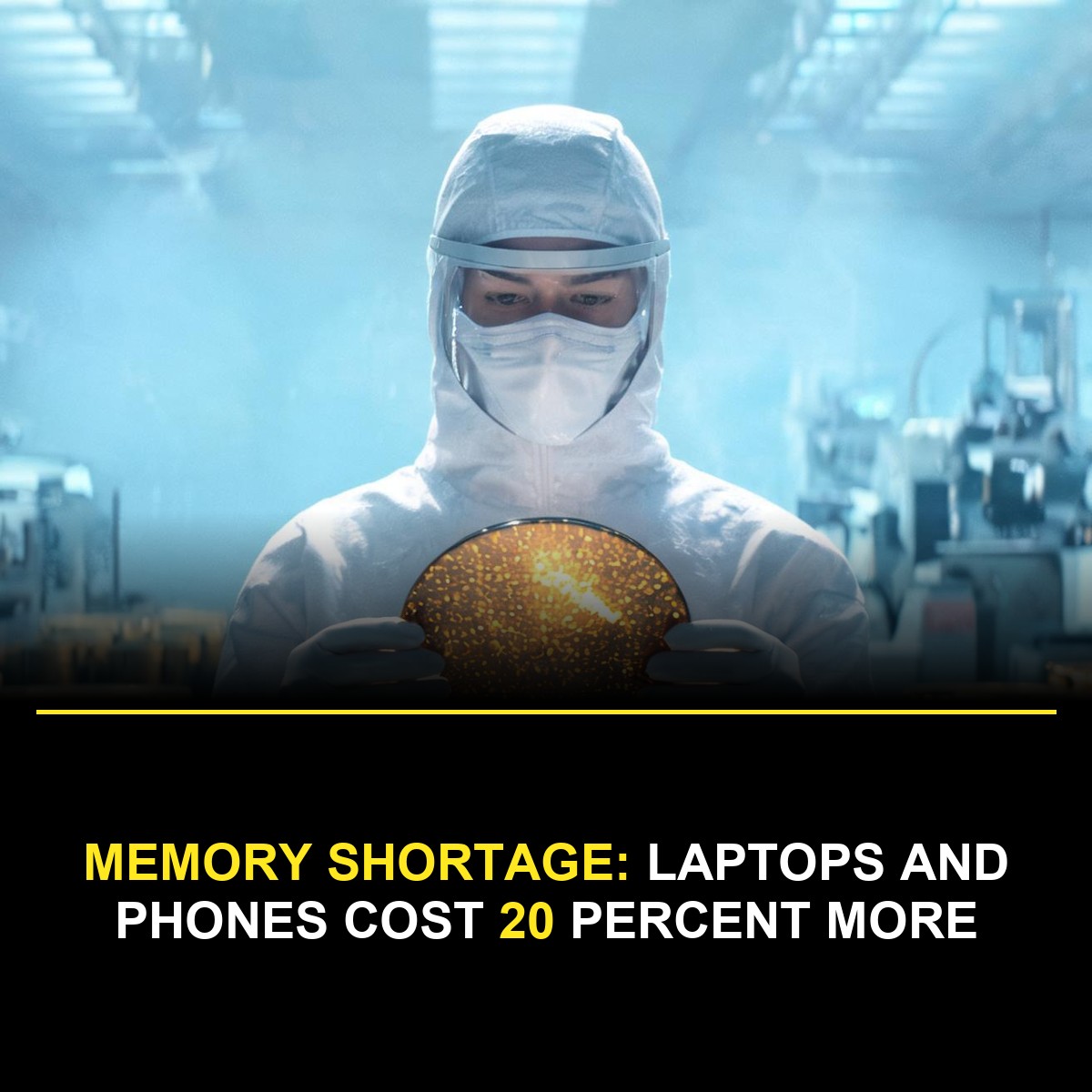
The memory shortage that began in late 2025 has become the defining constraint on consumer hardware, and the numbers have stopped being abstract. Lenovo, Dell, HP, Acer, and ASUS have confirmed price increases of 15 to 20 percent to their channel partners. Smartphone memory costs rose roughly 30 percent in a single quarter, with another 15 to 20 percent expected. And the industry's own forecasters now describe the situation as a strategic reallocation of silicon capacity rather than a temporary cycle.
The mechanism is simple enough to explain in one sentence: AI datacenters consume far more memory per system than any consumer device, the three companies that make most of the world's DRAM have shifted capacity toward high-bandwidth memory and high-capacity server modules, and every wafer allocated to an accelerator stack is a wafer denied to the LPDDR5X in a mid-range phone.
The consequences are not simple. They run through bill-of-materials math, vendor hedging strategies, the awkward timing of the AI PC push, and the question every buyer is asking this holiday season: wait, or pay more later.
This article covers what the memory shortage actually is today, why this cycle differs from previous ones, how it lands on phones, laptops, and consoles differently, why Apple and Samsung are protected while their competitors are not, when supply might normalize, and what a rational buyer should do between now and then.
What the memory shortage means, in numbers
Three figures frame the memory shortage, and each measures a different part of the squeeze.
The first memory shortage indicator is supply growth. IDC expects 2026 DRAM supply to grow 16 percent year over year and NAND to grow 17 percent, both below historical norms and both far below the demand curve that AI infrastructure has created. When memory shortage conditions persist for two consecutive years, prices do not drift upward; they gap.
The second memory shortage indicator is price. DRAM contract prices roughly doubled through 2025, with cumulative increases from the start of 2024 to the end of 2026 estimated by sell-side research in the several-hundred-percent range. Mobile LPDDR5X, the specific memory in phones, rose about 30 percent in the fourth quarter of 2025 alone, with analysts forecasting another 15 to 20 percent on top.
The third memory shortage indicator is bill-of-materials share. Memory represents 15 to 20 percent of the total component cost of a mid-range smartphone and 10 to 15 percent of a flagship. When that line item triples, the phone's economics break unless the price rises, the specification falls, or both. That is not a forecast about the memory shortage; it is arithmetic that handset product managers have already run.
The combination explains why the memory shortage changed the language coming out of the industry this year. Executives who spent a decade describing memory as a commodity now describe it as a constraint, and analysts who modeled cycles now model capacity allocation as a strategic variable.
Why AI ate the wafer
The root cause of the memory shortage is a reallocation, not a demand spike in the ordinary sense, and the distinction determines how long the shortage lasts.
For decades, DRAM and NAND production for phones and PCs was the primary driver of the memory industry. Consumer electronics set the volume, funded the fabs, and absorbed the learning curve that made memory cheap. That relationship has inverted. Hyperscalers building AI clusters buy high-bandwidth memory by the stack, at margins several times what consumer modules earn, and they buy it under multi-year contracts that let manufacturers plan capacity with confidence.
The result is a zero-sum competition for cleanroom space. HBM requires more wafer area per bit than conventional DRAM because of its stacked die architecture and lower yields, so the capacity shift is larger than the bit shift suggests. Add the packaging capacity that HBM consumes and the effect compounds: not only are fewer wafers available for consumer DRAM, but the advanced packaging lines that could otherwise serve other products are occupied as well.
IDC frames this as potentially permanent rather than cyclical, a strategic reallocation of the world's silicon wafer capacity. That framing matters for buyers because it implies the pre-2024 price baseline is not coming back. Memory will get cheaper again as new fabs come online, but it will not return to the commodity pricing that assumed consumer devices were the industry's center of gravity.
The three suppliers, Samsung, SK Hynix, and Micron, are behaving rationally within that frame. They are allocating scarce capacity to the highest-margin, most contracted demand, which is exactly what shareholders expect them to do. The consumer market is not being punished; it is being outbid.
The smartphone squeeze and its asymmetry
Handset makers face the memory shortage with wildly different capacity to absorb it, and the divergence is the most consequential story in the shortage.
At the low end, vendors competing on price with thin margins have almost no room. The memory cost increase alone can consume the entire margin on a budget device, and the choices are to raise prices into customers who are price-sensitive by definition, cut memory to keep the price, or absorb a loss. IDC names the exposed cohort directly: TCL, Transsion, Realme, Xiaomi, Lenovo, Oppo, Vivo, Honor, and Huawei, all of which built volume strategies on aggressive specifications at low prices.
At the high end, Apple and Samsung are structurally hedged. Their cash reserves and long-term supply agreements let them secure memory 12 to 24 months ahead, which means the price shock arrives at their next contract negotiation rather than immediately. That is a genuine advantage, and it comes with a visible cost: 2026 flagships are likely to ship without RAM upgrades, holding at 12 gigabytes for Pro models rather than moving to 16, because the incremental memory is either unavailable or uneconomic at current prices.
The consumer-visible consequence of the memory shortage is the end of a decade-long trend. For years, each generation brought flagship features down to cheaper tiers, and specifications democratized as manufacturing scaled. The memory shortage reverses that: the mid-range gets less memory for the same money, the low end loses features outright, and the gap between what a flagship and a budget device can do widens for the first time in a decade.
Market forecasts reflect the squeeze. IDC models a smartphone market contraction of 2.9 percent in a moderate downside scenario and 5.2 percent in a pessimistic one, with average selling prices rising 3 to 5 percent or 6 to 8 percent depending on severity. Those ranges look mild until you notice that they combine falling volumes with rising prices, which is the signature of a supply-constrained market rather than a demand-driven one.
The PC reset is steeper
Laptops and desktops face a harsher version of the memory shortage, and the timing could hardly be worse.
PC vendors have confirmed 15 to 20 percent price increases and contract resets to their channel partners, an industry-wide response that ends two years of aggressive discounting. The increases land as Microsoft's Windows 10 end-of-life refresh cycle pushes businesses to buy, and as the AI PC marketing campaign tries to convince consumers that local inference is the reason to upgrade. Both efforts assumed falling prices; both now face rising ones.
IDC's PC scenarios are darker than its phone scenarios: a 4.9 percent contraction in the moderate case, 8.9 percent in the pessimistic one, with average selling prices rising 4 to 6 percent or 6 to 8 percent. The reason the decline is deeper is that PCs are more memory-intensive per unit at the high end and more price-elastic at the low end, so the same cost shock hits both a gaming desktop's margins and a corporate procurement budget.
The memory shortage distributional effect is stark. Large vendors with inventory and supplier leverage gain share, because they can secure allocation and absorb temporary cost spikes. White-box builders, regional assemblers, and the DIY market, which includes a large share of PC gamers, bear the brunt, because they buy memory at spot prices with no contract protection. IDC notes the implication plainly: pre-built systems from major OEMs become relatively better value, which is an unusual position for the industry's incumbents to occupy.
The AI PC paradox
The cruelest detail of the memory shortage is that it arrived exactly when personal computers needed more memory than ever,
AI PCs, defined as machines with a neural processing unit, carry more RAM than their predecessors. Microsoft's Copilot+ specification requires a minimum of 16 gigabytes, and as small language models and on-device inference move into mainstream software, higher-end systems are shifting toward 32 gigabytes or more. Local model execution is memory-bandwidth-bound, so the capability the industry is selling is precisely the resource that became prohibitively expensive.
The memory shortage creates a downmix risk that undermines the AI PC pitch. A buyer choosing between 16 and 32 gigabytes in 2026 faces a price gap far wider than a year ago, and the honest calculation for many is that the larger configuration costs more than the AI features are worth to them today. That does not kill the AI PC category, but it slows the transition from marketing claim to purchased reality, and it hands a temporary advantage to cloud-based AI, where the user's RAM is irrelevant.
There is a longer-term irony worth naming. Every AI feature that runs in a datacenter consumes memory that could have gone into a laptop, so the same buildout that makes on-device AI attractive also makes the hardware for it more expensive. The two halves of the AI transition are competing for the same silicon, and in 2026 the datacenter is winning.
Beyond phones and PCs: consoles, cameras, and cars
The memory shortage reaches every product with DRAM or NAND inside it, and the categories outside the two headline markets show how broad the second-order effects are.
Game consoles are the clearest case. Both major platforms ship with fixed memory configurations that cannot be changed mid-generation without fragmenting the install base, so manufacturers face a choice between absorbing cost on every unit and reducing production. Neither is attractive, and both push the effective price up: discount promotions disappear, bundles shrink, and the console that was going to be cheap in year four stays expensive because the memory inside it did not get cheaper.
Cameras and audio equipment follow the same pattern with less visibility. A mirrorless camera contains a processor, buffer memory, and storage, and the buffer memory that enables high-speed continuous shooting is exactly the kind of low-volume, high-specification DRAM that suppliers deprioritize first. Expect fewer firmware-driven feature additions and slower refresh cycles in categories where the memory bill is small in absolute terms but large relative to margins.
Automotive is the most consequential extension. A modern vehicle contains dozens of memory-bearing modules, and automotive-grade parts carry qualification requirements that limit the supplier base further. Automotive contracts run for years, so the shortage shows up as longer lead times and allocation disputes rather than immediate price changes, which means the effect on vehicle pricing arrives with a delay and persists after consumer prices stabilize.
The pattern across all these categories is the same asymmetry that defines the memory shortage in phones and PCs: whoever holds long-term contracts and can absorb cost survives the cycle, and whoever buys at spot prices or operates on thin margins passes the increase to the customer or exits the category.
When supply catches up
The end of the memory shortage is a capacity question with a visible calendar, and the calendar is not soon.
New DRAM fabs take roughly two to three years from decision to volume production, and the capacity commitments made in 2025 and 2026 begin contributing meaningfully in 2027 and 2028. IDC's expectation that the shortage could persist well into 2027 is consistent with that timeline, and the 16 percent supply growth forecast for 2026 is roughly half what the historical demand curve would have absorbed in a normal year.
The memory shortage demand side offers some relief, though not much. AI infrastructure spending is projected to keep growing, but the mix may shift: as inference grows relative to training, the ratio of memory per accelerator changes, and efficiency work in model architectures reduces memory requirements per unit of capability. None of that reverses the shortage, and all of it is uncertain.
The honest memory shortage forecast is a plateau rather than a cliff. Prices likely peak sometime in 2026, stay elevated through 2027, and normalize gradually as capacity arrives and demand growth moderates. For consumers, that means the era of cheap, abundant memory and storage is over in the medium term, which is exactly how IDC concludes its analysis.
For readers tracking the buildout that caused this, the infrastructure side is examined in our Vera Rubin bandwidth analysis, the way memory costs are reshaping laptop pricing is covered in our MacBook Neo 2 forecast piece, and the token economics that make datacenter demand so inelastic are unpacked in our Gemini 4 Argon pricing analysis.
What a buyer should do now
Four practical conclusions follow from the memory shortage data, and they differ by buyer.
If the memory shortage has you deciding, and you need a device in the next six months, buy it. Prices are rising, not falling, and the historical pattern of waiting for the next generation to get cheaper is inverted this cycle. Holiday promotions in 2026 are discounts against a rising base rather than the beginning of a slide.
If the memory shortage leaves you a configuration choice, buy memory now rather than later. Memory is the component that cannot be upgraded in laptops and phones, and the price gap between configurations will widen before it narrows. The same logic favors 32 gigabytes over 16 in a machine you intend to keep four years.
If the memory shortage intersects your refresh cycle, contract early. Vendors are resetting contract terms upward, and the organizations that locked pricing before the resets are the ones whose budgets survive. Procurements that slip into 2027 will pay the new baseline.
If you build or upgrade your own machines, accept the spot market reality. DIY pricing tracks the spot market, which is the most volatile segment, and pre-built systems from major vendors now offer better value than they have in years because those vendors hold contract memory.
For the industry, the strategic question is whether the memory shortage accelerates the shift toward cloud inference or delays the AI PC transition long enough to matter. For buyers, the answer is simpler: the discount era ended, and the replacement arrives with a higher price tag.
Questions readers are asking
How long will the memory shortage last?
Forecasters expect it to persist into 2027, with new fab capacity arriving in 2027 and 2028. Prices are likely to peak in 2026 and normalize gradually rather than falling sharply.
Will phone and laptop prices actually rise?
They already are. PC vendors have confirmed 15 to 20 percent increases, and smartphone average selling prices are forecast to rise 3 to 8 percent depending on how severe the shortage becomes, with larger increases at the low end.
Why not just make more memory?
New fabs take two to three years and billions of dollars, and manufacturers are choosing to allocate existing capacity to higher-margin AI memory. Supply is growing, just at 16 percent rather than the 25 to 30 percent the market would need.
Should I wait for prices to fall?
Waiting is the wrong strategy this cycle. Prices are rising through 2026 and likely stay elevated into 2027, so a purchase deferred is a purchase made at a higher price with no compensating specification gain.
Sources
- IDC analysis of the global memory shortage and device market impact: https://www.idc.com/resource-center/blog/global-memory-shortage-crisis-market-analysis-and-the-potential-impact-on-the-smartphone-and-pc-markets-in-2026
- TrendForce DRAM contract price research: https://www.trendforce.com/research/
- Counterpoint Research smartphone market forecasts: https://www.counterpointresearch.com/insights/
- Micron investor relations and memory market commentary: https://investors.micron.com/