SpaceX at 125 Launches Builds Starlink Mobile Network
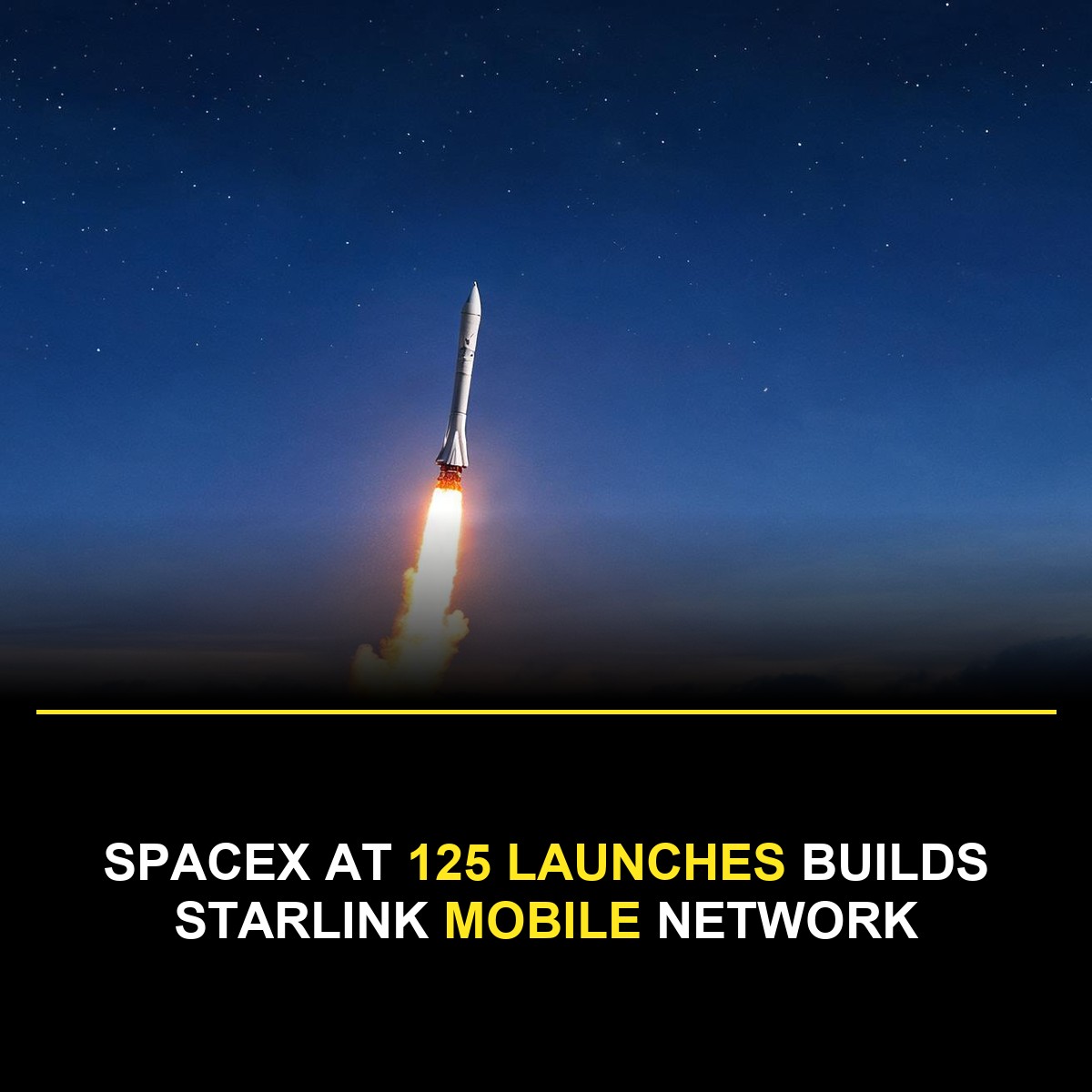
SpaceX launched its 125th mission of 2026 on November 6, extending a cadence that has rewritten the industry's expectations, a classified Space Force flight from California carrying what analysts believe are Starshield satellites, and the milestone lands in the same week the company struck a multiyear deal with Qualcomm to build the terrestrial half of Starlink Mobile's nationwide 5G network. Two stories, one Starlink Mobile thesis: the launch machine and the network it deploys have become a single business, and both just hit strides.
The launch number deserves context before the network deal, because it is the foundation everything else stands on. One hundred twenty-five launches in roughly ten months exceeds the entire flight rate of every other nation and company combined, and the pace has continued accelerating even as attention shifted to Starship: SpaceX set a record in August by launching two Falcon 9 rockets just 38 minutes apart, and the California manifest has carried an unusual share of the year as the company concentrates Starship operations in Florida.
The Qualcomm agreement announced November 4 is the quieter story with the larger ceiling: Starlink Mobile, Dragonwing cellular infrastructure platforms, 64-transmit-path Massive MIMO radios, and tens of thousands of terrestrial sites deploying from 2027, building the ground network that turns Starlink's satellite direct-to-cell service from a lifeline product into a genuine nationwide carrier competitor.
This article covers what the classified launch tempo reveals, why Starlink Mobile changes the phone market, the Starshield pattern hiding in plain sight, why SpaceX is building cell towers, and what a satellite-plus-terrestrial network means for the phone in your pocket.
The cadence record and what hides inside it
The raw number, 125 launches by early November, understates what the 2026 manifest actually demonstrates.
The launch rate is the visible surface of two deeper achievements behind Starlink Mobile's foundation. The first is reuse maturity: the booster on the November 6 mission was flying for the eighth time, having moved coasts mid-career after a GPS launch in April, and landing routine enough that the flight registered as one more entry in a catalogue. Booster fleets now cycle through refurbishment on timescales that made launch cadence a scheduling constraint rather than a manufacturing one, and the 38-minute dual launch in August showed the ground operations side has reached a tempo where two full missions fit inside a single evening.
The second is manifest diversity. The 2026 flights mix Starlink builds, classified Space Force missions, commercial payloads, and rideshares at a ratio that would have seemed implausible when Falcon 9 first flew. The R-series of Space Force launches, four flights since August, feeds the same Starlink Mobile infrastructure story, each carrying 23 satellites believed to be based on the Starshield platform, represents a defense program running at a cadence that treats orbit like a deployment schedule rather than an event.
The California concentration is the operational tell of the moment: with Starship development focused in Florida, Vandenberg has absorbed a larger share of Falcon 9 work, including the classified missions whose trajectories head south-east over the Pacific. The company is running two development programs and an operational manifest simultaneously, which no launch provider in history has attempted at this scale.
What the cadence buys is compounding option value. Every launch refines the process, every booster cycle lowers amortized cost, and every slot in the manifest is currency the company spends on its own constellations, government programs, or commercial customers as strategy dictates. The rocket is no longer the product; the schedule is.
The R-missions: Starshield in plain sight
The November 6 flight fits a pattern that open-source analysts have assembled despite official silence, and the pattern is one of the more significant defense space programs in years.
Since August, four Falcon 9 launches have deployed batches of 23 satellites each under Space Force designations, with the payloads catalogued by trackers and attributed by analysts to the Space Based Sensing and Targeting program, built on what is believed to be SpaceX's Starshield platform, the government derivative of Starlink. Neither SpaceX nor the Space Force has confirmed successful deployments, and the missions' purpose remains officially unacknowledged, but the shape is clear: a proliferated constellation of sensing satellites, launched in batches on a monthly-ish cadence, at a scale that traditional government procurement has never approached.
The significance runs in two directions. For the military, proliferated low-Earth-orbit sensing changes targeting and warning architectures, the way Starlink changed communications resilience: many cheap satellites replace few expensive ones, attrition tolerance becomes a design feature, and replenishment is a launch purchase rather than a decade-long program. For SpaceX, the R-missions are the proof that Starshield has become a prime defense business, with the company selling not just satellites but the launch-integrated deployment tempo that only it can deliver.
The dual-use economics are the strategic moat. Starshield rides Starlink's manufacturing line, its launch manifest, and its ground infrastructure, spreading fixed costs across both businesses. A government customer buying sensing satellites is implicitly buying the most efficient satellite deployment system ever built, and the classified program's cadence, roughly 92 satellites in four flights since August, demonstrates a replenishment rate that adversarial planning must now assume.
Inside the Dragonwing hardware deal
The Qualcomm agreement's technical specifics reveal how serious the network buildout is, and they are worth reading closely.
The radio units are 64T64R Massive MIMO, sixty-four transmit and sixty-four receive paths per antenna array, the configuration that modern macro networks use to multiply capacity in dense areas through beamforming. Starlink Mobile is deploying this grade of hardware from the start rather than upgrading into it, which suggests the terrestrial network is planned for data-heavy service from day one rather than voice-first and later enhancement. The Dragonwing QRU100 platform integrates the radio processing, and the QDU100 handles the latency-sensitive Layer 1 baseband work, with the pairing optimized for performance per watt, the metric that decides network economics at the scale of tens of thousands of sites.
The multi-band, multi-wave architecture language is the future-facing part: the platforms are designed for a network that will evolve across frequency bands and deployment phases, and Qualcomm's explicit reference to AI-native 6G infrastructure signals that the partners see this as a decade-long program, not a 5G endpoint. For a company whose terrestrial network experience starts now, buying into an evolvable architecture is the difference between building a network and rebuilding one every five years.
The division of labor is equally telling. SpaceX contributes the deployment machine, sites, power, backhaul via its own satellites, and logistics at a tempo no carrier matches; Qualcomm contributes the radio science and the silicon. Neither could build this alone at speed, which is precisely why the partnership exists, and thetens-of-thousands-of-sites figure implies a procurement of infrastructure hardware at a scale that reshapes Qualcomm's infrastructure business line on its own.
The Qualcomm deal: why the rocket company is building cell towers
The Starlink Mobile and Qualcomm agreement announced November 4 answers a question that has hung over satellite direct-to-cell since its debut: how does the service scale from messaging lifeline to mainstream network?
The Starlink Mobile answer is a hybrid architecture. Starlink's direct-to-cell satellites serve the areas terrestrial networks never will, and the new terrestrial buildout, powered by Qualcomm's Dragonwing QRU100 radio and QDU100 baseband platforms with 64T64R Massive MIMO antennas, serves everywhere else with the capacity that satellite links alone cannot provide. Tens of thousands of sites deploying from 2027, in a multiyear agreement, constitute the construction of a fourth national cellular network from scratch, by the company that launches satellites.
The Starlink Mobile strategic logic is compounding. Direct-to-cell satellites eliminated the coverage problem; terrestrial towers solve the capacity problem; and a single network that hands off between orbit and ground delivers what no existing carrier can promise, connection everywhere with metropolitan-grade speed. The company's own framing, the first fully-integrated nationwide satellite and terrestrial network, positions Starlink Mobile against the carriers not on price or coverage but on architecture.
For Qualcomm, the deal is a landmark entry into a market it has supplied components to but never defined. The Dragonwing infrastructure platforms were built for exactly the Starlink Mobile moment, and an AI-native 6G vision referenced in the announcement positions the partnership beyond 5G. For the carrier incumbents, the threat is no longer hypothetical spectrum-sharing experiments but a funded nationwide deployment by an operator with vertical integration from rocket to radio unit.
The Starlink Mobile 2027 rollout timeline is aggressive and credible for one reason: deployment logistics are SpaceX's core competence. A company that lands boosters on droneships will not struggle with tower installations, and the satellite half of the network is already flying.
Starlink Mobile for the phone in your pocket
The consumer consequence of Starlink Mobile arrives faster than most infrastructure stories, because both halves of the network already exist in early form.
Direct-to-cell service has been eliminating dead zones for messaging on ordinary phones for two years, and each satellite generation has added bandwidth. The terrestrial buildout converts that baseline into a full service: voice, data, and video at metropolitan speeds in cities, satellite fallback everywhere else, on devices with no special hardware. For the phone in your pocket, the practical Starlink Mobile consequence is a carrier whose coverage map has no white space, an offer no incumbent can copy without building its own satellite layer.
The competitive pressure lands on carrier pricing structures, roaming economics, and the rural coverage excuse that has justified geographic inequality in connectivity for decades. When coverage stops being a differentiator because a competitor covers everything, competition migrates to price and service, in a market that has quietly raised prices for years.
What it means for defense and the space economy
The defense consequence of the 125-launch cadence compounds alongside the consumer one, and it is arguably the more consequential story.
The same launch machine that fills commercial orbits replenishes military ones, and a nation whose commercial space company operates at 125 launches per year has a mobilization baseline no adversary can match without building its own equivalent machine. The R-mission satellites, the Starlink constellation, and the coming Starlink Mobile network are three expressions of one infrastructure: proliferated, replenishable, and launched on schedule, with the government and commercial sides sharing factories, boosters, and ground systems.
The space-economy consequence is the quietest and largest. Two industries, launch and telecommunications, that operated for decades as separate oligopolies are being fused into a single vertical business, and the 125-launch milestone plus the Qualcomm deal are the month's evidence that the fusion is no longer speculative. Competitors face a moving target: matching any single layer, launch price, satellite count, or network coverage, requires building the other layers too, because the integration is where the economics live.
For founders and investors, the signal is that infrastructure verticals are consolidating around operators who own their logistics. For policymakers, the signal is that a private company now operates critical national infrastructure across three domains at once, and the regulatory frameworks for that reality are still being written. For everyone else, the signal is that the phone in your pocket is about to get its first genuinely new network architecture in fifteen years, and it comes from a rocket company.
The 2027 competitive landscape
The Starlink Mobile rollout enters a market with four incumbents and settled economics, and the realistic scenarios for 2027 are worth mapping.
The coverage-led scenario plays out in rural and suburban America first: Starlink Mobile's satellite layer is already better than any terrestrial competitor outside cities, and hybrid service converts that advantage into subscribers in exactly the geographies where the majors are weakest. The capacity-led scenario runs through metropolitan areas, where the Massive MIMO buildout must compete against networks that have been densifying for a decade, and where Starlink Mobile will be the newcomer on spectrum it must use efficiently. The realistic 2027 is both at once: a regional rollout wave covering selected markets end to end, with national marketing built on the dead-zone elimination no rival can match.
The incumbents' responses to Starlink Mobile are constrained. Building their own satellite layers means partnering with SpaceX's competitors, whose constellations are smaller and whose direct-to-cell capability trails; fighting on price means margin erosion in a capital-intensive business; ignoring the threat means ceding the rural segment and the narrative. The most likely counter is bundled partnerships and spectrum messaging, which history suggests will not stop a hybrid network with a real coverage advantage.
The regulatory dimension is the wildcard. A new nationwide network needs spectrum coordination, tower permitting across thousands of jurisdictions, and carrier Interconnection agreements, and SpaceX has shown both impatience and effectiveness in regulatory fights. The 2027 timeline presumes those processes compress, and the company's track record with the FCC suggests they will.
For consumers, the practical advice is unchanged hardware and patient observation: direct-to-cell works on existing phones, the terrestrial service will launch in specific markets rather than nationally, and the moment to evaluate Starlink Mobile is when it turns on in your area, not when the press releases land.
Questions readers are asking
The consumer consequence of Starlink Mobile arrives faster than most infrastructure stories, because both halves of the network already exist in early form.
Direct-to-cell service has been eliminating dead zones for messaging on ordinary phones for two years, and each satellite generation has added bandwidth. The terrestrial buildout converts that baseline into a full service: voice, data, and video at metropolitan speeds in cities, satellite fallback everywhere else, on devices with no special hardware. The competitive pressure lands on carrier pricing structures, roaming economics, and the rural coverage excuse that has justified geographic inequality in connectivity for decades.
The defense consequence compounds alongside the consumer one. The same launch cadence that fills commercial orbits replenishes military ones, and a nation whose commercial space company operates at 125 launches per year has a mobilization baseline no adversary can match without building its own equivalent machine. The R-mission satellites, the Starlink constellation, and the coming Starlink Mobile network are three expressions of one infrastructure: proliferated, replenishable, and launched on schedule.
The market consequence is the quietest and largest. Two industries, launch and telecommunications, that operated for decades as separate oligopolies are being fused into a single vertical business, and the 125-launch milestone plus the Qualcomm deal are the month's evidence that the fusion is no longer speculative. The next milestone to watch is the first commercial Starlink Mobile markets in 2027, and the one after that is whether any incumbent answers with a hybrid architecture of its own.
For readers following the infrastructure buildout from the ground side, the datacenter power crunch driving terrestrial networks is examined in our Vera Rubin bandwidth analysis, the satellite communications transition NASA is making is covered in our Ka-band relay analysis, and the AI systems riding these networks are tracked in our AI gateway comparison.
Straight answers on the launch record and the network
What did the 125th launch carry?
A classified U.S. Space Force mission from Vandenberg, designated USSF-432, believed to be the fourth batch of 23 satellites in a sensing constellation built on the Starshield platform. Neither SpaceX nor the Space Force has confirmed the payload details.
Is 125 launches in a year a record?
Yes for any single organization, and it exceeds the combined launch totals of every other nation and company. SpaceX's own previous annual record was surpassed months before year end.
What is Starlink Mobile?
Starlink Mobile is SpaceX's nationwide cellular service combining its direct-to-cell satellites with a new terrestrial 5G network built on Qualcomm Dragonwing platforms, with tens of thousands of sites deploying from 2027 for fully integrated satellite-and-ground coverage.
Can one company really run launches, satellites, and a phone network?
It is already doing the first two at unmatched scale, and the Qualcomm partnership supplies the cellular expertise for the third. The vertical integration from rocket to radio is precisely the strategy; whether the carrier market accepts it is the open question of 2027.
Sources
- SpaceX launches page and mission archive: https://www.spacex.com/launches
- Qualcomm announcement on the Starlink Mobile infrastructure deal: https://www.qualcomm.com/news/releases/2026/11/spacex-selects-qualcomm-to-accelerate-starlink-mobile-s-nationwi
- Starlink direct-to-cell service information: https://www.starlink.com/business/direct-to-cell
- SpaceX Starshield government programs: https://www.spacex.com/vehicles/starship/