MacBook Pro Touchscreen Arrives in Five Apple Launches
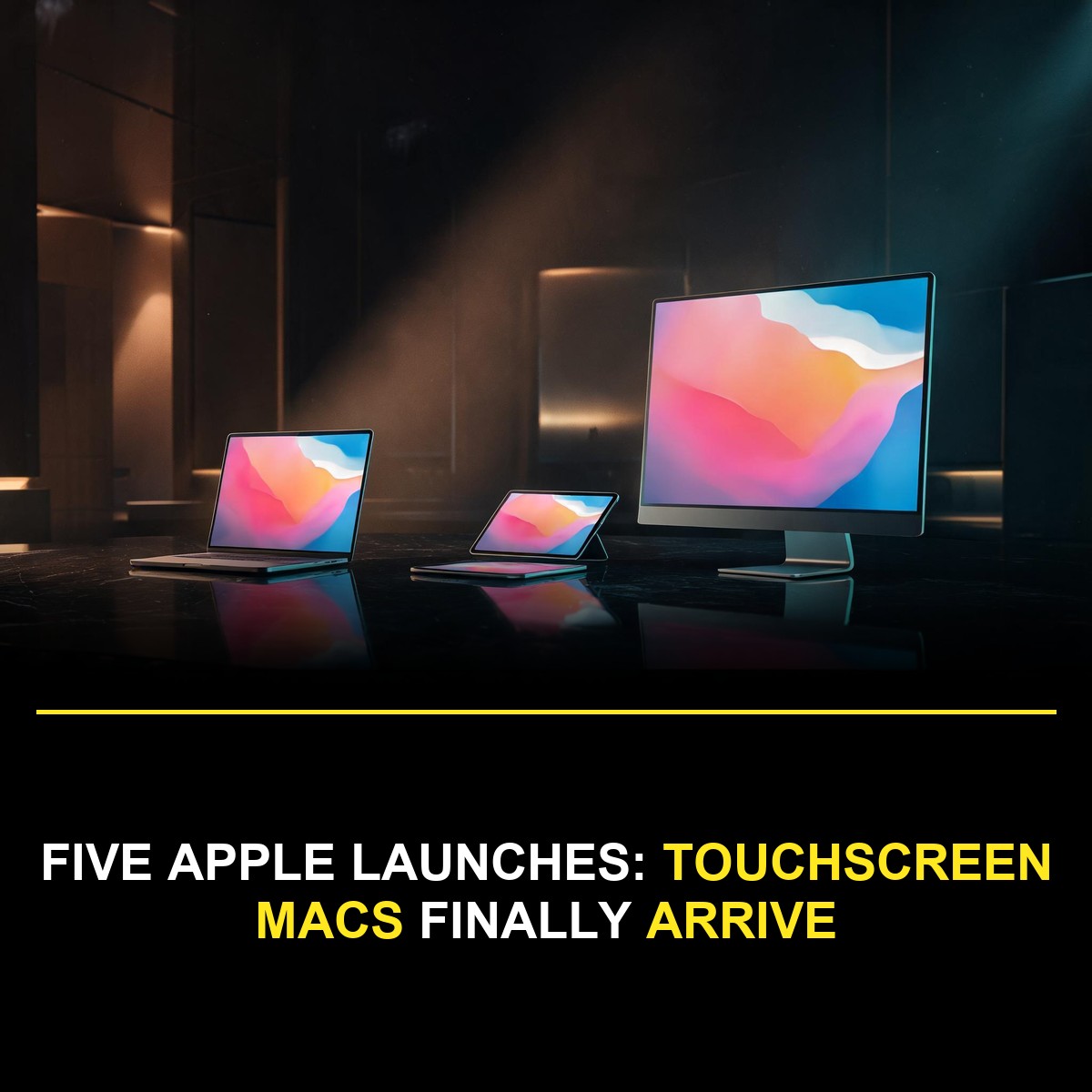
Apple is launching five products on Friday, November 6, and one of them, a touchscreen MacBook Pro, ends a debate that has run for as long as the Mac has existed. The 14-inch and 16-inch MacBook Pro models with OLED touchscreens, Apple's first touch-enabled Macs, go on sale alongside the OLED iPad mini with A20 Pro, the M6 iMac, and the 14-inch MacBook Pro with M6, capping the company's busiest product stretch in years.
The touchscreen MacBook Pro is the headline, and the numbers behind it explain why Apple waited two decades to build one. The new PROLED XDR display uses tandem OLED technology to reach 2,000 nits peak brightness with a 10,000,000:1 contrast ratio, the touch sensor is built directly into the display panel rather than layered on top, and the whole machine gets thinner and lighter in the process, down to 3 pounds for the 14-inch.
This article breaks down all five launches with their prices and what each one changes for MacBook Pro buyers and everyone else, examines why touch on the Mac arrived now and what it is actually for, weighs the early review consensus, and places the launches in the context of Apple's record quarter and the memory-cost pressures looming over every hardware buyer this season.
Why this launch day is unusually stacked
Five products on one day is not how Apple normally behaves, and the compression is itself information.
The traditional rhythm spread hardware across seasons, with Macs in autumn, iPads in spring, and breathing room between announcements so each product got its own news cycle. This year compressed everything: the iPhone Duo arrived in September, the touchscreen MacBook Pro announcement came October 28, and now five products land in a single Friday, followed by two more on November 13 and an accessory collection in December. The hardware chief's stated preference for faster cycles has become operational reality, and the effect is that Apple's calendar now resembles the smartphone industry's constant-refresh model more than its own historical one.
The commercial logic has two parts. Faster cycles mean a customer who needs a machine can always buy a new one this month rather than benchmarking against a refresh six months out, which converts waiting into buying. They also keep the lineup front-of-mind through the holiday quarter, when a disproportionate share of annual electronics spending happens and when every competitor is shouting.
The cost backdrop makes the timing sharper. Memory prices are climbing industry-wide because AI datacenter demand is absorbing DRAM supply, and every PC maker is navigating the squeeze. Launching now, at announced prices, locks in the holiday quarter before any further increases, and the company's leadership pointedly declined to rule out more hikes when asked this week. Buyers who need configurations with lots of memory have a rational reason not to wait.
The full launch slate and what each product costs
Friday's lineup covers four product lines, and each carries a distinct proposition.
The OLED iPad mini starts at 699 dollars with an 8.5-inch OLED display, landing far from the MacBook Pro tier on purpose, the A20 Pro chip, and a first for any iPad: IP67 water and dust resistance. That rating means the smallest iPad survives spills, rain, and an accidental bath drop, a meaningful durability statement for a device that travels everywhere in a bag.
The M6 iMac starts at 1,499 dollars and is the straightforward refresh of the lineup, a spec bump to Apple's newest mainstream silicon in the all-in-one design that remains the default family computer.
The 14-inch MacBook Pro with M6 starts at 1,999 dollars, giving the entry pro laptop the new chip while the display technology stays on the previous Mini-LED generation, a positioning that will confuse nobody who reads the pricing ladder carefully.
The two touchscreen MacBook Pro models anchor the event: the 14-inch MacBook Pro with PROLED XDR display and M5 Pro starts at 2,899 dollars, and the 16-inch with M5 Max starts at 3,399 dollars. Pre-orders opened October 28 after the announcement, with deliveries beginning November 6 and dates varying by region and configuration.
The price ladder is the strategy. A 900 dollar gap separates the M6 14-inch from the touchscreen 14-inch, which makes the touch-and-OLED combination the clear upsell rather than a spec footnote, and early reviews have focused on exactly that trade.
PROLED XDR: what the MacBook Pro tandem OLED changes
The display technology is the substance behind the marketing name, and it is worth unpacking.
Tandem OLED stacks two emissive layers instead of one, which is how the panel reaches 2,000 nits of peak brightness, both HDR and SDR, while an advanced display engine controls each pixel at sub-millisecond granularity to keep brightness and grayscale uniform across the panel. The claimed contrast ratio of 10,000,000:1 is an OLED structural property, true black from pixels that switch off entirely, and the practical consequence for colorists and photographers is shadow detail that Mini-LED, with its backlit zones, cannot match.
The color work targets professionals directly. The panel covers both P3 and Adobe RGB in a single default preset, exceeds 80 percent Rec. 2020 coverage for HDR video work, and ships factory-calibrated with industry-standard reference modes including new DICOM modes for medical imaging review. Apple also added genlock support, synchronizing the display's refresh to a camera's capture for virtual production work, which is a film-set feature appearing in a laptop for the first time.
The efficiency dividend for the new MacBook Pro is the sleeper benefit. OLED's display stack is thinner and more power-efficient, which is where the 24 hours of claimed battery life, the half-pound weight reduction on the 14-inch, and the 0.7-pound reduction on the 16-inch all come from. The redesign also moves to a Dynamic Island on the Mac for the first time, housing Spotlight, Live Activities, and Siri AI in the notch that iPhone users have known since 2022.
Touch on the Mac, after twenty years of refusal
Apple's resistance to touchscreens on the Mac was once a Steve Jobs talking point, and the reversal deserves scrutiny rather than a shrug.
The MacBook Pro implementation is deliberately Mac-native rather than iPad-derived. The touch sensor is integrated into the display panel itself, reducing latency so interactions register as touching the content directly, and macOS automatically translates touches into clicks so existing apps work immediately. A redesigned hinge adds stability against the pokes that would wobble a conventional lid, and video-call framing compensates for the arm movement touch creates.
The MacBook Pro use cases Apple demos are pro-shaped: designers drawing on the full display without trackpad constraints, musicians playing software instruments onscreen, developers testing how their iOS and iPadOS apps respond to touch directly on the Mac. The third one is the strategic tell. As Apple's device lines converge on shared silicon and shared interfaces, the Mac becoming a test surface for touch apps closes a loop that benefits the entire ecosystem, and it quietly acknowledges that the boundary between Mac and iPad interactions was always arbitrary from the user's side.
The catch is the same one critics have raised for two decades: vertical touch on a desktop display is ergonomically awkward for extended use, and the 400 dollar premium reviewers note for the OLED models over their Mini-LED equivalents prices the feature for enthusiasts and specific professionals rather than as a default expectation. Apple's bet is that specific professionals are enough.
The M6 chip inside the mainstream refresh
While the touchscreen models took the M5 Pro and M5 Max, the other three launches ride the M6 generation, and its role in the lineup matters for most buyers.
The M6 is Apple's newest mainstream system on a chip for the MacBook Pro and iMac lines, built on the same generation of process technology as the phone chips and carrying the improved neural accelerators that now sit inside every GPU core. For the iMac and the entry 14-inch MacBook Pro, it delivers the yearly performance-and-efficiency step that keeps the base lineup current: faster CPU and GPU, better battery life in the laptop, and headroom for the on-device AI features Apple keeps shipping through macOS updates.
The placement is deliberately conservative. The entry MacBook Pro keeps the Mini-LED display while the touch models leap to OLED, and the chip split, M6 below, M5 Pro and M5 Max above, looks counterintuitive until you read the pricing ladder: the M6 machines are the volume products, the touchscreen machines are the halo. Apple is doing with its laptop line what it has long done with iPhones, where the non-Pro models take the newest mainstream chip and the Pro tier takes the extreme silicon, and the historical answer to whether that split works is that both tiers sell.
For the iMac, the M6 refresh is the quiet workhorse update that keeps the all-in-one viable as the family computer, student machine, and home-office default. It will not headline any review, and it will outsell the touchscreen MacBook Pros by volume, which is the least glamorous and most important fact about the whole launch day.
What the reviews say so far
First reviews landed in the days before launch, and the MacBook Pro consensus is forming around display excellence with price friction.
The MacBook Pro display itself is drawing the strongest praise, with reviewers calling it the best laptop screen available and the color accuracy work earning specific mention from the photography and video crowd. The touch experience is described as polished where previous Mac touch rumors promised compromise, with the panel-integrated sensor delivering on the latency claims.
The friction is the MacBook Pro price. The OLED models cost 400 dollars more than the Mini-LED generation they parallel, which reviewers call steep for what is primarily a display upgrade, and the top configurations push past 4,000 dollars quickly. Combined with the memory-cost price increases Apple has applied across the lineup this quarter, the touchscreen Macs arrive as the most expensive MacBook Pro generation ever, in the same month the company reported 30.7 billion dollars in quarterly profit on 114.5 billion dollars of revenue.
The iPad mini reviews are warmer relative to price than the MacBook Pro reception. The OLED upgrade transforms the display of the small tablet, the A20 Pro keeps it current with the iPhone generation, and IP67 resistance answers the most common accident a device this size suffers. At 699 dollars it inherits the price of the MacBook Neo, which positions the two as the entry doors to the ecosystem from different directions.
The context: record profits, memory costs, and a packed quarter
The launches land in a revealing moment for Apple's hardware strategy.
The company's fourth quarter results, 114.5 billion dollars of revenue and 30.7 billion dollars of profit, landed the same week as the MacBook Pro launches, and the earnings call marked John Ternus's first as chief executive, with questions about further price increases met with deflection as memory costs climb industry-wide. The DRAM shortage driven by AI datacenter demand has raised component costs across every PC maker's bill of materials, and Apple's answer so far has been price increases plus a launch cadence that keeps newness in the channel.
The cadence itself is the other context. November 6 follows the iPhone Duo launch and precedes the November 13 arrival of the HomeView smart display and Apple TV 4K, with Creator Studio updates and the Apple Home accessory collection filling December. A faster release cycle, the company's leadership argues, means customers who need a machine can always buy a new one rather than waiting for the next refresh, and the theory is testable in this quarter's numbers.
For buyers, the practical advice splits by need. Anyone wanting a touchscreen MacBook Pro can finally buy one, and the display alone justifies it for color-critical work. Anyone wanting a Mac on a budget should watch Black Friday on November 27, where gift-card promotions have historically softened the sticker prices, and should buy memory-heavy configurations before further increases land.
For readers tracking the hardware market's cost pressures, the memory-price squeeze behind these launches is examined in our MacBook Neo 2 forecast coverage, the AI-driven DRAM dynamics are unpacked in our Vera Rubin bandwidth analysis, and the budget-laptop competition these prices sit above is surveyed in our AI gateway comparison.
The audio, camera, and details worth knowing
The display takes the headlines, but the supporting specs round out what is a genuine generational redesign rather than a screen swap.
The six-speaker system gained a new woofer design delivering 50 percent deeper bass and new tweeters for dispersion, and for the first time the tuning includes closed-lid use, acknowledging that many owners connect the laptop to an external display and previously lost half the sound system's design intent. The 12MP Center Stage camera carries over, studio-quality mics carry over, and Thunderbolt 5 remains the connectivity standard.
MacBook Pro storage goes to 16 terabytes at the top of the configuration ladder, which matters for video professionals who previously needed external arrays for large projects. Unified memory tops out at 128 gigabytes on the M5 Max, and the company's claim that the top configuration runs language models with hundreds of billions of parameters entirely on device places the machine in territory that required a datacenter rack until very recently.
The nano-texture display option, now etched into the cover glass rather than applied as a film, reduces glare for bright-environment work and remains the choice for anyone who has ever fought a window reflection during a color grading session. The thermal redesign redirects warm exhaust away from the display, which sounds minor until you recall how the previous design pushed heated air across the panel and into the airflow of anyone sitting nearby.
None of these MacBook Pro details will sell the machine on their own. Together they signal that the touchscreen MacBook Pro was engineered as a whole product rather than a display demo, which is what separates a generation change from a parts bin refresh.
Questions readers are asking
Are the touchscreen MacBook Pros worth the 400 dollar premium?
For colorists, photographers, and video professionals, the tandem OLED display alone approaches reference-monitor territory and justifies it. For general users, the Mini-LED models at 400 dollars less remain the rational choice until touch-specific workflows matter to you.
Does the iPad mini replace a small laptop?
Not quite, but the OLED display and A20 Pro narrow the gap for media consumption, note-taking, and light work. At 699 dollars it overlaps the MacBook Neo's price, and the right choice depends on whether you need macOS or value the mini's portability and stylus support.
Will older MacBook Pro models drop in price?
Typically yes around launches, though this quarter's memory-cost pressure has kept discounts unusually thin. Black Friday on November 27 is the realistic window for deals on the previous generation.
Is Apple planning more touch Macs?
The company has not said, but the panel-integrated touch implementation and the developer APIs shipped alongside it suggest the touchscreen line will expand if the first models sell, likely reaching the MacBook Air tier within a generation or two.
Sources
- Apple newsroom on the MacBook Pro with PROLED XDR Display: https://www.apple.com/newsroom/2026/10/apple-unveils-groundbreaking-macbook-pro-with-proled-xdr-display/
- Apple newsroom on the iPad mini update: https://www.apple.com/newsroom/2026/10/apple-gives-ipad-mini-its-biggest-update-ever/
- Apple Mac lineup and pricing: https://www.apple.com/mac/
- Wired review of the MacBook Pro OLED: https://www.wired.com/review/apple-macbook-pro-oled-2026/