Digit 5: The Humanoid Robot Cleared to Work Beside You
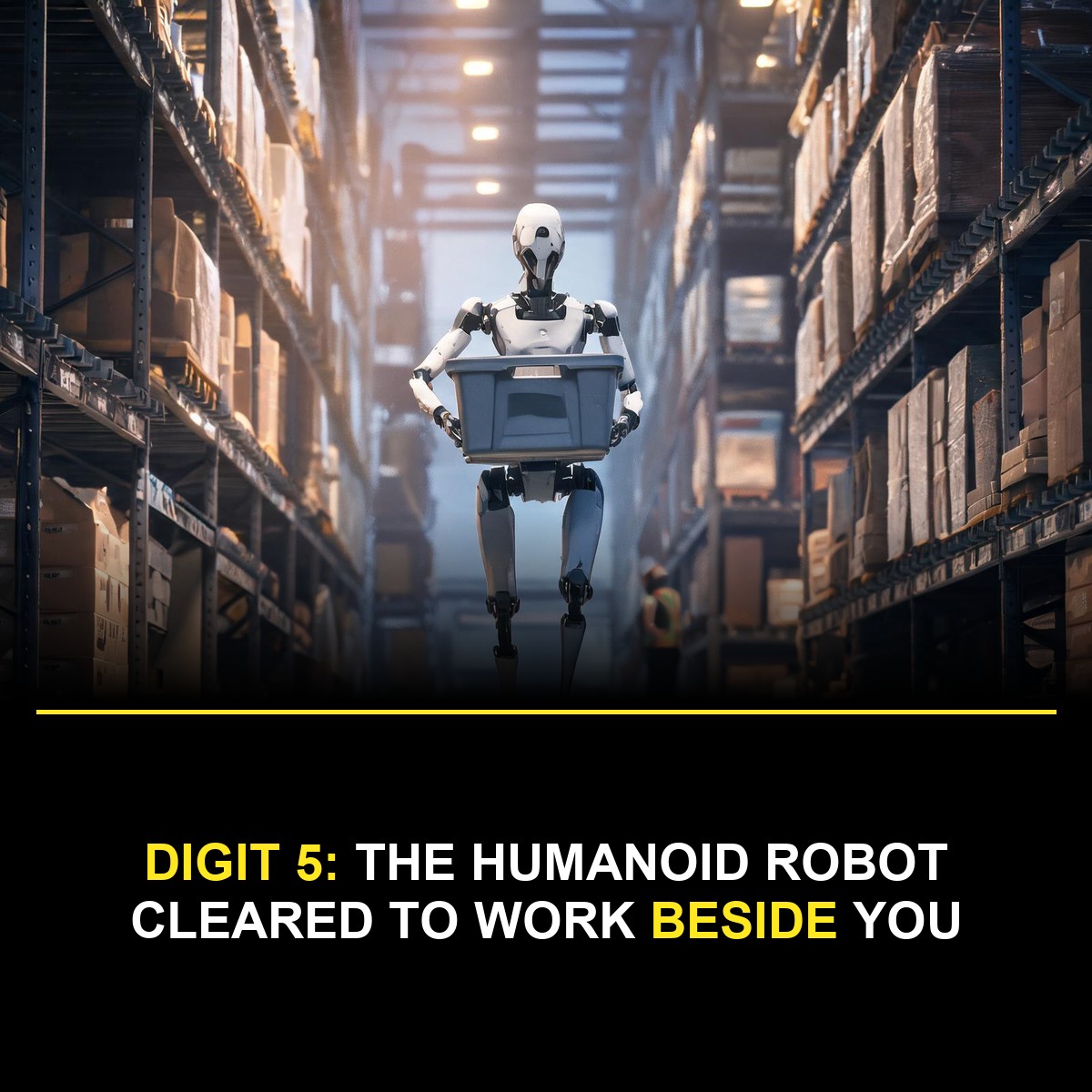
Agility Robotics has unveiled Digit 5, the next generation of the longest-serving commercial humanoid, and the spec sheet reads like a direct answer to the question that has kept humanoids behind fences: can one of them work next to a person without a safety cage? Digit 5 is the company's first robot engineered for cooperatively safe operation, backed by more than 300 million dollars in multi-year orders, 65,000 hours of real-world field time from its predecessor, and a public listing that values the company at 2.5 billion dollars.
The Digit 5 safety claim is not marketing language. Digit 4 became the first humanoid to pass an independent field evaluation against industrial safety standards administered by OSHA on a customer production line, and Digit 5 builds a full architecture on that foundation: continuous human detection, autonomous avoidance and stop responses, motion-intent signaling to nearby workers, and an independent safety controller that supervises it all. Agility is also writing the rulebook it must live by, leading the ANSI technical report for dynamically stable industrial robots in North America and contributing to ISO 25785-1, the first international safety standard for the humanoid category.
This article breaks down the Digit 5 hardware upgrades, the safety architecture and its NVIDIA partnership, what three years of commercial deployments proved, the warehouse math behind the 10:1 run-to-charge ratio, and what the 2.5-billion-dollar public listing means for the humanoid race.
Digit 5 hardware: bigger payload, smarter power, human sizing
Digit 5's physical upgrades target the gap between what three years of customers demonstrated and what they asked for, and every number maps to a workflow constraint.
Payload rises 40 percent to 50 pounds, 22.7 kilograms, delivered through a new leg design powered by proprietary cycloidal actuators. The figure is chosen deliberately: 50 pounds is the ceiling of single-person lift tasks in OSHA-regulated facilities, which means one Digit 5 can now cover every task a facility currently assigns to one human lifter, removing the need for dual-person handling or assist devices on the robots' assigned work.
The Digit 5 power system is the quiet revolution. A new 90-minute runtime battery charges in nine minutes, a 10:1 run-to-charge ratio up from Digit 4's 2:1, enabling more than 20 hours of productive work in a 24-hour day. At a 9-minute charge, energy management stops being a shift-planning problem and becomes an operational footnote: the robot slots charges into natural gaps in the workflow rather than dictating the schedule around them.
Reach grows from 5.5 feet to 7.2 feet, 2.2 meters, while the robot stands 5 feet 11 inches and weighs 284 pounds. The sizing logic is the company's design philosophy in numbers: Digit 5 reaches the same shelves, walks the same aisles, and fits through the same doorways as the people it works beside, so deployment requires no facility retrofit. That is the difference between an automation project and a plug-in workforce.
End-effectors become swappable, with ISO-standard mounting flanges letting grippers change per task, from tote handling to machine tending. The workflow coverage claim is the strategic payload: a single Digit 5 fleet is designed to handle depalletizing, machine tending, kitting and sequencing, quality inspection, and palletizing, the full material journey through a facility rather than one automated island.
The safety architecture that unlocks coexistence
The Digit 5 safety system is the product, and it works in three layers with an independent enforcement backbone.
Detection runs continuously: proprietary AI algorithms fusing multiple sensor technologies monitor for people within the workspace, and the robot autonomously chooses its response, avoiding, stopping, or assuming a seated posture, the seated position being a uniquely legible signal that the robot has ceded the space. Communication follows: visual and auditory cues convey motion intent, telling nearby humans what the robot is about to do so they can participate in safe operation rather than merely tolerate it. Enforcement closes the loop: an independent safety controller, separate from the main compute, supervises every human-proximity event and instantly triggers the safety responses, so the critical path does not depend on the AI stack that also drives the work.
The architecture is built on NVIDIA IGX Thor with the Halos for Robotics safety framework, with Digit 5 as the platform's first launch partner, NVIDIA's robotics lead framed the significance directly: safely operating around people and assets is what moves humanoids from pilots to industrial deployments at scale. The partnership matters because Halos is an end-to-end safety infrastructure, silicon through software, and a first-mover integration means Agility's safety case rides on validation infrastructure the entire industry can audit.
The standards work is the deepest moat. Agility leads the ANSI/A3 TR R15.108 technical report for dynamically stable industrial mobile robots, the document that will govern humanoids in the US and Canada, and contributes to ISO 25785-1 internationally. Writing the standard while building the product is a compounding advantage: every requirement Agility engineers into Digit 5 becomes a requirement competitors must meet, interpreted by the company that helped draft it.
Three years of field data behind the claims
Digit 5's specs are credible because its predecessor spent three years proving the deployment model, and the field record is the deepest in the industry.
Digit 4 has logged more than 65,000 operational hours across customer sites including GXO, Schaeffler, Amazon, and Toyota Motor Manufacturing Canada, nearly three years of continuous commercial operation, the longest tenure of any humanoid in industrial facilities. At GXO's Flowery Branch facility near Atlanta, Digit 4 crossed 100,000 totes moved while maintaining roughly 98 percent accuracy on task, a performance figure measured in production conditions rather than demonstrations.
The customer progression tells the adoption story: from pilots three years ago to repeat deployments to, as of May 2026, more than 300 million dollars in multi-year orders for Digit 5, contingent on contractual milestones, plus a pipeline across manufacturing, warehousing, and logistics. The order structure matters; milestone-contingent multi-year contracts tie vendor revenue to delivered performance, which is the commercial structure of a maturing industry rather than a speculative one.
The fleet management layer, Agility Arc, turns deployments into operations: fleet KPIs covering uptime, throughput, and mean time between incidents, integrated with warehouse management, execution, and manufacturing execution systems. Arc's metrics vocabulary, especially mean time between incidents, shows how far the discourse has moved from can it walk to what is its safety record.
Data governance rounds out the operational story: onboard processing of sensory data, encrypted transmission segregated by customer, mTLS and TLS 1.2-plus rooted to a private certificate authority, and encrypted storage at rest. Facilities processing sensitive goods need exactly this, and Agility shipped it as a product feature rather than an afterthought.
The workflow math: what one fleet covers
Digit 5's expansion from tote handling to full-facility coverage is the announcement's quiet strategic shift, and the workflow arithmetic shows why.
Digit 4 spent three years on one job done well: tote-based material handling, moving plastic bins between people, systems, and stations. That focus was deliberate discipline, automating a single workflow until its economics were proven, and the 100,000-tote milestone at 98 percent accuracy is the receipt. Digit 5's roadmap extends the same robot across the material journey: depalletizing at the dock, machine tending at the equipment, kitting and sequencing in between, quality inspection at the checkpoints, and palletizing at the outbound dock.
The economics of that coverage change the buying conversation. A facility automating one workflow buys one project; a facility that can redeploy the same fleet across five workflows buys flexible capacity that follows seasonal demand, layout changes, and volume shifts. The swappable end-effectors are the mechanical enabler, the Arc platform the scheduling brain, and the physical AI training pipeline the capability engine that adds manipulation skills without hardware changes.
The integration surface completes the picture. Digit 5 coordinates handoffs with existing autonomous mobile robots, conveyors, and warehouse systems, which means it enters a facility as a participant in the existing orchestration rather than demanding its own infrastructure. Every major warehouse already runs a mix of automation; the humanoid that cannot join that mix is a science project, and the one that can becomes another node in the material flow, albeit the node with legs.
What remains honest in the claim is the timeline: capability expansion rides on the physical AI training pipeline, which is work in progress, and the early-access units will prove how much of the full-workflow vision survives contact with real facilities. The 65,000 hours of Digit 4 earned the benefit of the doubt; Digit 5 still has to cash it.
Going public while the pilots turn into orders
The most consequential corporate fact accompanies the robot: Agility is going public through a merger with Churchill Capital Corp XI, valuing the company at a 2.5-billion-dollar pre-money equity value, with shareholders approving the deal in recent days and roughly 465 million dollars in gross capital expected to fund the Digit expansion.
The Digit 5 listing makes Agility the first pure-play publicly traded humanoid robotics company, which is a milestone with two edges. The edge that shines: a 2.5-billion-dollar valuation on the strength of 300 million dollars in orders and the industry's longest deployment record gives the sector its first public market benchmark, and the capital funds the scale-up, starting with RoboFab, the company's 70,000-square-foot Oregon factory purpose-built for humanoid assembly with a designed capacity of up to 10,000 robots per year at full run rate.
The edge that warns: public markets will now price humanoid progress quarterly, and the gap between the 10,000-unit design capacity and the hundreds-per-year deployment reality will be visible in every filing. The company's own timeline is honest about the gap: early access to Digit 5 in the first half of 2027, general availability by the end of 2027, and first international expansion to the EU and UK with CE marking, the first time Digit ships outside North America.
The strategic read is that Agility is racing UBTECH's volume machine from the opposite direction: fewer, safer, standards-defining robots in Western facilities, with the compliance moat, OSHA field evaluation, ANSI authorship, CE marks, substituting for the cost moat that Chinese supply chains provide. Whether the Digit 5 safety-first thesis or the volume-first thesis compounds faster is now the central question of the industry, and both companies just made moves that let investors watch it play out in public.
The RoboFab bet: manufacturing humanoids in America
The manufacturing story behind Digit 5 is as distinctive as the robot, because Agility builds its machines in a facility designed for exactly that purpose.
RoboFab, the company's 70,000-square-foot factory in Salem, Oregon, is described as the first factory purpose-built to assemble humanoid robots at scale, with a design capacity of up to 10,000 Digit robots per year and more than 500 employees at full rate. The engineering hub in Pittsburgh handles testing, validation, and skills development, and the new Fremont, California facility opened mid-year as the hardware and physical AI development center. The geography is deliberate: design in Oregon, engineer in Pennsylvania, develop in California, and sell into the North American facilities that already run Digit 4.
The contrast with the Chinese supply-chain model is structural. Agility owns its assembly but buys components in a market where actuator and battery costs are set by consumer-electronics scale, while Chinese manufacturers like UBTECH own the ecosystem advantage and price accordingly. RoboFab's 10,000-unit design capacity is a statement that Western humanoid manufacturing can exist, and the public listing's capital is what fills it; whether Western labor and component costs can produce a robot at a price the warehouse market accepts is the question the next three years answer.
The Made-in-America angle also matters for the buyer list. Defense-adjacent facilities, government warehouses, and firms with onshoring commitments face procurement rules that favor domestic manufacture, and a domestically assembled humanoid with an OSHA-validated safety case occupies a lane that imported robots cannot easily enter. That demand is real, and it is part of what the 300-million-dollar order book represents.
What warehouse operators should take from this
For operations leaders evaluating humanoids, Digit 5's announcement is the moment the evaluation criteria change.
The old Digit 5 evaluation checklist, can it lift, can it navigate, what does it cost, is now table stakes. The new checklist starts with safety certification status and the standards regime the vendor operates under, because that determines whether the robot can share floor space with staff or must be fenced. It continues with run-to-charge ratio and duty cycle, which determine fleet sizing and shift coverage. It includes the fleet platform's integration surface, whether the robots coordinate with the AMRs, conveyors, and execution systems already running. And it ends with the vendor's field record in hours and accuracy, measured at other customers, because three years of 98 percent accuracy is the only forecast that does not require faith.
The timing question has a concrete answer now too. Early access opens in the first half of 2027 and general availability follows by year end, so operators planning 2027 budgets can run evaluations this year against the actual successor rather than committing to end-of-life hardware. The EU and UK availability timeline means European operators have a compliant path for the first time.
For readers following the humanoid race, the volume-first counterpoint is covered in our Walker S2 mass delivery analysis, the agent software stack driving these machines is examined in our Orca coding agents coverage, and the infrastructure these fleets depend on is unpacked in our Sailboxes persistent compute analysis.
The deeper shift underneath the specs is cultural. Industrial automation has spent a century separating machines from people with fences, light curtains, and floor markings, and every one of those separations is a workflow constraint as much as a safety measure. A humanoid that can share floor space un-fenced does not just add a worker; it removes the architectural assumption that shaped every facility built since automation began. That is why the safety architecture, not the payload or the battery, is the headline: it is the first robot engineered for the factory without the fence.
Questions readers are asking
When can companies buy Digit 5?
Early access is expected in the first half of 2027, with general availability for manufacturing, warehouse, and distribution operators by the end of 2027. It will also be the first Digit available outside North America, with EU and UK deployments planned under CE marking.
What makes Digit 5 safe around people?
Layered architecture: continuous AI human detection with autonomous avoid, stop, or sit responses; visual and auditory motion-intent cues for nearby workers; and an independent safety controller enforcing responses, built on NVIDIA's IGX Thor and Halos safety framework, validated through the industry's first OSHA-administered field evaluation.
How does Digit 5 compare with Chinese humanoids like Walker S2?
Agility competes on safety certification, standards authorship, and Western deployment trust, with 300 million dollars in orders; UBTECH competes on manufacturing volume and supply-chain cost, targeting 5,000 units per year. One is racing compliance, the other is racing volume, and the market will likely need both.
What does the public listing mean?
The Churchill Capital XI merger values Agility at 2.5 billion dollars pre-money and provides roughly 465 million dollars in gross capital, making it the first publicly traded pure-play humanoid company and funding the RoboFab factory designed for up to 10,000 robots annually.
Sources
- Agility Robotics Digit 5 announcement: https://www.agilityrobotics.com/content/agility-unveils-digit-5-humanoid-robot-built-for-cooperatively-safe-work-at-scale
- Agility Robotics public listing announcement: https://www.agilityrobotics.com/content/agility-robotics-to-go-public-through-merger-with-churchill-capital-corp-xi
- NVIDIA Halos for Robotics safety platform: https://www.nvidia.com/en-us/automotive/robotics/
- OSHA industrial safety standards overview: https://www.osha.gov/machine-guarding