Walker S2: Humanoid Robots Go Into Mass Delivery
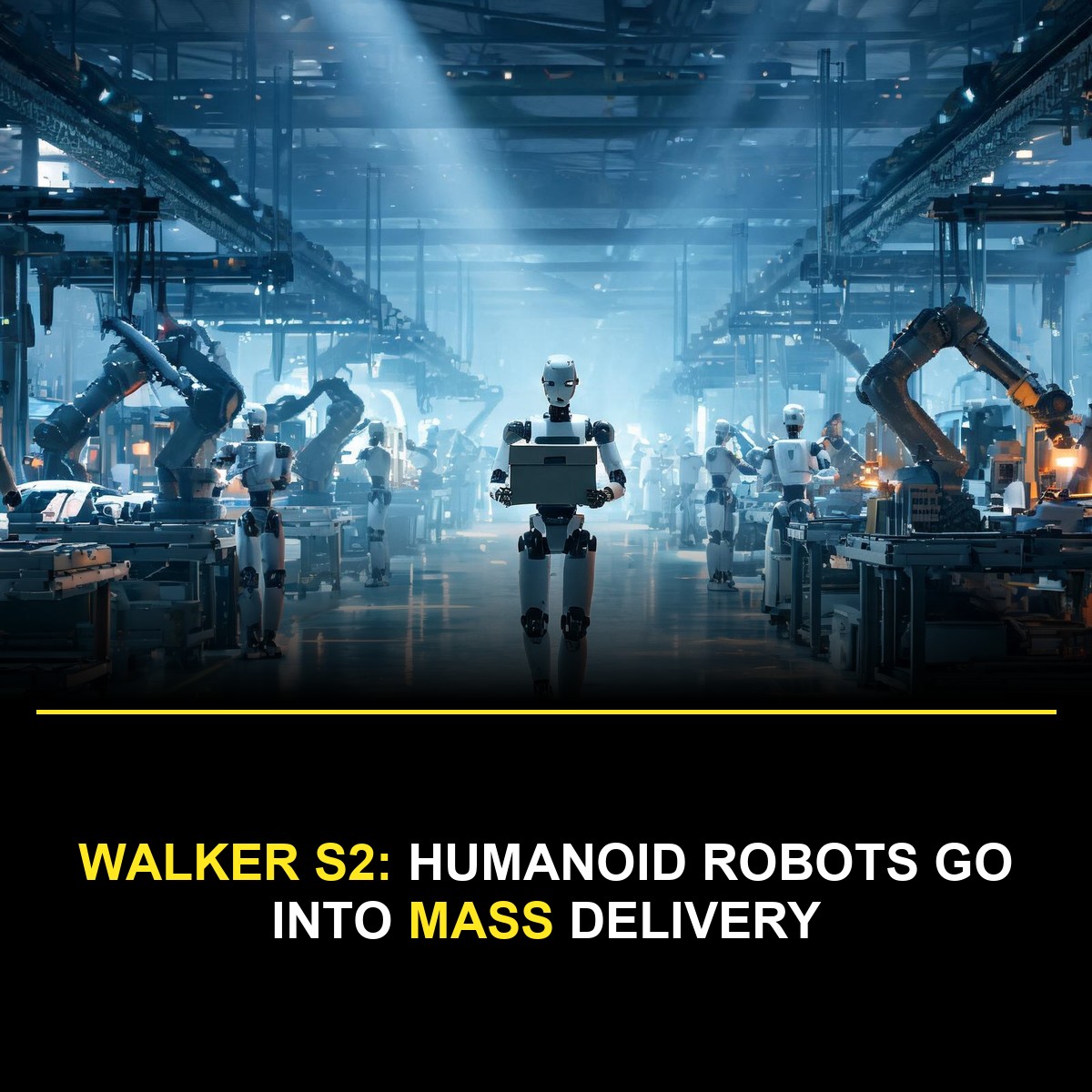
UBTECH has crossed the line that separates humanoid robots from demos to products with the Walker S2: mass production and delivery of the Walker S2, with the first batch of several hundred full-size industrial humanoids shipping to real factories and orders for the Walker series exceeding 800 million yuan, roughly 112 million dollars. The company's stated ramp is aggressive, from a 500-unit delivery target in the announcement year to an annual capacity of 5,000 robots in 2026 and 10,000 by 2027.
The milestone matters because it answers the question that has hung over the humanoid industry for a decade: can anyone manufacture these machines at volumes that resemble an industry rather than a laboratory? A shipment measured in hundreds, deployed across automotive plants, smart factories, logistics operations, and data collection centers, is the first credible yes.
This article covers what the Walker S2 actually does on a factory floor, the engineering choices that make round-the-clock operation possible, what the orders reveal about who is buying and why, and what mass delivery changes for the global race to industrialize humanoids.
What the Walker S2 is and what it does
The Walker S2 is a full-size industrial humanoid, roughly human-proportioned, built for the unglamorous work that factories struggle to staff: material handling, precision assembly tasks, sorting, and inspection across environments designed for human bodies.
Walker S2's physical capabilities center on a high-torque waist servo that lets the robot lift 15-kilogram payloads with a rotation range of plus or minus 162 degrees, plus a whole-body dynamic balancing system that enables deep squats and stooped lifting across a workspace reaching from the ground to 1.8 meters. Those numbers describe the actual job, which is picking things up from low places and putting them in high places, all day, without injury.
The Walker S2 perception stack uses pure RGB binocular stereo vision in the head, with self-developed deep-learning depth estimation producing dense depth maps in real time. The company describes the result as human-eye stereoscopic perception, and the design choice is deliberate: passive stereo cameras are cheap, robust, and scalable in manufacturing compared with lidar or exotic sensors, which matters enormously when the product itself must be manufactured by the thousands.
The intelligence layer is where UBTECH has differentiated Walker S2 hardest. Walker S2 ships with Co-Agent, described as the first industrial agent system integrated into a humanoid, intention understanding, task planning, tool usage, and autonomous anomaly detection and handling, wrapped in a dual-loop architecture with the BrainNet 2.0 platform coordinating task-driven swarm intelligence across multiple robots on a production line. The swarm framing is the strategic insight: the unit of deployment is not one robot but a coordinated fleet, sharing scene understanding and dividing tasks the way a human crew does.
The battery swap is the quiet masterstroke
The Walker S2 feature that makes continuous industrial operation possible is also the least glamorous: it is the first humanoid robot capable of autonomous battery swapping.
The Walker S2 robot carries dual batteries and can hot-swap them autonomously in about three minutes, with real-time battery monitoring and dynamic power management choosing between swap and charge modes based on task priorities. The dual-battery design supports both dual-battery and single-battery working modes, so the robot trades endurance against payload weight as the job requires.
The significance is arithmetic. A humanoid working an eight-hour shift needs roughly eight hours of charging, which either doubles the fleet size or strands robots at chargers during peak demand. Swap stations turn energy into a logistics problem instead of a scheduling one: robots rotate through swaps like forklifts through battery bays, and the line never waits for a charge. Every industrial robot before Walker S2 operated on a duty cycle bounded by its battery; Walker S2's 24/7 continuous operation claim rests entirely on this system, and it is the difference between a machine that augments a shift and one that replaces the shift's constraint.
The engineering risk in hot-swapping Walker S2, briefly unpowered moving robot with exposed electrical contacts, was solved with dual-arm coordinated precision swapping, which is exactly the kind of manipulation task the robot exists to perform anyway. The battery system is, in effect, the product demonstrating its own core skill on itself.
Who is buying, and what the orders say
The Walker S2 order book tells you more about the industry's direction than any roadmap does.
Since early in the announcement year, the Walker series accumulated more than 800 million yuan in orders, including a record 250-million-yuan contract in September and a 159-million-yuan deployment at a data collection center in Zigong, the year's second-largest. The buyer list is the meaningful part: BYD, Dongfeng Liuzhou Motor, Geely Auto, FAW-Volkswagen Qingdao, Audi FAW, BAIC New Energy, Foxconn, and SF Express. These are not Walker S2 innovation-theater pilots; they are among the largest automotive manufacturers and logistics operators on earth, putting humanoids on or adjacent to actual production lines.
The data collection center deployment deserves particular attention, because it reveals the flywheel strategy. Humanoid robots improve by practicing tasks in real environments, and real environments generate the training data that improves them. A facility whose purpose is generating robot training data, staffed by robots collecting that data, is the industry building its own learning loop at industrial scale, and UBTECH's closed-loop framing of technology, application, delivery, and iterative improvement states it plainly.
The revenue figures contextualize the scale. The company reported 1,079 full-size humanoids sold in the prior year, with humanoid segment revenue up more than twenty-fold year over year, and 921 full-size units sold in the first half of the current year alone. Growth of that shape, hundreds of units per half becoming thousands per year, is the signature of a product crossing from early adoption into the steep part of the curve, with per-unit economics around 100,000 dollars of revenue implied by the segment math.
The turnkey shift is the actual product strategy
The most strategically revealing claim in the Walker S2 mass delivery announcement is easy to miss: UBTECH describes shifting from delivering products to delivering full operational capabilities, a standardized, replicable turnkey solution.
This is the classic industrial-equipment playbook. A factory buying its first humanoid fleet does not know how to integrate one; the vendor who arrives with scenario templates, training systems, deployment methodology, and the Co-Agent software stack sells certainty, not hardware. The turnkey approach converts every deployment into a repeatable template for the next customer in the same industry, which is how you scale from hundreds to thousands without bespoke integration eating the margin.
The Walker S2 customer-training component matters as much as the robot. Humanoid adoption succeeds or fails on whether the existing workforce can supervise, redirect, and trust the machines, and a comprehensive user-training system bundled into delivery acknowledges that the deployment unit is robot plus people plus process.
It also frames the competitive race correctly. Western humanoid companies, led by firms like the warehouse-focused players and the automotive-adjacent startups, are racing on model intelligence and hardware capability, with commercial deployments measured in dozens of units and long pilot cycles. UBTECH's move changes the question from whose robot is smartest to whose deployment machine scales fastest, and volume manufacturing of thousands of units per year is a different competency than building the best single robot. China's supply chain advantages in actuators, batteries, and precision manufacturing feed directly into that race, and the 5,000-unit annual capacity target is a statement about which competition UBTECH thinks it can win.
Inside the swarm intelligence architecture
The software architecture coordinating Walker S2 fleets is the part of the system most observers overlook, and it is where the long-term value concentrates.
The dual-loop design pairs BrainNet 2.0, the coordination platform, with Co-Agent, the per-robot intelligence. The robot-level loop handles the immediate: understand the instruction, plan the task sequence, use tools, detect that something has gone wrong, and handle the anomaly autonomously, from a dropped part to a jammed conveyor interaction. The fleet-level loop handles the collective: decomposing production-line work across multiple robots, sharing scene understanding so one machine's observation updates the others' models, and rebalancing tasks as conditions change across the shift.
Task-driven swarm intelligence is the phrase that separates this from remote-operated or pre-programmed automation. The robots are not executing a fixed choreography; they receive production goals and negotiate the division of labor, with the coordination layer resolving conflicts the way a shift supervisor would. When one robot's battery runs low, the system routes its tasks to peers and queues a swap; when a new part geometry appears, the perception stack updates across the fleet rather than requiring each unit to relearn.
The architecture also explains the turnkey economics. A software-defined fleet improves with every deployment: new task templates, new failure-handling behaviors, and new perception cases accumulate centrally and propagate outward, so the thousandth robot ships more capable than the first without a hardware change. That compounding is the moat, and it is why the data collection center order, 159 million yuan for a facility generating training data, is best understood as infrastructure investment rather than an odd purchase.
For factory operators, the practical consequence is that the fleet gets better while you own it, which inverts the usual depreciation story of industrial equipment and begins to justify the capital cost in terms finance teams can model.
What mass delivery changes for the industry
The first mass delivery of humanoid robots is a checkpoint that reframes several industry debates in real terms.
The labor question becomes concrete. Hundreds of robots in automotive plants and logistics operations mean real displacement and real augmentation are now measurable rather than forecast, and the industry's claims about addressing labor shortages will be tested against actual deployment data rather than projections. The safety and standards questions mature with it: hundreds of full-size humanoids moving through human workspaces require the industrial safety frameworks that the sector has been drafting, and volume deployment is what forces those frameworks from paper to practice.
The economics question sharpens too. Mass production drives unit costs down the classic learning curve, and every douard of volume makes the humanoid cheaper relative to the labor it substitutes, tightening the business case with each production run. The industry's long-standing joke that humanoids are always five years away now has a visible counterexample shipping in quantities that make the five-year horizon concrete rather than perpetual.
For watching observers, the signals that matter over the next year are the delivery-actuals versus capacity-targets gap, which will reveal whether 5,000 units is manufacturing reality or ambition; the expansion of buyer logos beyond automotive into logistics, 3C manufacturing, and services; and the first published reliability metrics, downtime hours per robot per month, which will quantify whether the machines can hold the 24/7 claim the battery system was built to enable.
For readers tracking the automation wave, the warehouse-scale parallel is covered in our Sailboxes persistent agent compute analysis, the software-agent workforce behind these robots' intelligence is examined in our Orca coding agents coverage, and the embodied AI model layer is unpacked in our WeVisOne-VL analysis.
What a day on the line looks like
Concrete deployment detail is scarce in vendor material, but the announced use cases allow a reasonable reconstruction of what Walker S2's workday involves.
The Walker S2 shift begins at a swap station, not a charging dock: the robot rolls to the bay, swaps its battery pack in about three minutes, and receives its task allocation from the coordination layer, a manifest of pick, place, and ferry operations tied to the line's production schedule. On the floor Walker S2 works the areas between fixed automation, the zones where conveyors and robot arms end and human-shaped gaps begin: carrying totes between stations, loading components into fixtures, stacking finished bins, and performing the low lift, high reach movements the waist servo and 1.8-meter workspace were built for.
The anomaly handling shows up in the exceptions. A part arrives misoriented; the vision system registers it and the planning layer decides between correcting the grasp, flagging the station, or routing around. An obstacle appears in the path; the fleet model updates and the traffic plan rebalances. A battery approaches its threshold mid-task; the Walker S2 robot completes the current pick, hands off the remainder, and walks itself to a swap. None of this requires a human, which is the operational point: the shift runs until the schedule says otherwise.
The human role concentrates in supervision and exception escalation, and the training system exists to build exactly that competence on the factory's side. The buyer's maintenance team learns the swap stations, the fleet dashboard, and the escalation paths; the production team learns to read the task board and to trust, gradually, the robots' autonomous handling of the routine 99 percent.
What remains genuinely hard for Walker S2 is the long tail: novel objects, degraded lighting, layout changes after retooling. That is where the deployment data feeds back, and where each additional factory of robots makes the next one's software better.
The global race context
The Walker S2 milestone lands in a global competition with two distinct strategies, and the contrast defines the next five years of the industry.
The Chinese approach, which UBTECH embodies, is volume first: leverage the world's deepest supply chain for actuators, harmonic reducers, batteries, and precision manufacturing, get robots into factories in meaningful quantities, and let deployment data drive the intelligence flywheel. The state-level support for the sector, capacity targets, and buyer concentration among Chinese automotive giants all point the same direction, and the 5,000-to-10,000-unit capacity roadmap is credible precisely because the component ecosystem exists at scale today.
The Western approach, led by American startups with billions in backing, is intelligence first: build the most capable model and the most general-purpose machine, prove it in pilots, and scale once the robot justifies itself broadly. The bet is that generality wins the market when it arrives, and that early volume on narrow tasks is a trap that locks the industry into cheap, limited machines.
Both theses cannot fully win. If narrow Walker S2 competence plus volume creates the data flywheel that produces generality, the Chinese strategy reaches the destination first with revenue funding the journey. If generality requires architectural breakthroughs that only accumulate in the lab, the Western path wins with fewer deployed machines but better ones. The honest answer is that the Walker S2 flywheel and the breakthrough probably matter together, and UBTECH has just demonstrated with Walker S2 that the flywheel side is no longer hypothetical.
Purchasers face the practical version of this choice now: a robot fleet available today with structured-task competence and a scaling vendor, or a wait for machines with broader capability and a thinner deployment track record. The factories signing nine-figure orders have voted, for now, with their procurement.
Questions readers are asking
Is Walker S2 really the first mass-produced humanoid?
It is the first full-size industrial humanoid with announced mass production and delivery in the hundreds of units, a claim no other company has matched with equivalent volumes. Western competitors have impressive machines and smaller pilot fleets; the volume milestone is UBTECH's.
What does Walker S2 cost?
UBTECH has not published list prices. Segment revenue divided by units shipped implies roughly 100,000 dollars per robot across the product line, consistent with industrial-equipment rather than consumer pricing.
What jobs are these robots doing?
Material handling, precision handling and assembly, sorting, and inspection in automotive plants, smart factories, logistics, and data collection centers, the repetitive physical tasks that factory floors designed for human bodies require.
Does this mean humanoid robots will replace workers soon?
Mass delivery makes replacement measurable, but the deployed tasks remain narrow: repetitive handling in structured environments. The trajectory is augmentation of structured industrial work first, with broader capability a function of the data flywheel these deployments feed.
Sources
- UBTECH Walker S2 product page and specifications: https://www.ubtrobot.com/en/humanoid/products/walker-s2
- UBTECH industrial humanoid robot solutions: https://www.ubtrobot.com/en/humanoid/solutions/industry
- UBTECH official announcements: https://www.ubtrobot.com/en/news
- International Federation of Robotics industrial robot statistics: https://ifr.org/worldrobotics