Alexa+ Hardware: Five New Echo Devices for the AI Home
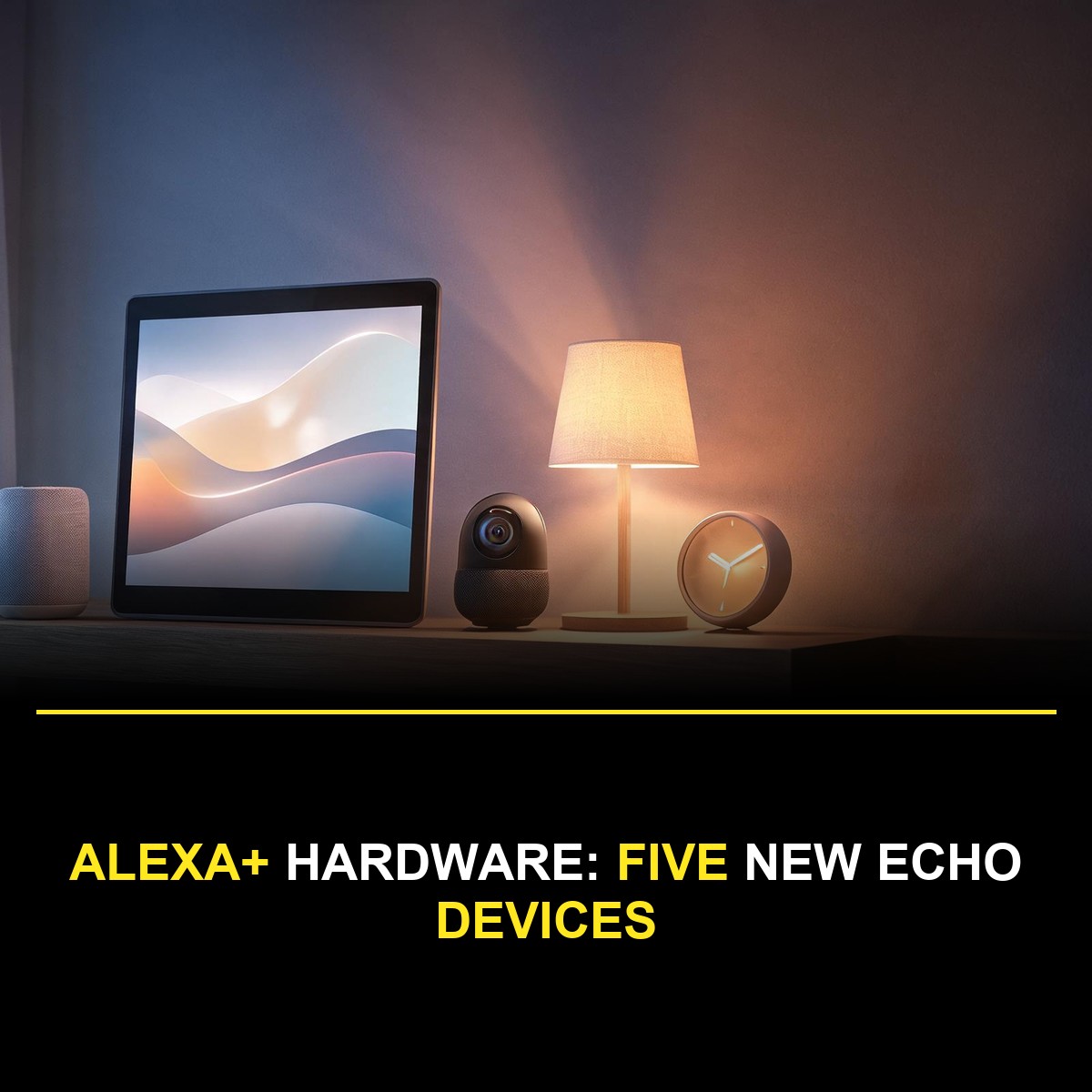
Amazon announced five new Alexa devices on October 28, all built around the Alexa+ assistant generation, and the lineup is the hardware half of the Alexa+ strategy: a redesigned Echo Show 16, a bedside clock with sleep sensing, a photo frame with the assistant built in, a new Echo Dot that doubles as a smart home hub, and an Echo Studio that can see the room it is playing music in.
The context matters as much as the products. Amazon reports that users of Alexa+ talk to Alexa two to three times more often and ask it to do more complex things, and this hardware exists to catch that usage: Alexa+ devices purpose-built for the moments where the assistant earns its subscription rather than the speakers that shipped when Alexa answered only timers.
This article covers each of the five devices with prices and the details that matter, the on-device AI silicon inside the new Dot, why the Echo Studio with a camera is the boldest product in the group, the subscription economics that tie it all to Prime, and how the lineup positions Amazon against Google in the fight for the home.
Echo Dot: the Alexa+ hub upgrade nobody expected
The new Echo Dot ships today at 99.99 dollars, and its two quiet additions matter more than its sound.
For the first time, the Dot includes a built-in smart home hub, connecting to thousands of compatible lights, locks, and thermostats out of the box rather than requiring a separate bridge. It also functions as an eero Wi-Fi extender, adding up to 1,000 square feet of network coverage, which turns a 99 dollar speaker into a mesh node for homes with dead zones.
Inside is Amazon's custom AZ3 silicon with a dedicated Alexa+ AI accelerator that runs conversational detection and background noise filtering on-device. That is the meaningful architectural change: the always-listening layer moves to local silicon, reducing latency and keeping routine processing in the home rather than the cloud, while the heavy reasoning still runs on Amazon's servers.
Sound improves too, with 50 percent more bass than its predecessor and crisper vocals, and Kids versions at 109.99 dollars include a year of Amazon Kids+. The Echo Dot has always been Amazon's volume product, and giving it hub and mesh duties makes it the default purchase for anyone starting a smart home rather than the cheap add-on it was.
Echo Studio with Home Camera: the Alexa+ speaker that looks back
The Echo Studio with Home Camera is the lineup's boldest product, and its 249.99 dollar price buys the most controversial capability in the group.
The audio side is familiar: Amazon's best-sounding speaker with a high-excursion woofer, Dolby Atmos spatial audio, and new Advanced Room Adaptation that continuously tunes output to the room. The new part is a camera that gives Alexa visual awareness of its surroundings, enabling real-time assistance such as explaining the rules printed on a board game box held up to the camera, recognizing a cereal box to reorder it, or letting a user check in on the room remotely from the Alexa app.
Amazon also plans to pair the Studio with compatible Fire TVs for video calling on the biggest screen in the home, which turns the speaker into a conferencing endpoint rather than a music device.
The product asks a privacy question that buyers will answer individually. A speaker with a camera is a different proposition from a speaker with a microphone, and Amazon is betting that usefulness, product recognition, room monitoring, and video calls, outweighs the discomfort for enough households. The Echo Show line has already proven that screens with cameras sell; a camera in a speaker is the next step in that argument.
The plain Echo Studio remains available at 219.99 dollars for buyers who want the audio without the lens.
Echo Time: the Alexa+ wellness turn
Echo Time is the surprise of the Alexa+ lineup, a 199.99 dollar bedside clock with sleep sensing that has earned the National Sleep Foundation's SleepMark.
The device is camera-free by design, which matters for a product that sits beside a bed. Its display offers hundreds of clock faces, from analog to playful and weather-themed, and its alarm behavior is the feature: Omnisense sleep sensing detects when the user is in lighter sleep and wakes them within a 10 to 60 minute window before the scheduled alarm, while the display brightens gradually to simulate sunrise and the tone builds gently.
That is sleep science from the wearables market migrating into a stationary device, and the absence of a wearable requirement is the differentiator. Users who dislike sleep rings and watches get the same gentle-wake functionality from a clock, and the SleepMark certification indicates evidence-based standards rather than a marketing claim.
Amazon Kids Echo Time starts at 209.99 dollars with a year of Kids+. The bedside is the most personal surface in the home, and Alexa+ entering it with a camera-free design is a deliberately careful choice that contrasts with the camera-bearing Studio.
Alexa Photo Frame: the assistant in disguise
The Alexa Photo Frame is the most consumer-friendly Alexa+ product in the group, and it is likely to outsell its more technical siblings.
It is the first photo frame with Alexa built in, pairing a 10-inch anti-glare touchscreen with Amazon Photos, which syncs pictures automatically as they are taken. The intelligence layer is the differentiator: Alexa surfaces the shots worth seeing, the ones where people are smiling and the season matches, and skips screenshots and clutter, and users can ask to see photos of a specific person, pet, or trip rather than scrolling.
Digital frames have been a stagnant category for a decade, sold on screen size and storage. Adding the assistant and intelligent curation turns the frame into an active display that answers questions and surfaces memories, which is a genuine upgrade to the product concept rather than a screen with Wi-Fi.
The frame also fits the gift market that made the original Echo Dot a phenomenon, and its design language, timeless frame, hidden intelligence, is aimed at buyers who never wanted a visible gadget in their living room.
Echo Show 16: the family dashboard
The all-new Echo Show 16 is the Alexa+ flagship, starting at 499.99 dollars or 569.99 with the Nanomatte display, on preorder with a 100 dollar discount.
The redesign centers on a 16-inch full HD screen that is nearly 40 percent thinner with 10 percent more viewing area, driven by 20 percent more processing power. The Nanomatte option cuts glare by more than 90 percent, addressing the reflection problem that has limited smart displays in bright rooms since the category began.
Screen Styles transform the device into what a household needs: a family organizer with color-coded calendars, chores, and meal plans; a digital photo frame; or a smart home dashboard with the new Alexa Home Map showing every light, lock, thermostat, and camera at its location in the house. Fire TV is built in, eliminating the need for a separate streaming box, and the camera is Amazon's best on an Echo Show with the widest field of view, auto-framing, and first-ever night vision for Live View at any hour.
Amazon reports the Echo Show line growing more than 25 percent year over year, which explains the investment: displays are the growth product in the Echo range, and the Show 16 is positioned as the kitchen and family room anchor that justifies its price through what it replaces, a TV, a dashboard, and a speaker.
The Alexa+ subscription economics
Every device in the lineup runs the latest Alexa, which holds natural conversations, reasons through multi-step requests, asks clarifying questions, and organizes conversations into Cards that persist across Echo devices, the Alexa app, and Alexa.com.
Certain features require Alexa+, which is included with a Prime membership and priced at 19.99 dollars monthly without it. That structure is the revenue model for the entire hardware line: devices sold to build the installed base, intelligence sold monthly, and the Prime relationship doing the bundling work that a standalone subscription would struggle with.
The strategy mirrors what Google did with the Google Home Speaker and its Premium tier, and the two companies are now running the same playbook with different bundles: Amazon ties the assistant to retail membership, Google ties it to camera and home services. The household that subscribes to both is paying roughly 40 dollars a month for home intelligence, which is a new line item in the family budget that did not exist two years ago.
The Cards feature deserves explanation because it changes how conversations persist. Alexa organizes each interaction into a card, a visual record of what was asked and what was done, and those cards follow the user across surfaces: start a request on the Show 16, continue on the Alexa app in the car, finish at Alexa.com on a desktop. That continuity is what makes an assistant feel like a service rather than a device, and it is the feature most likely to keep users inside Amazon's ecosystem once they experience it.
The five-device Alexa+ strategy also spreads the assistant across contexts rather than concentrating it: the Dot for entry, the Studio for the living room, Echo Time for the bedroom, the Photo Frame for the quiet surfaces, and the Show 16 for the kitchen. A household that adopts the full set interacts with the assistant in every room without repeating itself, because the Cards and account tie the experiences together.
For buyers, the practical guidance is to price the hardware plus the subscription they intend to keep. An Echo Dot without Alexa+ is a good 99 dollar speaker with local smart home control; the reasoning assistant that defines this generation requires the membership.
What the AZ3 silicon means for the Alexa+ smart home
The custom AZ3 chip with its AI accelerator is the least discussed part of the announcement and the most consequential for how Alexa behaves in daily use.
On-device processing means the always-listening layer, wake word detection, conversational intent classification for simple commands, and noise filtering, runs locally on the speaker rather than streaming audio to the cloud for every interaction. That reduces the round trip for common commands, keeps routine audio processing inside the home, and reduces the bandwidth a house full of speakers consumes.
The architecture also improves reliability in degraded network conditions, which is the failure mode that has always frustrated smart home users: a speaker that stops responding when the internet blips breaks the promise of voice control. Local handling of device control commands keeps lights and thermostats responsive regardless of the connection, with the cloud reserved for reasoning-heavy requests.
The competitive frame is Google's and Apple's, both of which moved to hybrid local-cloud assistant architectures in the past year. The industry has converged on the same answer: local silicon for speed and privacy on routine work, cloud models for reasoning. Amazon shipping AZ3 across its lineup brings it to parity on architecture, and the Dot's price point puts that architecture at the entry tier rather than only on premium devices.
For households, the practical effect shows up as faster responses, fewer misheard commands in noisy rooms, and smart home control that survives outages, which are the three complaints that have defined the category's reviews for a decade.
Alexa+ prices in a rising-cost market
The Alexa+ hardware lineup lands in a market where component costs are climbing, and the price points reflect that reality.
Entry prices across the Echo range have moved upward against their predecessors, consistent with the industry-wide pressure from memory and component costs, and the flagship Echo Show 16 at 499.99 dollars positions the top of the line well above the previous generation's pricing. Amazon is absorbing some of the increase through subscription economics and premium materials rather than cutting specifications.
For buyers, the relevant comparison is not against last year's prices but against the alternatives at the same price. A 99 dollar Echo Dot with a hub, mesh Wi-Fi, and on-device AI is a different product from the 50 dollar Dot it effectively replaces, and the value case depends on whether the buyer needs those functions.
For readers tracking the cost forces behind these prices, the component economics are examined in our memory shortage analysis, the Google counterpart is covered in our Google Home Speaker piece, and the on-device AI silicon in the new Dot connects to the edge inference story in our GPT-6.1 Terra analysis.
The smart home map feature deserves attention
The Alexa Home Map in Echo Show 16 is the feature most likely to change how families interact with their devices, and it is worth explaining.
The map shows every connected light, lock, thermostat, and camera positioned at its actual location in the house, turning device control from a list into a floor plan. A family member taps the lamp icon on the map rather than remembering which room a device name corresponds to, which removes the naming conventions that have made voice control confusing in multi-device homes.
Combined with Screen Styles, the Show 16 becomes a household surface rather than an individual device: calendars, chores, and meal plans for the family, with the home map beneath them. That positioning targets the kitchen counter, the place where family coordination actually happens, and it explains the 16-inch size and the 499.99 dollar price.
The feature also deepens the switching cost. A household that builds its device layout into a visual map, configures routines, and organizes calendars on a Show has a reason to stay in the Amazon ecosystem that no individual speaker provides. The hardware is the surface; the configuration is the lock-in.
For buyers considering the Show 16, the honest evaluation is whether the household wants a coordination surface at all. Families with children and busy schedules get the most from it, and single users or couples without children may find the 16 inches underused at that price.
The Alexa+ Google and Apple comparison
The Alexa+ hardware arrives into a home market where the three ecosystems have now each made their move, and the comparison is clearer than it has been for years.
Google counters with the Google Home Speaker at the same 99.99 dollar entry price and Gemini for Home, whose reasoning quality is the strongest in the category, plus a Premium subscription that unlocks camera intelligence and free-form conversation. Apple has no smart speaker refresh this year, and its home strategy runs through the HomePod line and the Apple ecosystem's privacy positioning, which appeals to a different buyer than the multi-vendor smart home.
Amazon's differentiation is breadth. Five Alexa+ devices covering every room and context, the largest third-party device catalog, retail distribution that no competitor matches, and a subscription bundled with Prime, a membership tens of millions of households already pay for. The Alexa+ strategy monetizes that breadth, and the hardware refresh gives the subscription something to run on in every room.
The honest assessment is that the assistant race is now a subscription race with hardware as the distribution mechanism. All three ecosystems price their best intelligence monthly, all three use local silicon for routine work, and all three are betting that households will pay recurring fees for home intelligence the way they pay for streaming. The 2026 holiday season is the first test of that bet at scale.
Questions readers are asking
How much do the new Echo devices cost?
Echo Dot at 99.99 dollars, Echo Studio at 219.99 or 249.99 with Home Camera, Echo Time at 199.99, the Alexa Photo Frame at a price announced with availability, and Echo Show 16 from 499.99 dollars, or 569.99 with Nanomatte, on preorder with 100 off.
Is Alexa+ included?
Alexa+ is included with a Prime membership and costs 19.99 dollars per month without it. Certain features across the new devices require Alexa+.
Which device is the best starting point?
The Echo Dot, because its built-in smart home hub, eero mesh extension, and on-device AI make it the foundation of an Alexa home, with larger devices added as needed.
Does the Echo Studio camera record constantly?
Amazon describes the Alexa+ visual awareness as real-time assistance and remote check-in, and buyers with privacy concerns should review the device's privacy settings and the camera shutter options before purchase.
Sources
- Amazon announcement of the new Alexa device lineup: https://www.aboutamazon.com/news/devices/new-alexa-devices-2026
- Amazon Echo device catalog: https://www.amazon.com/b?ie=UTF8&node=210779651011
- Echo Show 5 with Alexa+ retail listing: https://www.bestbuy.com/product/amazon-echo-show-5-newest-model-smart-display-with-alexa–2x-the-bass-and-clearer-sound-charcoal/J39QV8CYLF
- Alexa+ service information: https://www.alexa.com/