Vivo X500: 200MP Periscope Reaches India Nov 25
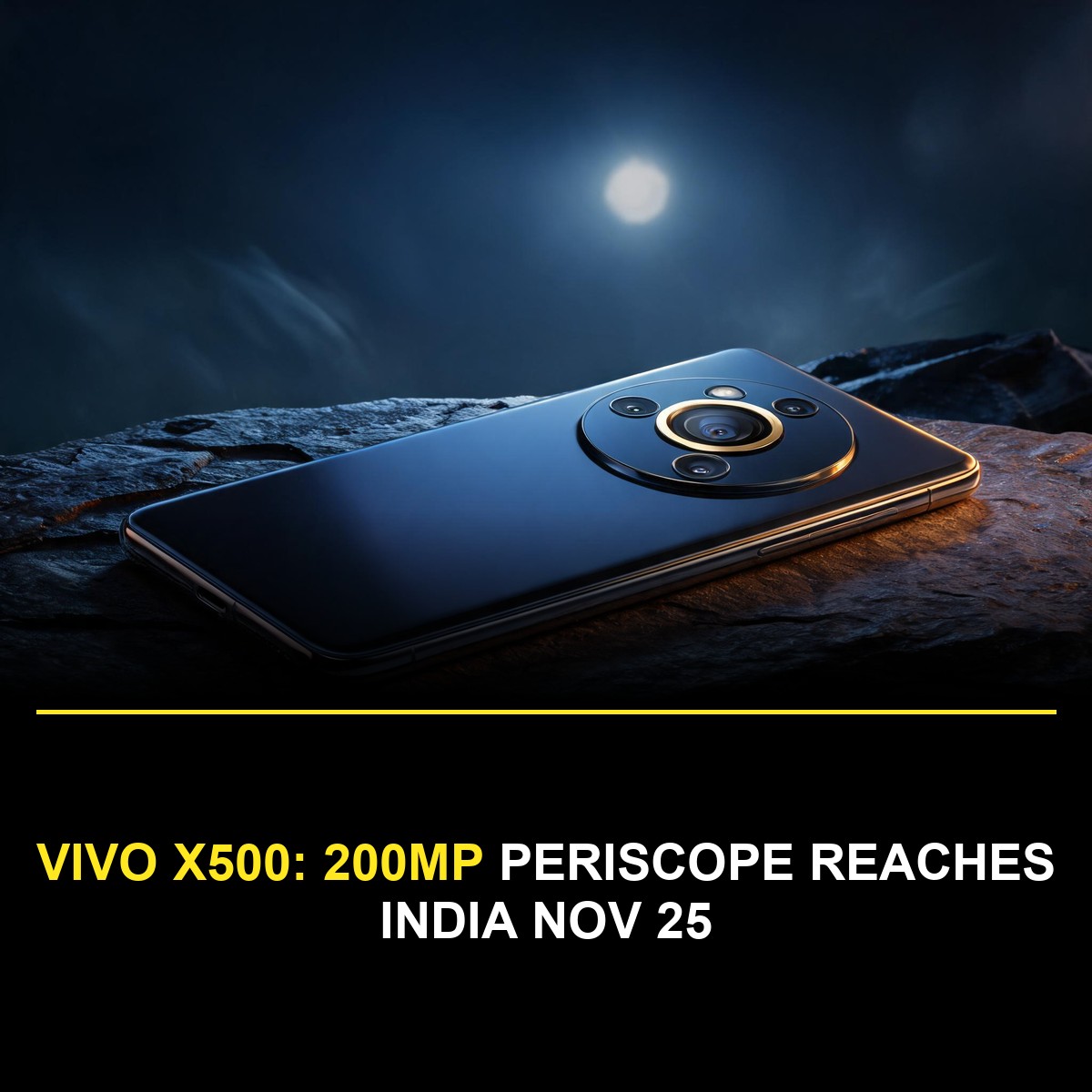
The Vivo X500 series is expected to reach India on November 25, bringing a flagship camera hierarchy that competes at the very top of the market. and the phone that matters most in the lineup is the Pro Max, because it carries a 200-megapixel periscope telephoto camera alongside a 2K 144Hz display and a battery approaching 8,000 mAh. Three phones are in play, the X500, X500 Pro, and X500 Pro Max, and all three have already appeared in India's BIS certification database under model numbers V2619, V2621, and V2610.
Caution is the operative word for the Vivo X500 India launch. Vivo has not officially confirmed the date, the lineup, or any Indian price, and the figures circulating online, roughly 79,000 rupees for the X500, 93,000 for the Pro, and one lakh for the Pro Max, are converted Chinese prices rather than announced ones. Pre-bookings at select offline stores were reported by a single tipster on November 3, without named stores or deposit details.
That uncertainty is worth stating plainly because the Vivo X500 series is already real. It launched in China in late September and globally on October 27, so this is not a rumor about unreleased hardware. It is a rumor about when already-shipped phones reach one specific market, which is a different and more reliable kind of leak.
This article covers what each Vivo X500 model actually offers, why the 200-megapixel telephoto is the series' defining feature, what the 2-nanometer Dimensity 9600 generation delivers, why the battery sizes tell a story about where phones are heading, and what an Indian buyer should reasonably expect on pricing.
The Vivo X500 lineup, model by model
The Vivo X500 series spans three sizes and two chipsets, and the differences are more meaningful than the shared design suggests.
The standard Vivo X500 carries a 6.59-inch 1.5K AMOLED display running at up to 144Hz, MediaTek's Dimensity 9600M, and a three-camera array of a 50-megapixel main sensor, a 50-megapixel ultrawide, and a 64-megapixel periscope telephoto. Its 7,500-mAh battery is larger than the Pro's, which is the first sign that battery size no longer tracks with price tier.
The Vivo X500 Pro is the compact flagship, with a 6.36-inch 1.5K AMOLED panel at 144Hz and the step-up Dimensity 9600 Pro. Its cameras match the standard model on paper, 50-megapixel main, 50-megapixel ultrawide, and a 64-megapixel periscope with 3.5x optical zoom, and its 6,510-mAh battery is the smallest in the series, which is the honest cost of a smaller body.
The Vivo X500 Pro Max is the flagship, with a 6.85-inch 2K AMOLED at 144Hz, the Dimensity 9600 Pro, and the camera that headlines the series: a 50-megapixel main sensor, a 50-megapixel ultrawide, and a 200-megapixel periscope telephoto. Its global version carries a 7,800-mAh battery, with the Chinese model at 8,000 mAh. All three phones support 90-watt wired and 40-watt wireless charging and run OriginOS 7 on Android 17.
What is notable about the Vivo X500 table is what is absent. There is no separate Pro camera system and a Pro Max camera system plus everything else; the Pro Max differs from the Pro primarily in display size, battery, and the telephoto sensor. Vivo is concentrating its differentiation in fewer places than the traditional four-model strategy, which makes the buying decision cleaner.
The 200-megapixel periscope is the real argument
The Vivo X500 Pro Max telephoto deserves its own examination, because 200 megapixels on a periscope is not just a number increase over 64.
The approach is the one Samsung pioneered on its Ultra models: use a very high-resolution sensor so that cropping is the zoom. At 3x optical magnification the full sensor area is used, and at longer reaches the phone crops into the center, retaining detail that a 64-megapixel sensor loses sooner. The 200-megapixel figure means usable images at 6x, 12x, and beyond, with generative enhancement extending reach further in the same way Google and Samsung implement theirs.
Vivo pairs the sensor with Zeiss optics and its APO certification for the telephoto, the same partnership that has defined the X series' camera identity for several generations. Zeiss involvement covers lens design and color science rather than manufacturing alone, and it is the reason Vivo's flagships have climbed from good to consistently excellent in blind camera comparisons over the past three years.
The honest caveat is that megapixels on a small sensor are a means, not an end. A 200-megapixel sensor with 0.56 micron pixels gathers less light per pixel than a 64-megapixel sensor with larger pixels, so the advantage shows up in daylight and long-range crops rather than in night photography, where the phone will pixel-bin down to a 12 or 16-megapixel mode anyway. Buyers who zoom a lot get real value; buyers who shoot indoors after dark get a phone that is no better than its main sensor.
That trade is defensible, and it is the same trade every high-resolution periscope makes. What makes the Vivo X500 Pro Max notable is that it brings the full implementation to a market where it has not been available before.
The 2-nanometer Dimensity generation
The Vivo X500 series is among the first phone families built on MediaTek's 2-nanometer Dimensity 9600 generation, and the silicon shift matters more than the marketing suggests.
A 2-nanometer process delivers transistor density improvements that translate into either more performance at the same power or the same performance at less power, and MediaTek has chosen the second path in its recent generations. The Dimensity 9600 Pro competes on sustained efficiency, which is what determines whether a 144Hz display drains a battery in four hours or eight.
The Chipset choice also frames the Apple-versus-Android performance conversation differently than it did two years ago. Snapdragon's 8 Elite Extreme Gen 6 leads on peak CPU performance, while MediaTek's flagship tier has closed the gap on graphics and often leads on efficiency, which is why phones like the Vivo X500 Pro Max can pair a 2K 144Hz panel with an 8,000-mAh-class battery and still claim all-day endurance.
The practical question for buyers is not which chip wins a benchmark. It is whether the phone sustains its display refresh rate and camera processing under load without throttling, and that answer depends on Vivo's thermal design as much as on MediaTek's silicon. Reviews of the Chinese and European units have been positive on that front, which bodes well for the India units since the hardware is identical.
The Vivo X500 Zeiss partnership and why it still matters
The Zeiss branding on the Vivo X500 series is easy to dismiss as marketing, and the honest assessment is more nuanced than either dismissal or endorsement.
The partnership covers optical design, coating specifications, and a color science profile that Vivo implements in its image pipeline. Lenses carry Zeiss T-star coating to control flare, the telephoto carries APO certification for apochromatic correction, which reduces color fringing at the edges of zoomed images, and portrait modes include Zeiss-style bokeh simulations modeled on specific classic lenses. Those are real engineering inputs, not stickers.
What Zeiss does not do is guarantee results. The sensor, the image signal processor, and Vivo's tuning decisions matter as much as the glass, and the X series' improvement over the past three generations tracked Vivo's own investment in processing as much as it tracked the partnership. The fair summary is that Zeiss provides a floor, consistent optics and a recognizable color signature, while Vivo's software determines the ceiling.
For buyers comparing against Samsung and Apple, the practical difference shows up in color rendering. Vivo's Zeiss profile produces warmer, more saturated images than the iPhone's neutral processing, and portrait backgrounds carry visible lens-character effects that some buyers love and others find artificial. Neither is correct, and the choice is aesthetic.
Battery sizes tell the story of the year
The battery figures across the Vivo X500 series, 7,500, 6,510, and 7,800 mAh, look like routine differentiation until you compare them with last generation.
Phones gained roughly 15 to 25 percent battery capacity across the flagship segment this year, driven by silicon-carbon anode chemistry that packs more lithium into the same volume. Vivo is a heavy user of that technology, and the Pro Max's 8,000 mAh in the Chinese model is among the largest capacities ever shipped in a mainstream flagship.
The Pro's smaller 6,510 mAh is the interesting data point. A compact flagship with a 6.36-inch display choosing 6,510 mAh would have been the segment's largest battery two years ago. Today it is the smallest in its own series, and Vivo made that choice to keep the phone thin rather than to give it the biggest cell, which is a design philosophy statement that some buyers will appreciate and others will not.
For Indian buyers of the Vivo X500 series, battery capacity has outsize importance because of network conditions. A phone that spends the day hunting for signal or switching between 5G bands consumes more power than the same phone on a stable network, and capacity is the buffer that absorbs that variance. A 7,800-mAh cell in the Pro Max is not just a comfort feature; it is a practical response to how the phone will actually be used.
The Vivo X500 Pro compact flagship problem
The Vivo X500 Pro specifications reveal a tension that defines the premium segment, and it is worth naming because it explains the phone's likely reception.
A 6.36-inch display and a 6,510-mAh battery make the Pro the compact option in a market where compact flagships are rare. Buyers who want a phone that fits one hand and a pocket have essentially two choices each year, the iPhone Pro in its standard size and whichever Android maker is willing to build small. Vivo is one of the few, and the Pro's specifications show the cost: the smallest battery in its own series and the same camera hardware as the cheaper standard model.
The camera duplication is the strangest part. The Pro costs more than the X500, runs the faster Dimensity 9600 Pro instead of the 9600M, and offers the same 50-megapixel main, 50-megapixel ultrawide, and 64-megapixel telephoto array. A buyer comparing the two phones finds the Pro's advantages in build refinement, thermal design, and chip speed, none of which show up in a spec sheet comparison and all of which show up in daily use.
That is a hard product to market, and it is why compact flagships keep disappearing. The buyers who want small phones are enthusiast minorities in every market, and the manufacturers who serve them do so partly for brand reasons and partly because the same chassis serves multiple SKUs. Vivo keeping a compact model in the X500 series is a signal that it values those buyers, and the price it sets for the Pro in India will show whether it expects them to pay a premium or a discount for the smaller option.
For most Indian buyers, the decision between the three models reduces to size and the Pro Max camera. The Pro is the phone for someone who wants flagship silicon in a smaller body, and that is a legitimate but narrow brief.
What Vivo X500 Indian pricing should look like
The converted Chinese prices are the wrong way to estimate Indian pricing, and the reasons are worth understanding before the launch.
China prices exclude the taxes and duties that apply in India, and Vivo's India pricing strategy has historically positioned the X series below its Chinese-equivalent conversion to compete with Samsung and OnePlus in the premium tier. The Pro Max launched in China at roughly 1,044 dollars, which converts to about one lakh rupees, but the Indian price could land anywhere from 90,000 to 1,10,000 rupees depending on how aggressively Vivo wants to place it against the Galaxy S26 Ultra and the iPhone 18.
The launch timing also matters commercially. November 25 places the Vivo X500 series after the festive season sales and before the year-end, a window where premium buyers have finished their Diwali purchases and the first wave of international reviews has informed the market. It is a deliberate slot rather than a slipped date, and the pre-booking reports suggest retail partners have already planned inventory around it.
Buyers waiting for this series should wait for the official announcement rather than pre-booking on rumor. The phones are identical to the ones already reviewed globally, so there is no hardware surprise pending, but the price and the variant lineup for India, which memory configurations and colors ship, remain unknown, and those details have historically changed the value equation for Vivo flagships in India more than any specification.
For readers tracking the camera competition this phone enters, the 200-megapixel periscope goes against Samsung's implementation described in our Motorola Signature 27 analysis, the component costs shaping every flagship price are examined in our memory shortage piece, and the on-device AI features these chips enable are unpacked in our GPT-6.1 Terra analysis.
The competition the Vivo X500 walks into
The Vivo X500 series does not launch into an empty market, and the comparison set determines whether the pricing works.
Samsung's Galaxy S26 Ultra carries the Snapdragon 8 Elite Extreme Gen 6, its own 200-megapixel-class periscope implementation, and the deepest carrier and service network in India. Apple's iPhone 18 Pro holds the premium tier's loyalty and resale value, and its camera pipeline remains the reference for video. OnePlus competes directly on price with fast charging and an OxygenOS experience many buyers prefer to OriginOS.
Vivo's differentiators are the periscope resolution, the Zeiss portrait rendering, battery capacity that exceeds both Samsung and Apple, and a design language that has matured into something genuinely distinctive. Against those, the software question is the recurring objection: OriginOS 7 is feature-rich and polished, and buyers coming from Samsung's One UI or stock Android describe an adjustment period rather than a defect.
The premium Android segment in India has consolidated around four credible choices, and each has a clear identity: Samsung for breadth and service, OnePlus for speed and price, Apple for the ecosystem, and Vivo for cameras and battery. The Vivo X500 series is a strong entry in the identity it has chosen, and the launch pricing will determine whether it is also a strong entry in value.
For buyers, the practical advice is to wait for Indian pricing and compare against the Samsung and OnePlus alternatives at the same price rather than against converted Chinese figures, because the value judgment only means something at real prices.
Questions readers are asking
When does the Vivo X500 series launch in India?
November 25 is the widely reported date, based on tipster reports and BIS certification listings, but Vivo has not officially confirmed it.
What is the India price?
No official price exists. Figures of roughly 79,000, 93,000, and one lakh rupees are converted Chinese prices, not announcements, and the actual pricing may differ once Vivo positions the series for India.
Which Vivo X500 model has the 200-megapixel camera?
The Pro Max. It pairs the 200-megapixel Zeiss periscope telephoto with a 6.85-inch 2K 144Hz display, the Dimensity 9600 Pro, and a 7,800-mAh global battery.
Is the standard X500 worth buying over the Pro?
For most buyers, yes. It has a larger 7,500-mAh battery than the Pro, the same 64-megapixel periscope, a bigger 6.59-inch display, and a lower expected price, with the Pro trading battery for compactness.
Sources
- Vivo official X500 series launch event page: https://vivo-official.com/pages/x500
- Vivo India product information: https://www.vivo.com/in/
- MediaTek Dimensity 9600 platform: https://www.mediatek.com/products/smartphones-2
- Zeiss camera partnership overview: https://www.zeiss.com/photooptics/en/consumer-products.html