Lumai Iris: Computing With Light to Cut AI Power 90 Percent
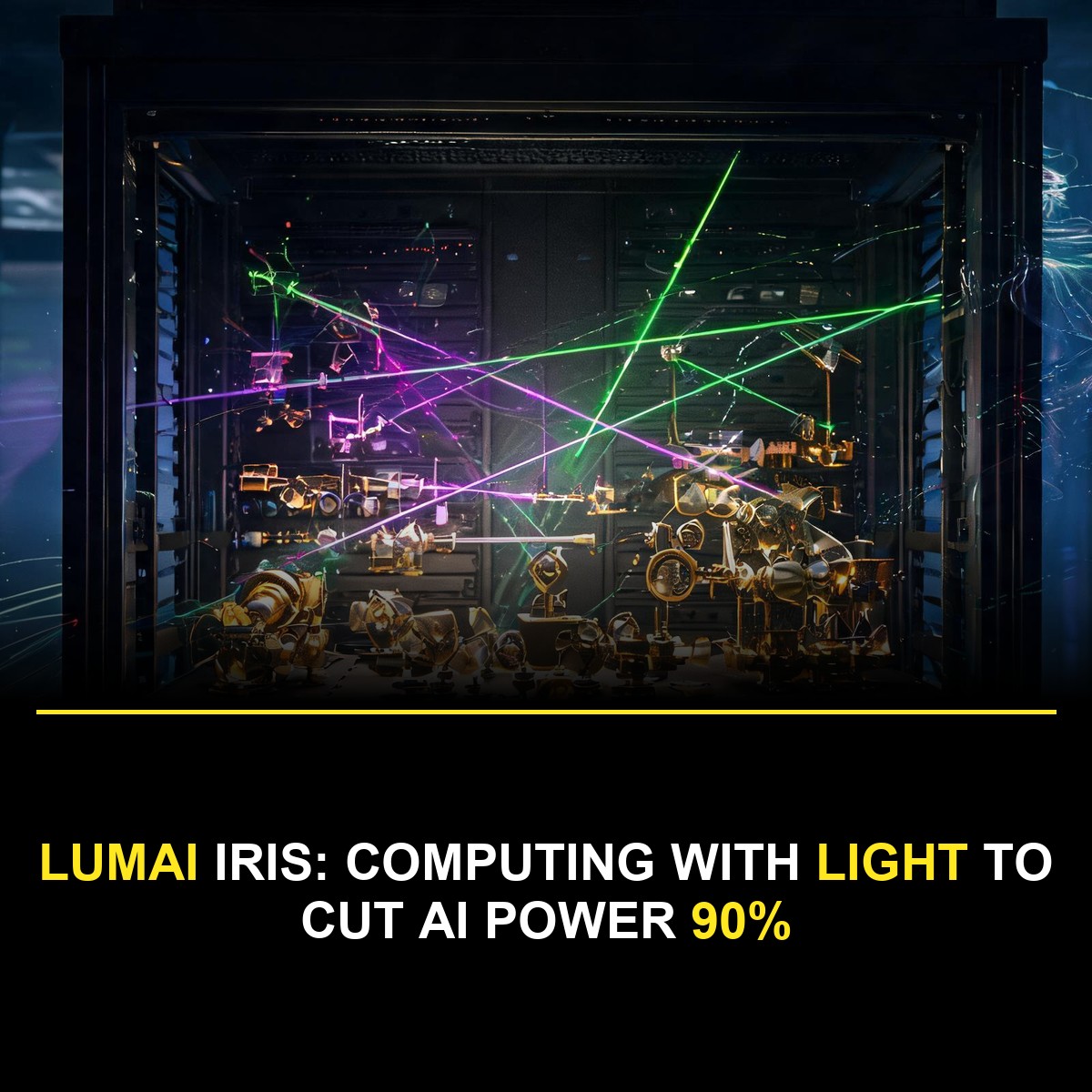
Lumai has moved optical AI computing from the laboratory into a commercial data center, with servers that compute with light instead of transistors, and the deployment is the first time optical AI inference has run at rack scale in a commercial data center. The Advanced Research and Invention Agency, known as ARIA, announced on November 3 that Lumai's Iris servers are now the first optical inference platform in its Scaling Inference Lab, where researchers will evaluate the technology on real workloads using standard power, cooling, and rack integration.
The claims attached to the hardware are large: up to 90 percent lower data center power consumption, around one tenth the total cost of ownership of GPU architectures, and at least 16 times better energy efficiency per inference than silicon-only systems when paired correctly. The honest caveat is equally important: those figures have not been independently verified at rack scale, and the lab doing the testing exists precisely to verify them.
The deployment matters because the constraint it addresses is now the binding one. Power, not chip supply or demand, has become the limit on how fast AI can be deployed, and a compute technology whose energy consumption barely rises as performance scales would change the arithmetic of the entire buildout.
This article explains how the Lumai optical compute works, why prefill is the workload it targets, the numbers that make the case, the sovereign angle behind the UK funding, and the honest assessment of what is proven and what remains a claim.
How computing with light works
The Lumai mechanism is genuinely different from silicon, and understanding it explains both the promise and the limits.
Conventional AI computation happens when transistors switch and move electrons through matrix operations, and every switch consumes energy that becomes heat. Lumai's approach encodes numbers as light intensity and performs matrix multiplication using passive optical components, lenses and beam combiners operating in three-dimensional space, where the physics of light interference does the math.
The energy profile follows from the physics. Passive optical components consume essentially no power while operating, so the computation itself uses a negligible amount of energy that barely rises as performance scales. A single optical cycle performs millions of matrix operations in parallel, which is the throughput claim: the light does the work that would require thousands of transistor cycles, simultaneously.
The limits are equally physical. Optical systems excel at the linear operations at the heart of neural networks, matrix multiplication, but nonlinear operations, memory access, and the sequential parts of computation still require silicon. The encoding precision of light intensity limits numerical accuracy compared with digital arithmetic. And the practical engineering, getting data in and out of the optical domain, packaging the optics, and manufacturing repeatably, is where optical computing startups have historically struggled.
Lumai's significance is that it has moved the technology from paper demonstrations to a product, Iris Nova, launched in April 2026 as the first optical AI accelerator engineered for datacenter scale, now running in a commercial environment rather than a lab bench.
Prefill and decode: the split that makes it work
The most technically interesting part of the announcement is the workload division, because it shows where optical compute genuinely fits rather than claiming to replace everything.
Large model inference happens in two phases. Prefill is the compute-bound stage before the first token appears, where the model processes the entire prompt and performs the bulk of the matrix operations. Decode is the memory-bandwidth-bound stage where tokens are generated one at a time, each depending on the previous. The industry's specialized inference hardware has concentrated on decode because it dominates latency in chat-style workloads.
Lumai Iris targets prefill instead, the compute-heavy stage where the optical architecture's parallelism pays off, and it is designed to pair with silicon handling decode. The combined system delivers the claimed 16x efficiency gain per inference because each phase runs on the hardware suited to it, rather than forcing both through power-hungry GPUs.
That division is also the honest boundary of the claim. Iris servers are not a GPU replacement, and the company states this plainly: the optical system is particularly effective for prefill when paired with silicon for decode. Deployments that need decode speed, low-latency chat, agentic loops, will keep their GPUs, and the optical advantage applies to the processing-heavy portion of the workload.
For data center planners, the hybrid architecture is actually the easier sell. Adding optical prefill capacity alongside existing GPU decode capacity extends what a fixed power budget can serve, which is exactly the constraint every operator now faces.
The numbers that make the case
The projections behind the announcement are grounded in a scale problem worth stating precisely, because it justifies the search for new physics.
Lumai's own framing cites the estimate that serving the computational ambitions of even one leading AI lab with conventional accelerators would require roughly 100 trillion dollars of infrastructure within five years, with energy requirements exceeding 1,000 gigawatts. Those numbers describe a demand curve that silicon, however efficient, cannot serve at current economics, and they explain why governments and investors are funding alternatives that would have seemed exotic two years ago.
The claimed economics are specific: up to 90 percent lower data center power consumption for the prefill workload, total cost of ownership around one tenth of conventional GPU architectures, 50x higher processing speeds on the targeted operations, and at least 16 times better energy efficiency per inference in the hybrid configuration. Each figure is a projection based on the physics and early results, not a verified rack-scale measurement, which is the distinction the ARIA lab exists to close.
The Lumai verification path is the story. ARIA's Scaling Inference Lab, backed by 50 million pounds and delivered by CommonAI, was built to stress-test new compute architectures on real workloads in a live commercial data center using standard power, cooling, and rack integration. An eight-node Iris system will run production-scale workloads alongside conventional systems, and the comparative results, whatever they show, will be the first independent evaluation of optical inference at this scale.
ARIA's chief science and technology officer described Lumai as the most mature optical compute platform the agency evaluated, which is a considered statement from an organization that assessed the field before choosing one to test.
The sovereign compute angle
The UK funding behind the Lumai deployment is not neutral research support; it is an industrial strategy, and the sovereignty framing explains the money.
Building domestic AI compute capacity, the argument runs, depends on getting more from limited power and grid capacity, because the UK cannot outbid hyperscalers for gigawatts of grid expansion. A technology that delivers the same inference from a tenth of the power converts the UK's constrained grid into sufficient capacity, and a UK-developed technology deployed in UK data centers keeps the value onshore.
Lumai is a spinout of optics research at the University of Oxford, founded in 2021, and its trajectory has been deliberately accelerated: the Falling Walls Award for Science Breakthrough of the Year in 2025, Best Overall Technology at the OCP Future Technologies Symposium, and a place in Intel Ignite's first London cohort. The ARIA deployment is the step that turns a promising startup into a verified supplier, if the results cooperate.
The supply chain argument compounds the sovereignty one. Optical compute relies on lenses, lasers, and passive components rather than the advanced silicon fabrication capacity that is constrained worldwide, so a mature optical industry would partially decouple AI infrastructure from the foundry bottleneck that limits accelerator supply today.
For the UK government, the bet is small relative to national AI budgets and potentially decisive if the physics performs at scale, which is exactly the profile of the high-risk, high-leverage bets that ARIA was created to make.
What the workload split means in practice
For data center architects, the prefill and decode division deserves a concrete explanation, because it determines where Lumai hardware could actually be installed.
A production inference cluster spends its compute unevenly across the two phases. Long prompts, the kind that carry entire documents, codebases, or conversation histories, concentrate the work in prefill, while the generated responses distribute theirs across decode. RAG systems, agent loops with large context windows, and document analysis workloads are prefill-heavy; chat and code completion are decode-heavy.
The consequence is that the optical advantage is largest for the workloads driving the current demand surge. Agent systems re-reading large context on every turn, enterprise document pipelines, and long-context reasoning all push prefill compute up faster than decode, which is precisely the phase where conventional GPUs burn the most power doing matrix operations that light can perform passively.
A practical deployment architecture pairs Iris nodes with existing GPU nodes, routing prefill to the optical tier and decode to silicon, connected through the data center's existing networking. The power saved on prefill becomes capacity for more decode, more users, or simply a lower bill, and the integration requires no change to the models themselves.
That compatibility is the commercial insight worth noting. A technology that requires replacing the fleet is a decade-long transition; a technology that slots into the existing fleet's heaviest workload can be evaluated on one rack and expanded on results, which is the adoption path the ARIA deployment is designed to demonstrate.
The honest assessment
The distance between a physics demonstration and a production technology is where optical computing companies including Lumai have historically faced failure, and the sober assessment of Lumai's position sits there too.
What is proven for Lumai: the technology runs production-scale LLMs, it has shipped as a product for evaluation, and it has been selected by an independent government agency over competing optical approaches. What is claimed but unverified: the 90 percent power reduction, the tenth-of-TCO economics, and the 50x speed figures at rack scale under commercial data center conditions. The unite.ai reporting noted directly that Lumai has not published independently verified rack-level results, and the ARIA lab is the mechanism that will produce them or not.
The Lumai engineering risks are specific. Optical alignment and packaging must survive data center conditions, the accuracy of light-intensity encoding must hold for production workloads, the interface between optical prefill and silicon decode must not become the bottleneck, and manufacturing must scale from eight nodes to commercial volumes with consistent quality. Each is solvable; none is guaranteed.
The historical pattern is also sobering. Optical computing has promised this transformation for decades, and previous efforts stalled on exactly these integration problems. What distinguishes the current wave, including Lumai and its competitors, is the demand pressure: the power wall has created a market willing to pay for alternatives that no longer need to be perfect, only better than the alternative of not serving demand at all.
The rational position on Lumai is informed optimism with a verification deadline. The ARIA results, expected as the lab runs its evaluation, will either validate the claims with independent data or document the gaps, and either outcome advances the field.
Where Lumai sits in the AI infrastructure story
The Lumai deployment connects to the broader constraint story that has defined the industry this year, and the pieces are worth assembling.
The power wall, the projection that 40 percent of AI data centers will be operationally constrained by 2027, is the demand-side pressure that makes optical compute interesting. The grid response, including the federal orders forcing interconnection reform, addresses supply at the policy level. Memory shortages constrain the silicon supply chain that conventional accelerators depend on. And the token economics of inference, with prices falling but volumes rising faster, mean the cost per unit of intelligence is increasingly a power question rather than a chip question.
Optical compute enters that picture as the only proposed solution that changes the physics rather than optimizing within it. Efficiency improvements and cooling advances stretch the existing architecture; the FERC reforms and BESS deployments manage it; but a technology whose computation consumes almost nothing attacks the constraint directly.
The realistic timeline for impact runs through verification. The ARIA lab results land over the coming months, commercial deployments would follow if the numbers hold, and meaningful adoption of optical prefill capacity in hyperscale facilities is a 2027-2028 story at the earliest. The industry does not need it before then, and it will need it badly after.
For readers tracking that constraint from every angle, the power wall projection is examined in our Gartner 40 percent analysis, the regulatory response is covered in our FERC orders piece, and the component shortage compounding the pressure is unpacked in our memory shortage analysis.
The competitive field Lumai faces in optical compute
Lumai is not alone in betting that light can carry AI's computational load, and the field's shape explains why ARIA had options to evaluate.
The optical computing space spans several approaches: companies doing analog optical matrix multiplication with lenses and modulators, the approach Lumai uses; silicon photonics startups building optical interconnect rather than optical compute; and research efforts exploring phase-change materials and frequency-domain computation. The common enemy is the energy cost of electronic matrix multiplication, and the common problem is integration with digital systems.
What separates Lumai's position is the 3D free-space architecture, which uses the volume of the optical path rather than a flat chip plane, allowing more parallel operations per cycle than planar approaches, and a product that has moved beyond laboratory demonstration to a shippable server. Most competitors remain at prototype or funding stages.
The incumbents' response matters too. GPU vendors are improving efficiency per generation, and custom silicon from the hyperscalers keeps raising the bar that any alternative must clear. An optical system does not need to beat the best GPU on peak performance; it needs to beat the combined cost of GPU plus power plus cooling on the workloads it targets, which is a different and more achievable comparison.
For observers, the useful discipline is to track verification rather than announcements. The field has produced credible physics for decades; what it has not produced is independently verified rack-scale economics, and whoever does that first changes the conversation for everyone else in it.
The recognition side of the story matters too. Lumai's work has earned the Falling Walls Award for Science Breakthrough of the Year 2025 and Best Overall Technology at the OCP Future Technologies Symposium, and the company participates in Intel Ignite's first London cohort. Those are signals of technical credibility within the industry rather than proof of production economics, but they explain why an agency evaluating the full field selected this platform for the first optical deployment.
Questions readers are asking
How does the Lumai Iris server work?
It encodes numbers as light intensity and performs matrix operations with passive optical components in three-dimensional space, so the computation itself consumes negligible energy that barely rises as performance scales, with millions of matrix operations per optical cycle.
Does it replace GPUs?
No. It targets prefill, the compute-bound phase of inference, and pairs with silicon for the memory-bound decode phase, delivering at least 16 times better energy efficiency per inference than silicon-only systems in that configuration.
Are the 90 percent power savings verified?
Not yet at rack scale. The figures are projections based on physics and early results, and the ARIA Scaling Inference Lab deployment exists to test them independently in a commercial data center environment.
Why is the UK funding this?
Sovereign AI compute within a constrained power grid: a technology that delivers inference from a tenth of the power extends the UK's limited grid capacity, and a UK-developed platform keeps the value onshore.
Sources
- Lumai announcement of the ARIA Scaling Inference Lab deployment: https://www.lumai.ai/resources/arias-scaling-inference-lab-deploys-lumais-optical-compute-technology-to-help-power-ai-era
- Lumai company and Iris Nova product page: https://lumai.ai/
- ARIA official site: https://aria.org.uk
- PR Newswire distribution of the announcement: https://www.prnewswire.co.uk/news-releases/arias-scaling-inference-lab-deploys-lumais-optical-compute-technology-to-help-power-ai-era-302926852.html