40 Percent of AI Data Centers Face the Power Wall
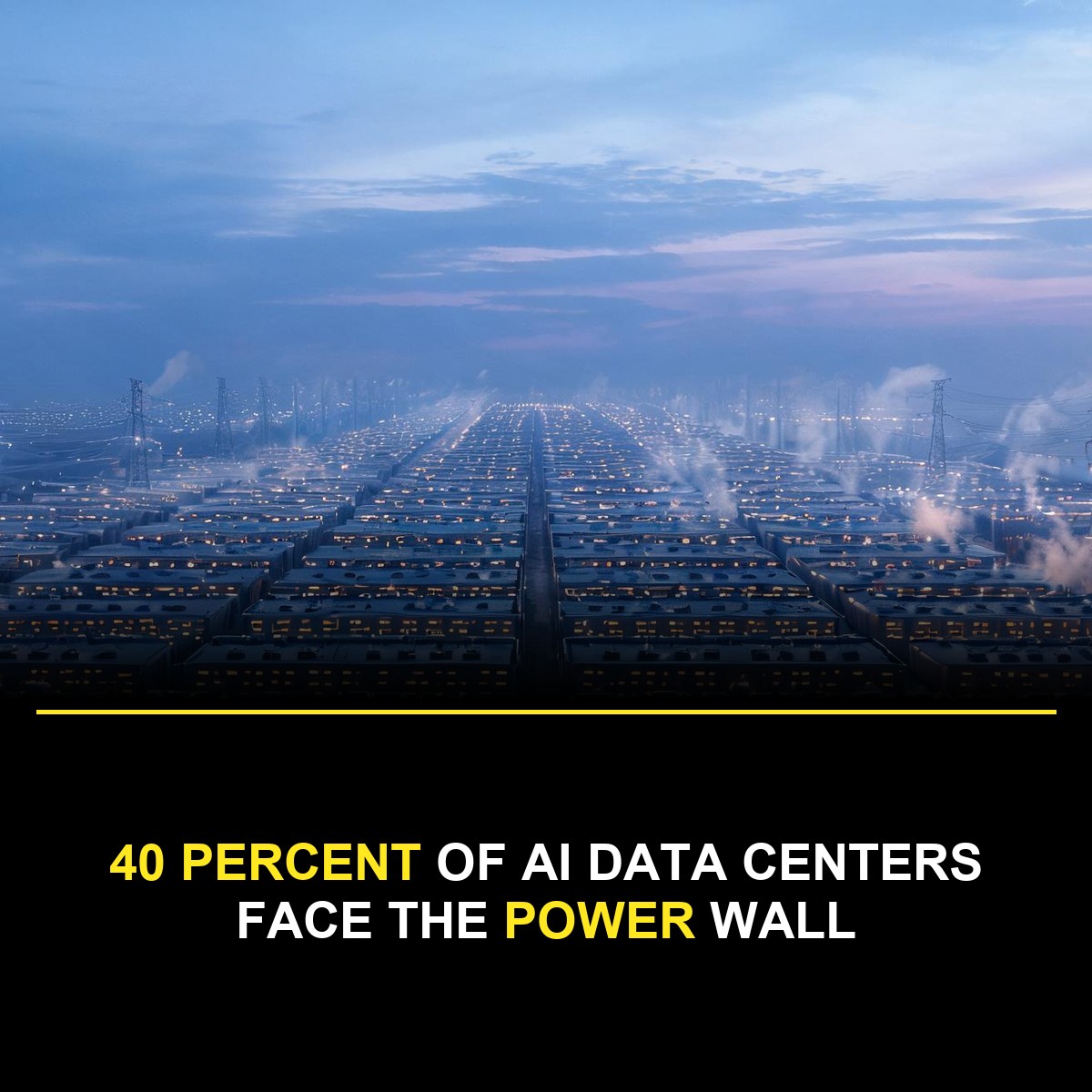
By 2027, Gartner predicts that 40 percent of existing AI data centers will be operationally constrained by power availability, physically unable to draw the electricity their hardware is designed to consume. The prediction, issued in late 2024 and reinforced by the firm's updated consumption forecasts for AI data centers, has moved from analyst caution to the operating assumption of an entire industry, and the numbers behind it explain why.
Worldwide AI AI data center electricity consumption is projected to rise from 448 terawatt hours in 2025 to 980 TWh by 2030, doubling in five years, with AI-optimized servers growing nearly fivefold from 93 TWh to 432 TWh and accounting for 44 percent of all data center power by the end of the decade. Those demand curves collide with grids that expand on five-year timelines, and the collision is already visible in interconnection queues, utility tariffs, and the sites that hyperscalers can no longer secure.
This article unpacks what the 40 percent figure means for AI data centers operationally, the demand numbers behind it, why the geography of the constraint favors China over the United States, what the emerging power solutions actually deliver, and what operators facing the constraint should do about it.
What the 40 percent means for AI data centers in practice
The prediction is about operational constraint in AI data centers, not construction delay, and the distinction defines who is exposed.
A power-constrained AI AI data center is one that exists, is staffed, and is filled with servers that cannot run at capacity because the electricity is not there. The constraint shows up as capped compute allocations, training runs that queue behind each other, cooling systems running at limits, and utilization rates that never reach the level the capital investment assumed. It is a facility performing below its specification for reasons that have nothing to do with its hardware.
Gartner's projection covers existing AI data centers by 2027, which means the exposure lands on assets that are already built and already financed. For the operators affected, the constraint converts a compute investment into a stranded-capacity problem: servers amortized over five years running at 60 percent of their capability, with the gap representing revenue that cannot be earned and cannot be recovered.
The secondary effects compound the primary one. Constrained facilities bid up whatever power remains available in their regions, raising costs for every other consumer on the same grid. Constrained regions lose the next round of investment to regions with headroom. And constrained operators face a choice between curtailing their own growth or buying their way out through on-site generation, which is the path that raised the co-location and behind-the-meter questions regulators are now racing to answer.
The 40 percent figure for AI data centers is a prediction rather than a measurement, and it depends on how much grid expansion and new generation actually arrive by 2027. Its value is as a planning assumption: an operator who assumes the constraint is coming builds differently from one who assumes the grid will keep up.
The numbers behind the AI data centers power wall
The consumption forecast is the arithmetic that makes the 40 percent plausible, and its components tell different stories.
Total AI AI data center electricity consumption rises from 448 TWh in 2025 to 980 TWh in 2030, growing 16 percent in 2025 alone and doubling across the period. That trajectory outpaces every other category of electricity demand growth except electrified transport, and it arrives concentrated in specific regions rather than spread evenly.
The AI component is the accelerator. AI-optimized servers consumed an estimated 93 TWh in 2025, about 21 percent of AI AI data center power, and Gartner projects that figure to reach 432 TWh by 2030, nearly fivefold growth that takes AI servers to 44 percent of total data center consumption and 64 percent of the incremental demand. In plain terms, the data center industry's growth is now almost entirely an AI story, and the power demanded by AI servers alone in 2030 approaches the entire industry's consumption in 2024.
The supporting infrastructure grows too: cooling, networking, and conventional servers all expand, but their share of the total falls as AI hardware dominates the marginal watt. That composition matters for grid planners, because AI server loads are more concentrated, more sensitive to interruption, and harder to shed than the general-purpose workloads that preceded them.
The regional split sharpens the AI data centers picture. The United States and China together account for more than two-thirds of AI data center electricity demand, and within the United States, data centers grow from 4 percent of regional consumption in 2025 to 7.8 percent in 2030. Europe rises from 2.7 percent to 5 percent. Those percentages sound small until they are read as growth rates: a region whose data center share nearly doubles in five years is adding demand faster than most utilities have ever planned for.
Why China is better positioned for AI data centers
The geographic asymmetry in the forecast is the part most American readers miss, and it has implications for where the industry's next AI data centers get built.
Gartner's analysis states that China is better positioned than the United States due to more power-efficient servers and superior infrastructure planning. The server efficiency claim reflects the domestic hardware ecosystem, where domestic accelerator designs optimized for local power constraints ship alongside the imported chips that dominate American datacenters. The infrastructure claim is the larger one: China plans generation and transmission as a coordinated state project, with grid expansion preceding demand rather than chasing it.
The American system builds through markets, which works well for innovation and poorly for speed. Generation projects compete for permits, transmission lines fight siting battles for years, and the interconnection process that FERC just ordered reformed exists precisely because market-coordinated infrastructure has not kept pace with concentrated demand. The result is the constraint Gartner projects, landing unevenly across regions whose grids were built for demand curves that AI flattened.
The strategic consequence is visible in site selection. Hyperscalers evaluating where to build their next generation of facilities weigh power availability as heavily as latency and labor, and regions, American states, and countries that can deliver electricity on datacenter timelines are winning projects that other regions priced themselves or regulated themselves out of. The competition for AI infrastructure is increasingly a competition for power delivery, and the Chinese model's speed advantage is a real factor in that competition.
For American policymakers, the forecast reads as a warning about the cost of slow infrastructure rather than as a competitive indictment, and the federal orders accelerating grid reform are the direct response.
The solutions for AI data centers, ranked honestly
The power alternatives emerging for constrained operators vary in maturity, and Gartner's own assessment of them is more sober than the industry's marketing.
Natural gas leads in the near term, and it is the only option delivering hundreds of megawatts on datacenter timelines today. Turbine orders are sold out for years, which makes gas generation a queuing problem as well as a cost problem, but it remains the default choice for on-site and co-located power.
Battery energy storage systems are the near-term complement, with rapid growth expected over the next three to five years to balance the fluctuations of solar and wind. BESS does not generate power, but it makes variable generation usable for datacenter loads and provides the ride-through capability that grid operators increasingly require of large loads.
Green hydrogen, geothermal, and small modular reactors are the end-of-decade options Gartner expects to become viable for AI AI data center microgrids by 2030. SMRs are the most interesting for AI specifically, because their output profile matches datacenter demand perfectly and their footprint fits beside a facility, but the first commercial units are years from deployment and their costs remain uncertain. Geothermal offers constant output where the geology allows it, with high initial costs and permitting challenges keeping it niche for now.
The honest AI data centers hierarchy is that gas solves today, storage smooths tomorrow, and the clean baseload options arrive late in the decade. Operators facing the 2027 constraint cannot wait for the clean options, which is why the near-term buildout is gas-heavy and why the sustainability story of AI infrastructure is more complicated than its marketing.
What operators of constrained AI data centers should do
For organizations operating AI data centers that face the power constraint, the practical playbook has four moves, each with different costs.
The first AI data centers move is efficiency. Power usage effectiveness improvements, better cooling, higher-temperature operation, and workload scheduling that runs training during grid-favorable hours, extract more compute from the same megawatts. Every percentage point of efficiency is capacity that does not need to be built.
The second AI data centers move is flexibility. Grid operators increasingly reward loads that can curtail on request, and a datacenter designed to shed noncritical work during grid stress gets better interconnection terms and cheaper power than a rigid one. The FERC reforms formalizing flexible load services make this a contractual opportunity rather than just an engineering one.
The third AI data centers move is generation. On-site and co-located power, gas today with clean options layered in as they mature, converts a constrained load into a self-sufficient one, at the cost of capital and regulatory complexity. The operators with the strongest balance sheets have already moved here, and the constraint is accelerating that consolidation.
The fourth AI data centers move is siting. The next facility should be evaluated on power availability as the primary criterion, because a region with grid headroom and a credible adequacy plan is worth more than a cheaper location with a four-year queue. The operators that internalized this lesson early are the ones whose expansion plans still have room to execute.
For readers tracking the infrastructure story from every angle, the regulatory response is examined in our FERC orders analysis, the component shortage adding a second constraint is covered in our memory shortage piece, and the compute demand driving it all is unpacked in our Vera Rubin bandwidth analysis.
The AI data centers impairment warning
Gartner's follow-up research attached a dollar figure to the AI data centers power problem, and it changed the conversation from infrastructure to finance.
The firm warned that more than 3.5 trillion dollars of AI infrastructure spending could be exposed to impairment by the end of 2030, a projection that treats stranded compute, underutilized facilities, and devalued power contracts as accounting events rather than operational inconveniences. Impairment matters to public companies because it writes down the value of assets on balance sheets, and a wave of AI infrastructure impairment would mark the first financial correction of the AI buildout.
The logic connects directly to the power constraint. A facility that cannot draw the power its servers need earns less than its investment case assumed, and an asset whose revenue underperforms its depreciation schedule eventually gets written down. The 40 percent constraint and the impairment warning are the same risk expressed in operational and financial terms.
The warning also disciplines the buildout itself. Companies financing new AI data centers now face lenders and boards asking power-availability questions that were absent from credit committees two years ago, and the answers, interconnection timelines, generation contracts, grid studies, are becoming part of the diligence that capital requires.
For the industry, the impairment projection is best read as a constraint on speculation rather than a prediction of collapse. Infrastructure that secures power and operates efficiently holds its value; the exposure concentrates in projects that assumed the grid would keep up and did not verify.
The AI data centers cooling half of the problem
Power gets the headlines for AI data centers, but heat is the twin constraint, and the two interact in ways that make the 40 percent projection worse rather than better.
Every watt a server consumes becomes heat, and removing that heat consumes more power, typically 20 to 40 percent of a facility's total depending on cooling design. AI server racks concentrate heat densities that air cooling cannot manage, which is why liquid cooling has moved from exotic to standard for new AI facilities, and why the power consumed by cooling is itself a constraint on how much compute a site can run.
The water question compounds it. Evaporative cooling consumes millions of liters per year at large facilities, and the regions with the best power situations, hot, dry climates with cheap land, are often the worst water situations. Communities that welcomed datacenters for the tax revenue have begun resisting expansions over water use, adding a social license constraint to the technical one.
The interaction means that solving power alone is insufficient for AI data centers. A facility that secures 200 megawatts of generation must also dissipate 200 megawatts of heat, and the cooling plant, its water supply, and its discharge permissions are part of the same bottleneck. The industry's move to liquid cooling and closed-loop systems is the response, and the facilities designed for it are the ones that will operate through the constraint period.
For observers assessing the 40 percent projection, the cooling lens explains part of why the constraint is operational rather than theoretical: even where power exists, the thermal engineering to use it takes time and water that many sites did not plan for.
The AI data centers timeline check: is 2027 on track
Two years after the prediction, the evidence for it can be assessed against what actually happened, and the record is mixed in ways that sharpen the forecast.
The AI data centers constraint signals have materialized. Interconnection queues grew, utilities began imposing large-load tariffs, regions imposed moratoriums on new datacenter approvals while power studies completed, and the behind-the-meter generation workaround became standard practice, all consistent with power availability binding before 2027.
The counter-signals exist too. Grid reform accelerated, with the federal orders forcing interconnection process changes and some utilities signing generation contracts at a pace the forecast did not assume. Several large facilities came online without visible constraint, and the industry's efficiency improvements, better cooling and more efficient accelerators, extracted more compute per watt than the projection assumed.
The honest read is that the 40 percent figure will land somewhere in range, concentrated in the regions where grid expansion lagged and less severe where generation contracts and reforms arrived early. The prediction's value was never its precision; it was the planning discipline it forced on an industry that had treated electricity as unlimited.
For the operators still building, the forecast's lesson is already embedded in site selection, power contracting, and the design choices described in this piece. For the policy community, the remaining question is whether the generation buildout arrives fast enough to turn a projected constraint into a historical note.
Questions readers are asking
What does the 40 percent prediction actually mean?
That 40 percent of existing AI data centers will be unable to run their hardware at full capacity by 2027 because the electricity is not available, translating into capped compute, queued workloads, and underutilized investments.
How fast is AI AI data center power demand growing?
From 448 TWh in 2025 to a projected 980 TWh in 2030, doubling in five years, with AI-optimized servers growing nearly fivefold from 93 TWh to 432 TWh and reaching 44 percent of total consumption.
Which regions are best positioned?
China, due to more power-efficient servers and state-coordinated infrastructure planning, with the United States and China together accounting for more than two-thirds of global AI AI data center electricity demand.
What can constrained operators do?
Improve efficiency, build flexible load capability that earns grid credits, invest in on-site generation where regulations permit, and site future facilities based on power availability rather than cost alone.
Sources
- Gartner prediction on AI AI data center power shortages: https://www.gartner.com/en/newsroom/press-releases/2024-11-12-gartner-predicts-power-shortages-will-restrict-40-percent-of-ai-data-centers-by-2027
- Gartner forecast on data center electricity demand growth: https://www.gartner.com/en/newsroom/press-releases/2025-11-17-gartner-says-electricity-demand-for-data-centers-to-grow-16-percent-in-2025-and-double-by-2030
- OECD AI Policy Observatory note on the power constraint: https://oecd.ai/en/incidents/2024-11-12-2836
- Gartner infrastructure and operations research: https://www.gartner.com/en/infrastructure-and-it-operations-leaders