Vulcan Rocket Failure Costs Amazon 40 Leo Satellites
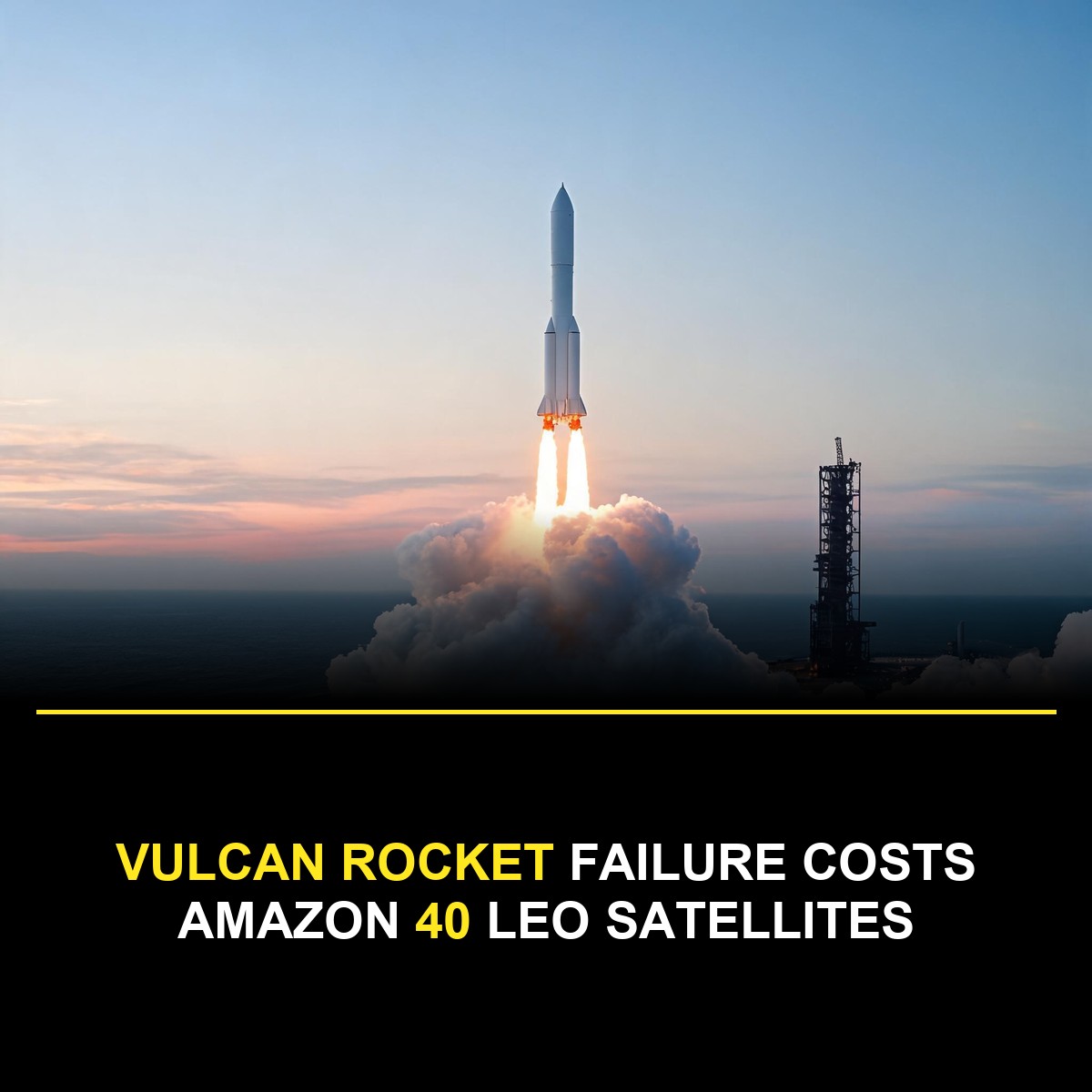
A Vulcan rocket carrying 40 Amazon Leo satellites failed 10 minutes into flight on November 15, 2026, and did not reach orbit. The loss is a setback for both the United Launch Alliance vehicle and the broadband constellation that Amazon is assembling in low Earth orbit. United Launch Alliance confirmed the anomaly in a statement from the launch operator, saying the vehicle launched from Space Launch Complex 41 at Cape Canaveral Space Force Station and suffered the problem roughly 10 minutes into the flight. It was the fifth mission for the Vulcan rocket and the first dedicated Amazon Leo payload on the vehicle. That this Vulcan rocket failure came on a return to flight added weight to the loss.
The timing makes the failure more consequential. This Vulcan rocket flight was a return to service after a roughly nine month pause, and it carried hardware improvements intended to address an earlier booster problem. It was also the first of 38 Vulcan launches that Amazon has contracted for its network. This article covers what is known about the mission, the vehicle and its payload, the state of Amazon's constellation, and the questions that now face the investigation. It also separates confirmed facts from details that have been reported loosely, because the cause of the failure was not known at the time of writing.
What happened during the mission
The mission, designated LV 01 and also called Leo Vulcan 1, saw the Vulcan rocket lift off from Space Launch Complex 41 on November 15 during an afternoon window. The published launch window ran from 12:11 to 12:40 p.m. Eastern time. The exact minute of liftoff within that window was not stated in the primary material, so the 12:40 figure should be understood as the close of the window rather than a confirmed launch time.
According to the operator's statement, the Vulcan rocket suffered an anomaly about 10 minutes into flight and failed to deliver the Amazon mission to orbit. The same statement acknowledged the miss plainly, saying that the company did not meet its standard that day. That is the full extent of the official description of the failure itself. No cause had been identified, and the operator said it did not yet have specific data to explain what happened.
The company added that it would work with its customer and other appropriate organizations to find the cause, determine the corrective action, and return to flight. That language signals an open investigation rather than a preliminary conclusion. Anyone analyzing the event should resist the temptation to assign blame before that work is finished. The only firm facts are the anomaly, the timing, and the loss of the payload.
For readers unfamiliar with the vehicle, our earlier coverage of Amazon Leo and how the network works explains what the satellites were meant to do once in orbit.
The Vulcan rocket configuration
The vehicle flown on LV 01 was a Vulcan in the VC6L configuration, an individual rocket designated V 012. Its first stage is powered by two BE 4 engines that burn liquefied natural gas, paired with six side mounted GEM 63XL solid rocket boosters. That combination gives the Vulcan rocket substantial lift for heavy payloads such as a full satellite deployment stack.
The upper stage was a LEO optimized Centaur V, fueled by liquid hydrogen and liquid oxygen and powered by two RL10C 1 1A engines. The term matters. Calling it simply a Centaur is imprecise, because this variant is configured specifically for the lower orbits that a broadband constellation uses. The initial upper stage burn was described as lasting nearly 12 minutes to reach a preliminary parking orbit, with a second burn planned later in the mission. Some reports gave a more precise burn duration, but that precision was not in the primary documentation.
The 40 satellites sat inside a fairing roughly 70 feet tall. Getting that many spacecraft to orbit in one launch is part of the economics of building a global network, and it is a core reason Amazon chose the Vulcan rocket for this mission. A single failure therefore removes a large block of capacity at once, which is why this event matters beyond the vehicle itself.
The Vulcan rocket had completed four successful missions before this one. Those flights covered a range of national security and demonstration payloads, and the operator said all four were completed successfully. This was the fifth flight and the first in about nine months, following the previous mission in February 2026.
Why this was a return to flight
The February 2026 Vulcan rocket mission experienced a solid rocket booster nozzle anomaly. In the technical material published before LV 01, the company said the team identified three credible causes and had taken positive steps to mitigate all of them. The November launch carried an improved GEM 63XL nozzle design as part of that work.
That context is important and easy to misuse. The new anomaly occurred on a mission that was specifically intended to demonstrate the fix, but that does not mean the nozzle was involved. No evidence connected the two events, and the cause of the November failure remained unknown. Suggesting that the improved hardware failed would go beyond what the operator said. The honest position is that a return to flight mission encountered a separate anomaly whose cause is under investigation.
A failure on a return to flight mission is a difficult moment for any launch program. It resets the confidence that the earlier corrective work was meant to rebuild, and it sends the engineering team back into analysis. The operator's public statement was measured and quick, which drew a response from NASA Administrator Jared Isaacman. In a post on the social platform X, Isaacman thanked the company for keeping the public and partners informed and offered NASA's help with the investigation and remediation effort.
What Amazon loses and what remains
The lost payload consisted of 40 satellites for the network now called Amazon Leo. The program was renamed from Project Kuiper in November 2025, so older references use a different name for the same constellation. Amazon has said the initial system will contain more than 3,000 satellites, while the regulatory authorization covers a first generation figure of 3,236. Some reporting used a larger number, but the primary company material did not support it.
Before this launch, Amazon had placed nearly 400 satellites into orbit across 14 missions, according to its own progress page updated in late October 2026. An exact count of 396 has appeared in secondary coverage, but the company phrased it as nearly 400. Losing 40 spacecraft is therefore a meaningful slice of the satellites deployed so far, though it does not end the program.
Amazon has diversified its launch providers deliberately. The company has 24 firm launches booked on New Glenn, 24 with Arianespace on Ariane 6, and additional capacity on Falcon 9. Arianespace confirmed that its contract total rose to 24 launches, and Amazon's own material lists 10 additional Falcon 9 flights beyond those already flown. That spread means a Vulcan rocket problem does not halt constellation deployment, although it does remove one of the planned vehicles from the near term schedule.
The broader competitive context is a race to provide low Earth orbit broadband. Coverage of connectivity efforts such as the Ka band relay work shows how much infrastructure depends on reliable access to orbit. Every failed launch shifts timing, and timing matters when rivals are already deploying at scale.
The satellite stack and what was being tested
Beyond the question of whether the Vulcan rocket reached orbit, the mission carried a payload with its own engineering logic. Amazon Leo satellites are built for high volume production and deployed in shells that work together to hand traffic across the network. Launching 40 at once on a single Vulcan rocket is efficient, but it also concentrates risk. A single Vulcan rocket failure removes a whole block of spacecraft that would have been spread across the constellation.
The deployment sequence would have begun only after the upper stage reached its preliminary parking orbit. The LEO optimized Centaur V was designed to make that first burn of nearly 12 minutes, then coast before a second burn to place the satellites near their operational altitude. Because the anomaly occurred about 10 minutes into flight, it happened before the upper stage had completed the work needed to release the payload. The satellites never had a chance to separate.
That timing is one of the few firm details in the official account. It tells engineers that the problem occurred early, during a phase dominated by the first stage and boosters rather than by deployment hardware. It does not tell them which component failed. The operator explicitly said it lacked the data to explain the event, so any listing of suspect systems at this stage would be guesswork.
Why a ten minute anomaly is hard to diagnose
A failure roughly 10 minutes into flight sits in a complicated part of a launch. The Vulcan rocket has by then cleared the dense lower atmosphere and the solid boosters have typically done their work, while the upper stage is preparing for its long burn. Many systems are transitioning at once. That makes the telemetry rich but the interpretation difficult, because a fault can appear at one moment and have its root cause somewhere earlier.
Investigations of this kind usually begin by reconstructing the flight from recorded data, then comparing it with the expected profile. The operator said it would work with its customer and other appropriate organizations, which suggests that both the launch provider and Amazon will have access to relevant information. NASA's offer of assistance adds another possible source of expertise, though no formal role was announced in the initial statement.
The practical question for the constellation operator is when the next Vulcan rocket can fly. Return to flight decisions depend on identifying a cause and demonstrating that a fix addresses it. The earlier booster nozzle issue took time to analyze, and the company said it considered three credible causes before applying mitigations. A similar process now lies ahead, with the added pressure of a broadband rollout that is already behind some of its rivals.
What the investigation will need to answer
The coming inquiry has a narrow technical job and a broader institutional one. Technically, it must determine why the Vulcan rocket departed from its expected flight profile about 10 minutes after launch and whether the fault lay in the booster, the upper stage, or an interface between systems. Institutionally, it must produce enough of a public account to restore confidence before the next Vulcan rocket mission carries a customer payload.
The operator has said it will work with its customer and other appropriate organizations. That phrasing leaves room for Amazon to participate directly, which makes sense given that the lost satellites were its property. NASA's offer of help gives the company another pool of expertise to draw on if it chooses. None of that guarantees a quick answer, and the earlier nozzle investigation showed that even a bounded problem can have several plausible explanations.
The other question is schedule. Amazon had booked this Vulcan rocket flight as the first of 38, and the loss of 40 satellites has to be absorbed somewhere in the rollout plan. The company's other launch contracts provide flexibility, but each provider has its own manifest and constraints. A prolonged grounding of the Vulcan rocket would shift more of the deployment burden onto New Glenn, Ariane 6, and Falcon 9, each of which has its own recent history of anomalies and recoveries. The competitive pressure comes into focus in our coverage of SpaceX's 125 launches and Starlink mobile, where launch cadence directly shapes how fast a network can grow.
Until the investigation reports, the most defensible statement is the simplest one. A Vulcan rocket launched, encountered an anomaly 10 minutes in, and failed to deliver its payload. Everything beyond that is pending. That may be unsatisfying, but it is the honest position, and it protects against the kind of premature explanation that has surrounded other recent launch anomalies.
The company and the people now in charge
The operator of the Vulcan rocket is United Launch Alliance, and the company that built the Vulcan rocket is led by president and chief executive officer Mark Peller. He took the role on August 17, 2026, following a leadership sequence in which Tory Bruno served until December 2025 and John Elbon served as interim chief executive until August 2026. Some informational pages on the company site still show the older arrangement, so the dated newsroom announcement is the reliable source.
Peller had been with the company since its formation in 2006, which gives him a long view of its operating history. He is the executive who will have to guide the investigation and the return to flight effort. The company's public statement was issued in the name of the organization rather than an individual, but the responsibility for the outcome sits with the leadership team he now heads.
It is worth being careful with superlatives here. A claim that this was the first outright failure in the company's history appeared in reporting, but the operator's own statement did not make that claim. The primary material confirms that the four prior Vulcan rocket missions succeeded and that the company was formed in 2006. Whether this was the first failure ever across all vehicle families is a detail that the official record did not establish at the time.
How other launch programs frame the setback
Rocket failures are not rare in the industry, and the way a company responds to a Vulcan rocket failure often matters more than the event itself. The operator's statement followed a familiar pattern: confirm the anomaly, state the payload was lost, decline to speculate on cause, and promise an investigation with the customer and other organizations. That is a disciplined response, and NASA's offer of assistance suggests that the relevant parties see the work as a shared technical problem.
Other providers have faced their own recent anomalies. Blue Origin confirmed a significant event during a New Glenn integrated hotfire test on May 28, 2026, and said early analysis pointed to the aft section of the first stage. A specific component cause appeared in some reporting, but the company said the investigation was still open. That case is a useful parallel because it shows how quickly a tentative explanation can outrun the evidence. The same restraint should apply to the Vulcan rocket investigation.
For a constellation operator, the practical response is to keep other launch vehicles moving. Amazon's contracts across New Glenn, Ariane 6, and Falcon 9 give it that flexibility. The question is whether the lost block of 40 satellites can be made up without delaying the broader rollout, and that depends on how quickly the operator returns to flight.
The failure also illustrates why launch cadence and vehicle diversity are strategic assets. A company relying on a single rocket for its entire constellation would face a much sharper problem. The Vulcan rocket was meant to be one of several paths to orbit for Amazon, and that diversity is what keeps the broader program alive after a single loss.
Questions readers are asking
What failed on the Vulcan rocket mission? The operator reported an anomaly about 10 minutes into flight on November 15, 2026, and said the mission failed to deliver its Amazon payload to orbit. The cause was not known at the time, and the company said it did not yet have specific data.
How many satellites were lost? Forty Amazon Leo satellites were on board, enclosed in a fairing about 70 feet tall. That is a significant fraction of the nearly 400 satellites Amazon had launched across 14 previous missions.
Was this the first Vulcan rocket launch since February? Yes. The previous Vulcan flight was in February 2026, roughly nine months earlier. It experienced a booster nozzle anomaly, and the November Vulcan rocket mission carried an improved nozzle design as part of the corrective work.
Did the improved booster nozzle cause the November failure? There is no evidence for that. The cause of the November anomaly was unknown, and the operator did not connect it to the earlier nozzle issue. Linking the two would be speculation.
Which launch vehicles does Amazon still have available? Amazon has 24 firm New Glenn launches, 24 Ariane 6 launches through Arianespace, and additional Falcon 9 capacity, including 10 further flights beyond those already used.
Who leads United Launch Alliance now? Mark Peller became president and chief executive officer on August 17, 2026. Tory Bruno led the company until December 2025, and John Elbon served as interim chief executive until August 2026.
Sources
- ULA, official statement on the LV 01 anomaly
- ULA, Vulcan Leo 1 mission page
- ULA, technical blog on the Vulcan Leo 1 mission
- ULA, announcement of Mark Peller as chief executive
- Amazon, Leo launch progress and manifest
- NASA Administrator, offer of assistance
- Arianespace, expanded Amazon Leo launch contract
- Blue Origin, New Glenn return to flight note