HP ZGX Fury Packs 748GB RAM and GB300 for 132,000 Dollars
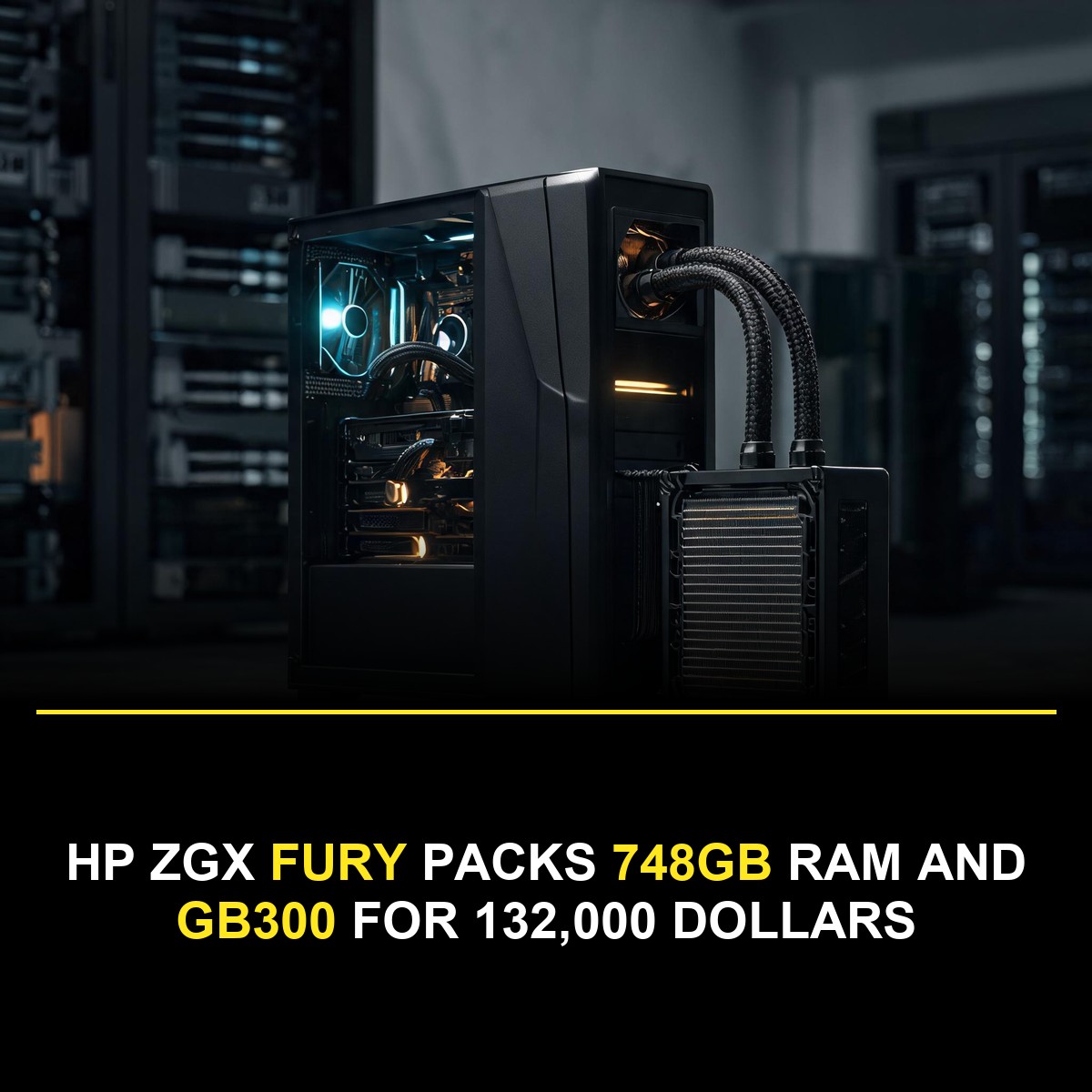
Desk-side AI supercomputers are now a product category. The HP ZGX Fury G1n pairs 748GB of memory with a GB300 superchip, starting at 132,000 dollars. HP describes the machine as a workstation, but the specification reads more like a rack of AI servers that has been persuaded to fit under a desk. It is liquid cooled, it draws from a 1,600 watt power supply, and it can be bolted into a 5U rack when the office arrangement stops being funny.
The interesting part is not the price, although the price is the part everyone will quote first. It is the memory. Unified memory of 748GB means a single developer can load a model that would otherwise require a cluster, then fine-tune it locally without shuttling data to a cloud provider. That changes the shape of certain AI projects, and it also creates a new category of very expensive, very quiet desk furniture.
This article covers what the HP ZGX Fury actually contains, why the memory figure matters more than the processor name, how the configuration prices stack up, and where the machine fits. It also covers the parts of HP's own documentation that do not agree with each other, because anyone spending six figures on hardware deserves to read the footnotes before the purchase order goes out.
What the HP ZGX Fury actually contains
The ZGX Fury G1n is built around the NVIDIA GB300 Grace Blackwell Ultra Superchip. In HP's configuration that superchip combines a 72-core Arm Neoverse V2 Grace CPU with a Blackwell Ultra GPU, and the two share one coherent memory pool. HP's own ZGX Fury product page and the machine's QuickSpecs document are the two sources worth reading, and together they give a clear parts list.
The 748GB total is not one kind of memory. It is the sum of two different allocations, and the distinction matters for anyone deciding what the machine can do:
- 496GB of LPDDR5X system memory, running at 6,400 MT/s and delivering roughly 396 GB/s of bandwidth to the CPU. HP fits this as four 128GB SOCAMM modules.
- 252GB of HBM3e graphics memory on the Blackwell Ultra GPU, with about 7.1 TB/s of bandwidth.
Add the two figures and the 748GB headline appears. The HBM3e portion is the expensive, high-bandwidth pool that feeds the GPU during inference, while the larger LPDDR5X pool holds model weights and working sets that would overflow an ordinary workstation. Because the CPU and GPU share a coherent address space, data does not need to be copied between two physically separate banks for every operation.
NVIDIA describes the same underlying design in its DGX Station documentation, where the GB300 Grace Blackwell Ultra Desktop Superchip is credited with up to 748GB of coherent memory and 20 petaFLOPS of FP4 AI compute. HP has essentially taken that superchip, wrapped it in a workstation chassis, and added its own support and configuration structure. The ZGX Fury is not a unique silicon design so much as a specific, very well supplied implementation of a platform NVIDIA already sells.
The processor choice is Arm rather than x86. The Grace CPU uses Neoverse V2 cores under ARMv9, which places the ZGX Fury in the same architectural family as a growing set of AI-first machines. That has consequences for software compatibility, and it is one of the reasons the machine ships with Linux rather than Windows. Anyone evaluating the ZGX Fury should start from the assumption that the software stack is NVIDIA's CUDA ecosystem on Ubuntu, not a conventional Windows workstation.
Why 748GB of memory is the whole proposition
Processors get the headlines, but memory determines whether a large model fits at all. A model that does not fit in memory either runs extremely slowly through offloading or does not run. The ZGX Fury is designed around the idea that fitting matters more than raw speed, and HP states the intended scale plainly on its product page: developers can fine-tune models in the 100 billion parameter class on premises, and run inference on models up to the trillion parameter class using FP4 quantization. Those are company claims, and the fine print matters, but the underlying logic is sound.
Inference at one trillion parameters is only plausible with aggressive low-precision formats. FP4 stores each weight in four bits, which cuts memory consumption dramatically compared with 16-bit formats, at some cost to numerical fidelity. A model that would need several terabytes at 16-bit can be squeezed into a pool measured in hundreds of gigabytes at FP4. The footnote on HP's page confirms that the model harness quantizes at FP4, so the trillion parameter figure describes a quantized workload rather than a full-precision one. Readers who follow low-precision inference work will recognise the tradeoff from FP8 attention research on AMD MI355X, where the same tension between memory savings and accuracy shows up at a different precision level.
Fine-tuning is a different proposition from inference. Training or adapting a 100 billion parameter model requires room for weights, gradients, optimizer state and activation data at the same time, which is why memory capacity dominates the discussion. The 496GB LPDDR5X pool gives the ZGX Fury enough headroom for this class of work in principle, while the HBM3e pool handles the bandwidth intensive parts. Whether a given fine-tuning job fits depends on batch size, sequence length and the chosen method, all of which are workload decisions rather than fixed properties of the machine. Readers who want a concrete sense of how compiled GPU kernels affect throughput on large models can see our look at QwenGPU and SIMT GPU compilation, which covers the software side of getting good performance from this class of hardware.
The practical alternative to this much local memory is distribution across cheaper machines or rental from a cloud provider. Both options introduce complexity. Sharding a model across multiple systems means dealing with interconnect latency and synchronization, while cloud rental converts a one time capital cost into an ongoing operational one and may raise data governance questions. The ZGX Fury argues that for some teams, a single box with a very large memory pool is simpler than either alternative. It is a strong argument as long as the work actually needs that much memory, and a weak one if it does not.
The 132,000 dollar price ladder and what it buys
HP's United States store lists the ZGX Fury G1n at a manufacturer suggested retail price of 132,000 dollars for the base configuration with no discrete graphics card. Two graphics equipped configurations sit above it. The RTX PRO 2000 version is listed at 133,000 dollars, and the RTX PRO 4000 version at 136,000 dollars. Those figures come from HP's own store listings rather than a press release, and some store pages fail to render the price script, which is why the product detail page is the one to check rather than a cached listing.
The price step between configurations is small relative to the base cost, which is unusual. A graphics card that adds only a few thousand dollars to a six figure system is being treated as a minor option rather than a major decision. There is a reason for that. The GB300 superchip already contains a powerful Blackwell Ultra GPU with its own 252GB of HBM3e, so the discrete RTX PRO cards are additions rather than the primary compute engine. They exist for teams that need specific workstation graphics capabilities, certified drivers or additional video memory, not for teams that need the ZGX Fury to be an AI machine in the first place.
HP notes that configurations with certain RTX PRO 6000 options can cause the system to apply a power limit to the GB300 at boot, with a possible performance impact. That caveat appears in the QuickSpecs and is the kind of detail that a buyer should read twice. Adding hardware to a machine with a fixed power envelope can redistribute that envelope, and the ZGX Fury's 1,600 watt supply is sized for the base design. This is not a reason to avoid the graphics options, but it is a reason to ask HP exactly how a proposed configuration behaves under load before signing anything.
It is also worth being blunt about who will never buy this machine. A developer who wants more memory for a desktop can find far cheaper routes, and a gamer has no reason to look twice. The ZGX Fury only makes financial sense when the alternative is a cluster rental bill, a multi node build that needs specialist staff, or a project that simply cannot proceed without local access to a very large model. In those cases the price stops looking arbitrary and starts looking like a budget line with a clear justification behind it.
Cooling, power and the 5U rack question
A machine that pulls 1,600 watts through a Titanium rated, 94 percent efficient supply cannot be cooled by the fans in an ordinary PC case. HP uses closed loop liquid cooling with forced air convection, and describes the chassis as a liquid cooled rackable tower. The same QuickSpecs document lists rack dimensions of 5U and an optional rail rack kit, so the ZGX Fury is designed to live in both worlds: upright beside a desk or mounted in a rack with other infrastructure.
That dual identity is more revealing than it first appears. A 5U rack mountable workstation is infrastructure equipment, and the office sized framing is a matter of presentation rather than engineering. Teams that buy the ZGX Fury will likely end up deploying it near a network cabinet, with attention to ventilation, power circuits and noise, even if the initial plan was to place it under a desk. The liquid cooling loop makes the machine quieter than an equivalent air cooled system, but it does not remove the heat from the room.
The 5U dimension also sets a practical limit on scale. Several ZGX Fury units in one rack consume rack space and power that would otherwise go to conventional servers, which is why the network specification deserves as much attention as the compute specification. HP is not selling a single toy here; it is selling a building block that organisations can repeat when one unit is not enough.
For buyers comparing against other high density AI boxes, the relevant comparison is not a desktop PC with a large graphics card. It is a rack scale system such as NVIDIA's DGX GB300 platform, which NVIDIA describes as a liquid cooled, rack scale system built on Grace Blackwell Ultra Superchips. The ZGX Fury takes similar ideas and packages them for a smaller site. Readers interested in how the surrounding GPU roadmap affects bandwidth choices can find more in our coverage of Vera Rubin bandwidth cuts, which explains why memory bandwidth has become as contested as memory capacity.
Networking that assumes more than one machine
The ZGX Fury ships with an NVIDIA ConnectX-8 network interface offering two QSFP112 ports at 400 gigabits per second each, with support for optical and direct attach copper connections. NVIDIA markets ConnectX-8 as capable of up to 800 gigabits per second when both ports are used together, and the pairing with a 5U rackable chassis makes the intent clear. This machine is expected to talk to other machines at very high speed.
That matters because the memory ceiling, large as it is, remains a ceiling. A workload that exceeds 748GB must either be quantized further or spread across systems, and spreading it across systems only works when the interconnect is fast enough that the network does not become the bottleneck. Two 400 gigabit ports give a ZGX Fury enough bandwidth to participate in a small cluster without immediately saturating the link. For comparison, ordinary workstation networking is measured in tens of gigabits, an order of magnitude below what HP has fitted here.
The choice also signals that HP expects the ZGX Fury to be managed by infrastructure teams rather than individual enthusiasts. QSFP112 optics and 400 gigabit switching are not consumer technologies, and a buyer who needs those ports will already know it. A buyer who does not need them is still paying for them as part of the platform, which is one of the reasons the starting price is what it is. The specification is optimised for a use case, not for a broad market, and the networking is the clearest evidence of that focus.
This cluster ready design connects directly to the debate about local versus hosted compute. Organisations that want to keep model work on premises often discover that a single powerful box is only the first step, and that the operational model matters more than the hardware. Our analysis of cloud computers for AI agents looks at the tradeoffs that appear when compute moves between a local rack and a remote provider, and the same tradeoffs apply here. The ZGX Fury is at its best when an organisation has already decided that local compute is the right answer and needs hardware to match.
Ubuntu, Windows and a document conflict
The ZGX Fury ships with Ubuntu 24.04 LTS and NVIDIA AI Developer Tools preinstalled. HP also states that the system is certified for Red Hat Enterprise Linux and powered by Red Hat AI Enterprise on its product page. The QuickSpecs list only Ubuntu as the preinstalled operating system, and an FAQ on the product page asks whether the ZGX Fury is Red Hat certified without providing a clear answer in the supporting text. A buyer should treat Linux support as real and specific, then ask HP to confirm which distribution is supported for the intended software stack.
The Windows picture is more confused. The HP product page carries a banner saying Windows support is coming soon, while the QuickSpecs contain an explicit note that the product does not support Windows. Those two statements cannot both be accurate at the same time. The most likely reading is that support is planned but not available, with the QuickSpecs reflecting the current shipping state and the banner reflecting marketing intent. Until HP resolves the conflict in writing, anyone who needs Windows on this hardware should assume the answer is no.
There is a similar problem on the store page. The features block for the ZGX Fury G1n contains text about NVIDIA DGX OS, a 20-core Grace CPU and 1,000 TOPS of FP4 compute, all of which describe a different, smaller system. The GB300 and 72-core specification on the same page is the correct one, as confirmed by the QuickSpecs and by NVIDIA's own description of the platform. This is stale copy rather than a hidden specification, but it illustrates why the QuickSpecs document should be treated as authoritative when a store page and a datasheet disagree.
None of this makes the ZGX Fury a bad machine. It makes the documentation a poor substitute for a conversation with HP. At this price point, a buyer should expect written confirmation of the operating system, the supported drivers, the behaviour of any proposed graphics configuration and the upgrade path. Those questions are normal procurement questions for infrastructure hardware, and the ZGX Fury should be bought with the same process used for a server rather than the process used for a laptop.
Who should buy the ZGX Fury and who should not
The ZGX Fury makes sense for a narrow set of organisations. Research teams that fine-tune large language models and need the data to stay local are the clearest fit. So are small teams that would otherwise rent GPU time by the hour and have reached the point where the rental bill and the data movement overhead exceed the cost of ownership. Companies that need a quiet, rackable node with extremely high memory capacity as part of a larger cluster are another natural audience, particularly given the ConnectX-8 networking.
It makes less sense for teams whose models fit comfortably in a well specified GPU workstation with a fraction of the memory. A model that runs in 128GB does not become faster because the machine also has 620GB it never uses, and the ZGX Fury is not a general purpose productivity machine. It also makes less sense for anyone who needs Windows today, or who relies on software that has not been ported to Arm Linux. The software constraint is more likely than the price to disqualify an otherwise interested buyer.
There is a third category: teams that are curious about local AI but have not yet defined a workload. For them, the honest advice is to rent compute first and measure what is actually needed. The ZGX Fury solves a specific problem extremely well, and buying it before that problem is confirmed is an expensive way to discover that the problem was smaller than expected. The machine is a tool for a known constraint, not an entry point into AI experimentation.
Questions readers are asking
Can the ZGX Fury really run a one trillion parameter model locally? HP says inference at that scale is possible when the model harness quantizes weights to FP4. That is a real technique, but it changes precision and therefore output quality relative to a full precision model. The claim describes a supported configuration, not a guarantee that every trillion parameter model will perform well.
Is 748GB of memory all usable for one model? The figure combines 496GB of LPDDR5X and 252GB of HBM3e in a coherent pool. Workloads can draw on both, but bandwidth differs sharply between them, so performance depends on which pool holds which part of the working set at a given moment.
Does the ZGX Fury support Windows? The available HP documentation conflicts. A product page banner says support is coming soon, while the QuickSpecs state that the product does not support Windows. Buyers should assume Linux only until HP confirms otherwise in writing.
Why does a workstation have 400 gigabit networking? Because the design assumes clusters. When one machine cannot hold a model, the interconnect determines whether multiple machines can work together efficiently, and conventional workstation networking would limit that.
Is the RTX PRO graphics upgrade worth the extra cost? For AI work, the GB300 superchip is the main compute engine, so the discrete card is not the primary reason to buy. The upgrade makes sense for specific certified graphics workloads, and HP warns that some configurations may reduce GB300 power and performance.
Sources
- HP ZGX Fury AI station product page: https://www.hp.com/us-en/workstations/ai-stations/zgx-fury-ai-station.html
- HP ZGX Fury G1n QuickSpecs: https://h20195.www2.hp.com/v2/GetDocument.aspx?docname=c09316164
- HP United States store product detail page: https://www.hp.com/us-en/shop/pdp/zgx-fury-g1n-with-3-year-warranty-no-graphics-card-with-4x2tb-self-encrypting-ssds-north-america-aba
- NVIDIA DGX Station and GB300 Grace Blackwell Ultra Desktop Superchip: https://www.nvidia.com/en-us/products/workstations/dgx-station-for-windows
- NVIDIA Grace CPU platform: https://www.nvidia.com/en-us/data-center/grace-cpu/