IBM Quantum Nighthawk r3: 10,000 Operations on 520 Qubits
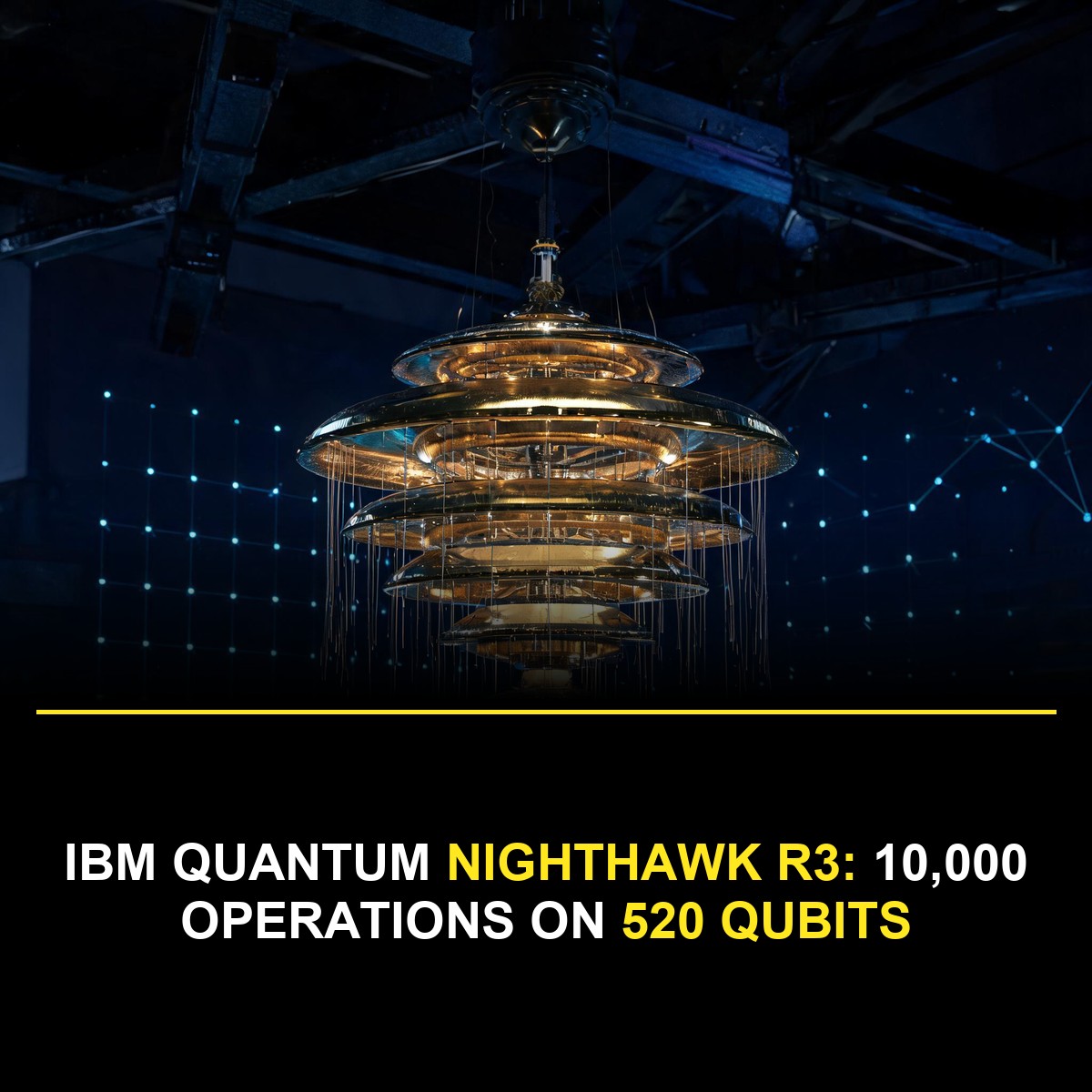
IBM has announced Quantum Nighthawk r3, its next-generation quantum processor, to be built for accurately executing 10,000 quantum operations across 520 programmable qubits. And in 2027, IBM plans to link two of the chips into a single system with more than 1,000 qubits, a milestone on the company's road toward fault tolerance. The Nighthawk r3 announcement is the clearest statement yet of how IBM intends to get there.
The announcement, made at IBM's Quantum Developer Conference in Yorktown Heights on 11 November 2026, is less about the new chip alone and more about the architecture it extends.
The current-generation Nighthawk r2, deployed since September, has been executing real workloads at speeds that surprised even IBM's partners. Nighthawk r3 takes that same high-speed design and scales it fourfold in qubit count, while introducing the chip-to-chip interconnects that make the two-chip 1,040-qubit system possible. This article draws on IBM's announcement and Quantum Computing Report's technical coverage of the conference.
Why speed matters as much as qubit count
Quantum computing headlines usually lead with qubits, but IBM's argument at the conference was that speed decides whether quantum computers are useful at all. A quantum computer delivers its answer in samples: each run of a circuit returns one result, and industry-relevant applications require circuits running thousands of operations on 100 or more qubits, generating millions to billions of samples. Scale and quality make complex computations possible; speed determines whether they finish in practical timeframes at reasonable cost.
Nighthawk r2 was built around that insight. It delivers up to 100,000 samples per second, supported by high-speed qubit reset technology that dramatically shortens the time between circuit executions. It supports accurate computations with more than 7,500 quantum operations on 120 qubits. The reset speed is the quiet hero. Without it, collecting billions of samples would spend most of its time waiting between runs.
Nighthawk r3 inherits this sampling engine unchanged in spirit, which keeps the risk profile of the 2027 milestone lower than a redesign would be.
Jay Gambetta, Director of IBM Research and IBM Fellow, framed the dual requirement in the announcement: useful quantum computing hinges on whether results can be delivered with accuracy and speed, and both are fundamental. Nighthawk is already showing what that looks like today, and as the Nighthawk r3 architecture scales to larger and more powerful quantum computers, the capabilities will reach new levels as quantum integrates more closely with classical resources on the way to fault tolerance.
The market has responded with usage. Clients and partners including E.ON, Algorithmiq and Q-CTRL have executed more than 34 billion circuits on Nighthawk r2, reporting speedups of up to 19 times beyond previous IBM quantum processors. E.ON reported a 15 times speedup in quantum machine learning for energy grid optimization. IBM itself recorded a 12 times speedup on an experiment with Oak Ridge National Laboratory that simulated real magnetic materials, with results consistent with neutron scattering experiments. Both speedups were measured against previous work on IBM's Heron processors, the prior generation.
What Nighthawk r3 changes, and what carries over
Nighthawk r3 extends the r2 architecture rather than replacing it. The processor is designed to support 10,000 quantum operations on 520 programmable qubits, with 2,034 total physical qubits. It retains the square-lattice connectivity and fast operations of r2 while adding the piece that makes scaling modular: 10 chip-to-chip interconnects, called l-couplers, designed to link processors into larger systems.
That last feature is where the 2027 roadmap lives. IBM plans to connect two Nighthawk r3 processors into a single 1,040-qubit system, extending the architecture to larger computations without inventing an entirely new chip. Modularity, in IBM's design, is how you scale a quantum computer the same way classical datacenters scale: by linking proven units rather than betting everything on one ever-larger device.
Two demonstrations back the confidence. Earlier this year, IBM connected Nighthawk r1 processors using four l-couplers and achieved 99.3 percent quantum state transfer fidelity, progressing toward its 99.9 percent target. And IBM connected two cryogenic modules into a single system for the first time, reaching operating temperature in under five days and cooling below 15 millikelvin. Both are engineering prerequisites for the 2027 two-chip system, and both have now been demonstrated rather than merely projected.
The l-coupler fidelity number deserves a note of caution alongside the excitement. State transfer at 99.3 percent means roughly 0.7 percent of the quantum information degrades at each crossing, and a two-chip system will push quantum information across those links constantly. The 99.9 percent target exists because error correction budgets are unforgiving, and IBM has not yet published results from a full two-r3 system. The 2027 milestone will be the test.
Inside the Nighthawk r3 specification
The spec sheet rewards a close reading, because each number encodes a different engineering constraint.
The 520 programmable qubits are the usable ones: qubits that can carry and manipulate quantum information in a computation. The 2,034 total physical qubits are the full count on the device. The gap between the two numbers exists because superconducting quantum computers devote physical qubits to supporting roles, including error mitigation overhead and the control infrastructure around each programmable site. The ratio, roughly four physical qubits per programmable one, is consistent with the r2 generation's 120 programmable on 458 physical, which tells you the layout discipline carried over rather than being redesigned.
The 10,000-operation budget is the number that maps most directly to real applications. Running accurate two-qubit operations is the scarce resource in quantum computing: every operation adds noise, and a circuit that exceeds what the processor can execute accurately produces results no better than random. Moving from r2's 7,500 operations to 10,000 means circuits can run roughly a third deeper before accuracy runs out, which translates directly into the size of problems that fit.
The 10 l-couplers are the structural novelty. Each one is a chip-to-chip interconnect designed to carry quantum state between processors with minimal degradation. Ten of them give the two-chip system enough bandwidth to act as one machine rather than two halves exchanging results occasionally. The choice of ten is itself a design statement: enough links for dense coupling, few enough to keep the cryogenic and control complexity manageable.
What Nighthawk r3 does not change is as telling. The square-lattice connectivity stays, because it is the layout that made r2's operation fidelity and reset speed possible. The sampling architecture stays. IBM is scaling a proven design, not testing a new one, and the risk profile of the 2027 milestone depends heavily on that continuity.
How Nighthawk r3 fits the competitive field
The quantum computing market in late 2026 is a race between different physical modalities, and the Nighthawk r3 announcement is IBM's move in that larger game.
Superconducting processors like the Nighthawk r3 run at millikelvin temperatures and switch states in nanoseconds, which is where the 100,000-samples-per-second throughput comes from. Trapped-ion systems from competitors offer longer coherence and higher two-qubit fidelities on small registers but sample more slowly. Neutral-atom platforms promise rapid scaling in qubit count. Each modality has a different bottleneck, and the honest comparison runs through application benchmarks rather than spec sheets, which is why the Quantum Advantage Tracker's open circuit library is a useful shared reference.
By the metrics the industry has converged on, accurate operation counts and sample throughput at useful qubit scales, the Nighthawk family holds a leading position. The Nighthawk r3 spec extends it. Ten thousand operations at 520 programmable qubits exceeds what any competitor has published as an accurate-operation budget at comparable scale, and the 2027 two-chip link would push the programmable count past 1,000 in a single system.
The less visible competition is for developer mindshare. The Qiskit stack, the Functions marketplace, the agent skills and the managed hybrid workflows are all bets that quantum software settles into an ecosystem the way classical cloud computing did. The vendor with the smoothest path from laptop to quantum result keeps the developers, and the Nighthawk r3 fleet is the hardware those developers will land on.
The workloads Nighthawk r2 is already running
The r2 fleet gives the Nighthawk r3 announcement its evidence base, and the partner results are the most concrete part of the story.
The Algorithmiq collaboration extended a heterogeneous quantum material simulation to Nighthawk r2, executing circuits eight times faster than the original experiment on Heron. The new circuits are also significantly harder for classical computers to simulate, requiring an estimated 240 times more memory to match accuracy with leading tensor-network methods. That combination, faster on the quantum side and harder to fake classically, is exactly what quantum advantage experiments need to demonstrate.
The July advantage experiments IBM published with partners were first run on Heron, with circuits and results openly available for independent testing through the community-led Quantum Advantage Tracker. Openness about methods and data has become part of IBM's positioning, which matters in a field where advantage claims have historically been contested.
ParityQC and Quantum Elements are also among the partners reporting significant performance improvements on their own Nighthawk r2 workloads, which widens the evidence beyond a handful of flagship collaborations. The breadth matters for the r3 story: a processor family that different teams, in energy, materials science and quantum control software, all find faster in production is a stronger foundation for scaling than any single benchmark.
Quantum meets classical on the IBM Quantum Platform
The other half of the Nighthawk r3 announcement is software. IBM Quantum Platform is bringing high-performance classical computing and quantum execution into a single managed environment. Users can integrate quantum workflows with classical compute from a laptop, a supercomputer, or the HPC resources newly available on the platform itself.
The reason is error handling. Industry-relevant workloads demand layers of quantum error correction and error mitigation alongside noise learning and post-processing, and as quantum workloads scale, they call for more classical resources. The integration challenge, how to orchestrate the two efficiently, is now a platform problem rather than a research problem.
The results from early users make the case. IBM and RIKEN scientists executed their sample-based quantum diagonalization workflow roughly five times faster while performing 100 times more computations than in the original study. Cleveland Clinic and RIKEN used the platform to automatically process 608 million samples for modeling biologically relevant structures, 33 times faster than without workflow automation. Workflows at this scale resemble the managed agent pipelines emerging elsewhere in enterprise computing, a pattern our coverage of Arete 27B and agent benchmarking also reflects.
At the hardware level, IBM also launched a co-design platform for quantum error correction with Oak Ridge National Laboratory and AMD, physically co-locating Nighthawk with ORNL's Umbrella HPC system powered by AMD Instinct GPUs and EPYC CPUs. Physical co-location matters because error correction is a latency game: the classical decoder has to keep up with the quantum processor's stream of measurement results, and network distance adds delay that eats into the correction budget.
For developers, the software stack expanded broadly. Managed workflows under a unified Resource Units billing model bring persistent storage, GPU-accelerated classical compute and parallel orchestration for multi-billion-sample hybrid jobs. The directed execution model, modular error mitigation and noise learning libraries, and pulse-level dynamic circuit tools capable of running million-round repetition codes end to end push control closer to the hardware. A Rust-based resource management interface targets HPC schedulers, and open-source Qiskit Agent Skills bring the platform to AI coding assistants, mirroring where the wider developer ecosystem is heading with agent-facing interfaces.
What the two-chip 1,040-qubit system will demand
Linking two Nighthawk r3 processors into one 1,040-qubit system is the 2027 milestone, and the difficulty is worth spelling out because it explains why IBM spent 2026 on demonstrations rather than declarations.
Quantum state transfer across a chip boundary is not a data move. The state being transferred is a fragile quantum amplitude that cannot be copied or buffered, only carried through a calibrated physical link whose errors compound with every crossing. At 99.3 percent fidelity, a state that crosses two l-couplers arrives with about 98.6 percent of its integrity, and complex circuits will cross many times. The 99.9 percent target is the point where the error correction layer can absorb the link noise without consuming its entire budget.
The cryogenic demonstration addresses the other half. Two processors mean two or more cryogenic modules that must act as one machine, held at temperatures below 15 millikelvin, with control wiring that does not leak heat into the system. Reaching operating temperature in under five days matters for practical deployment, because a quantum computer that takes weeks to cool between configuration changes is a research instrument, not a service.
What remains between here and 2027 is integration: two full Nighthawk r3 processors, ten l-couplers running at target fidelity, and one control stack that treats the pair as a single computer. IBM has demonstrated the parts and stated the date. The industry has learned to treat such dates with caution, but IBM's recent record on this roadmap, shipping Nighthawk r2 on schedule in September, buys the 2027 claim more credibility than most.
Where Nighthawk r3 sits on the road to fault tolerance
IBM's stated destination remains the fault-tolerant IBM Quantum Starling system targeted for 2029, and Nighthawk r3 is the transitional stepping stone. The Loon memory architecture work behind Starling has already cut the required Josephson junctions per module from roughly 5,000 to 2,000 through denser couplers, and the modular cryogenic and interconnect demonstrations feed directly into that system's design.
The competitive context is moving in parallel. IBM's square-lattice superconducting approach competes against trapped-ion, neutral-atom and other modalities, each with different fidelity and scaling trade-offs, and the industry has largely converged on measuring usefulness through operation counts and sample throughput rather than raw qubit numbers. By that measure, Nighthawk r3's 10,000-operation budget across 520 programmable qubits, with demonstrated 100-kHz-class sampling in the family, is a leading position, and the two-chip 1,040-qubit link would extend it.
For context on how hybrid compute ecosystems are evolving around specialised hardware, our coverage of ChatGPT Enterprise reaching AWS Marketplace and agentic development tooling like Git Forge shows the same pattern in classical computing. The value is moving from raw capability to the managed workflow around it. Quantum is following the same path, with the IBM Quantum Platform's managed hybrid environment as evidence, and the Nighthawk r3 processor is the engine that platform will drive.
Questions readers are asking
What is Nighthawk r3?
IBM's next-generation quantum processor, announced 11 November 2026 and planned for 2027. Nighthawk r3 is designed to accurately execute 10,000 quantum operations across 520 programmable qubits, with 2,034 total physical qubits, and 10 chip-to-chip interconnects for linking processors into larger systems.
What is the 1,040-qubit system?
In 2027, IBM plans to connect two Nighthawk r3 processors into a single system with more than 1,000 qubits. The building blocks have been demonstrated separately: four l-couplers linking r1 processors at 99.3 percent state transfer fidelity, and two cryogenic modules cooled below 15 millikelvin in under five days. The combined two-chip system is the 2027 test.
How fast is Nighthawk r2 today?
The deployed r2 delivers up to 100,000 samples per second with more than 7,500 accurate operations on 120 qubits. Partners including E.ON, Algorithmiq and Q-CTRL have run more than 34 billion circuits on it, reporting speedups of up to 19 times over the previous Heron generation.
When does fault tolerance arrive?
IBM targets 2029 for its fault-tolerant Starling system. Nighthawk r3 and the 2027 two-chip link are the stepping stones, with the qLDPC memory architecture work already reducing hardware requirements per module.
The bottom line
Nighthawk r3 is a scaling announcement with its evidence already on the table. The r2 fleet has executed 34 billion circuits for real partners, the interconnect and cryogenic demos de-risk the two-chip 2027 system, and the hybrid quantum-classical platform turns the error-correction orchestration problem into managed software. The milestones IBM chose to publish, state transfer fidelity at 99.3 percent, cooling below 15 millikelvin, samples per second, are engineering numbers rather than aspirational ones.
The gaps are equally clear. The 99.9 percent interconnect target is not yet met, and no full two-chip system has run. The 10,000-operation budget on 520 qubits is a design goal for a processor that ships in 2027. What makes the roadmap credible is that every step between here and there has a demonstrated counterpart, and the step after that, fault tolerance in 2029, now has a hardware lineage leading to it. Quantum computing's next two years will be decided on numbers like these, and IBM has just published its own.