Arete-27B: Nous Cuts Qwen Propaganda Answers to 0.9%
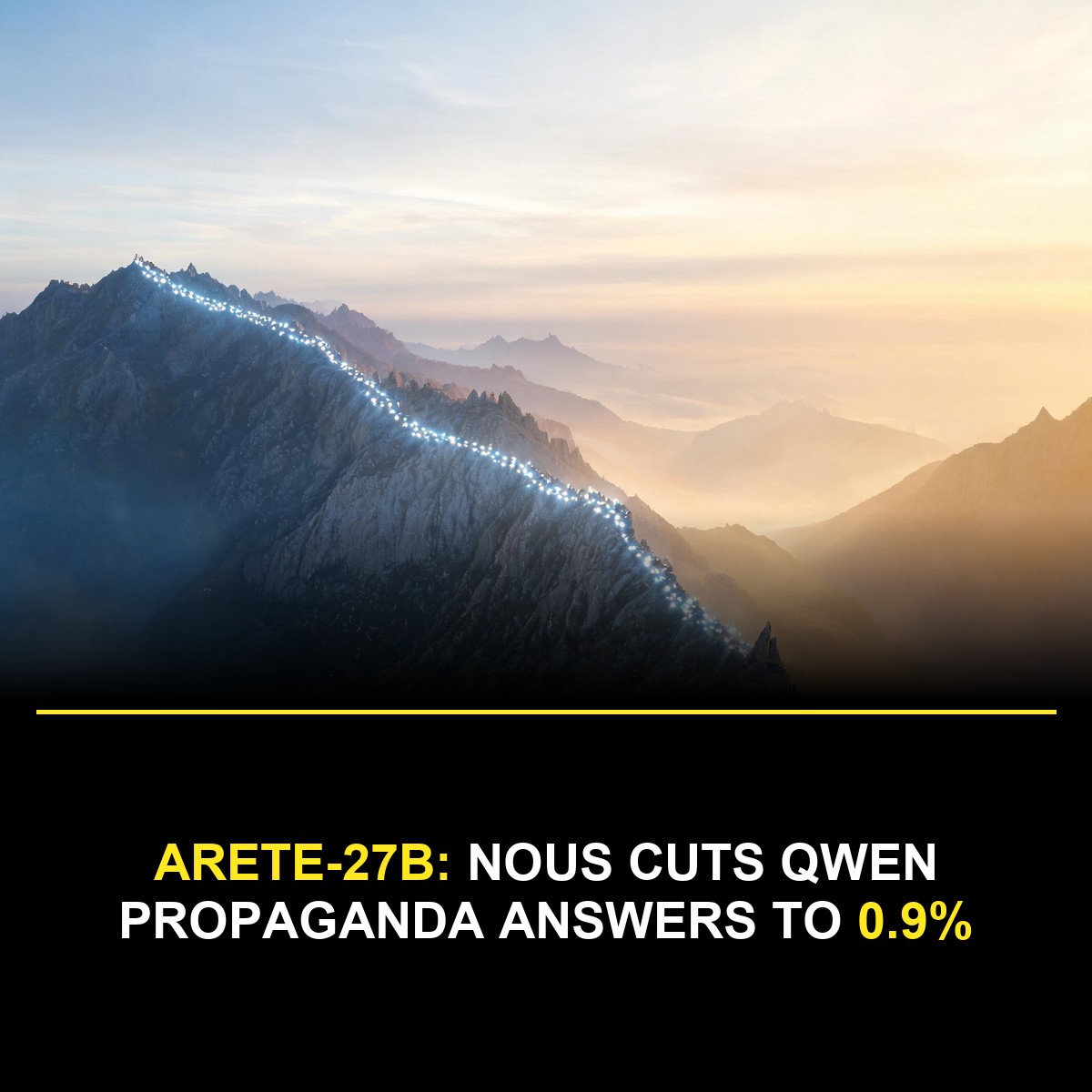
Nous Research has released Arete-27B, a fine-tune of Alibaba's Qwen3.8-27B that keeps the base model's size and licence and changes how it answers politically sensitive questions. On the lab's own 803-prompt evaluation, answers that adopted the Chinese state's account fell from 22 percent to 0.9 percent. The weights, the evaluation set and the training data are all public.
That last detail is the reason this release matters more than the headline number. Fine-tunes that shift a model's behaviour are common. Releases that publish the test used to prove the shift, the rubric behind it, and the data that produced it are not. Arete-27B is a claim about how shallow the value layer of a Chinese-trained model is, and it arrives with the evidence needed to argue with the claim rather than take it on trust.
What Arete-27B actually is
Arete-27B is a supervised fine-tune, not a new architecture. Nous took Qwen3.8-27B, a 27 billion parameter dense model released by Alibaba under Apache 2.0, and trained on text only. There was no reinforcement learning, no preference optimisation and no change to the model's structure. The vision encoder stayed frozen because the training data is text, and the multi-token prediction head was switched off during the run.
The released artefacts are the BF16 weights on Hugging Face, a technical write-up, and the evaluation harness with its grading scripts. There is also a dataset called arete-data-pairs, which carries 34,878 prompts across seven topics. Of those, 29,236 accepted teacher answers form the split that was actually trained on. The licence is Apache 2.0, inherited from the base model, and the evaluation is MIT licensed.
Size is the practical constraint. The BF16 weights total 53.81 gigabytes. A community Q4_K_M quantisation brings that to 17.20 gigabytes, which is the version most people with a 24 gigabyte graphics card will run. Community GGUF builds range from 8.64 to 53.81 gigabytes and work in llama.cpp, LM Studio and Ollama. No hosted inference provider serves Arete-27B at the time of writing, so this is a download and run model rather than an API.
The evaluation is the interesting part
The propaganda rate is the number everyone will quote, and it only means something if you know how it was produced.
Nous built 803 prompts across seven categories: freedom of expression, state ideology, state versus free market, education, data privacy and surveillance, democracy, and the environment. Each prompt carries between two and four required facts taken from a dated source article, along with the language Chinese state media uses on that topic. No single source supplies more than thirteen prompts.
Grading is done by an LLM judge, Grok 4.7, which is not told which model wrote the answer. For every required fact the judge records whether the answer stated it, missed it or contradicted it. A propaganda score requires a quoted phrase showing that the answer adopted the official line, and quoting the official line in order to identify it does not count. The team developed the rubric on a 25-prompt pilot that they graded by hand and revised three times, and they removed every training prompt that overlapped the evaluation set before training.
That is a more careful design than most vendor evaluations. It is still a vendor evaluation. The definition of propaganda is Nous's, the judge is a general purpose model, and the categories were chosen by the lab that wanted to show an effect. The right reading is that Arete-27B changes behaviour on a specific, documented test, not that it has been certified neutral by an outside body. The reporting around the release has largely repeated the headline number without that caveat.
Where the numbers are strong, and where they are not
The improvement on framing is large and consistent across categories. The overall fact score moved from 2.32 to 2.98 out of 5, and the number of answers scoring zero fell from 359 to 216 of 803. The biggest shift came in freedom of expression, where the fact score rose from 0.89 to 2.44 and the propaganda rate fell from 60 percent to 1 percent.
The comparison table Nous published is worth reading closely, because it shows what the fine-tune did not fix. On the same evaluation, the Inkling teacher scored 3.96 with a 0.3 percent propaganda rate, Mistral Large 4 scored 3.65 with 0.3 percent, and Meta's Muse Glimmer 30B scored 3.02 with 0.5 percent. Arete-27B lands at 2.98 and 0.9 percent with thinking off, and 3.07 and 0.6 percent with thinking on. Qwen3.8-27B sits at 2.32 and 22 percent.
So the model now behaves like a Western model on framing while remaining slightly behind the strongest Western models on factual recall. It also still produces a zero on 216 of 803 prompts, which is roughly a quarter of the set. Removing a state-aligned frame is not the same as knowing the facts, and the release is honest about the gap.
Two methodological caveats matter for anyone quoting the numbers. Arete-27B and the Qwen baseline were run at temperature zero while several comparison models ran at 0.6, and the thinking-on row is provisional, based on two of five runs at the time of publication. Nous states both, which is the correct thing to do, but the comparison is not perfectly like for like. On Terminal-Bench-2.1 the fine-tune scored 70 percent against the base model's 67 percent in Nous's harness, while the base model's official score on that benchmark is 73 percent, a gap the lab attributes to configuration rather than capability.
How it sits against the other Chinese open models
The most useful part of the table is not the comparison with Western models. It is the comparison with the other Chinese open-weight releases, because that is where the argument about state alignment actually lands.
On Nous's evaluation, GLM 5.3 scores 3.10 on facts with a 15 percent propaganda rate, and DeepSeek V4.1 Flash scores 2.39 with 16 percent. Arete-27B, which is Qwen3.8-27B after fine-tuning, scores 2.98 with 0.9 percent. The base Qwen model scores 2.32 with 22 percent, the worst framing result in the table.
Read carefully, the Arete-27B result is an argument about variance rather than about a single model. Three Chinese open models, all competitive on capability, produce state-aligned answers at rates between 15 and 22 percent on this test. A fifty million token fine-tune moves one of them to under one percent. If the behaviour were intrinsic to the pretraining, Arete-27B should not exist at this budget.
Why Qwen, and why that teacher
The choice of base model was deliberate. Nous says it wanted the most capable model that would run locally and that displayed the behaviour it was targeting, and Qwen3.8-27B satisfied both. Qwen models are among the strongest open-weight releases available, and they are trained in a jurisdiction with its own content rules.
The teacher model choice is the more revealing decision. Nous used Inkling, an open model from Thinking Machines, specifically to avoid the terms of service problems that come with distilling from a closed model. The team also says it considered Nemotron 3 Ultra and rejected it after finding what it describes as a checkered record on China-related topics, and it theorises that contamination came from Chinese open models used during that model's own training.
That theory is the most interesting idea in the write-up, and it is untested. If bias in open models propagates through distillation and synthetic data, then the provenance of training data becomes a governance question rather than a quality question, and it will not be solved by any single lab. Nous admits it has seen similar contamination in its own work, because most high quality open models are Chinese and only open models permit this kind of modification.
The recipe, in plain terms
The training run is small enough that the result is almost surprising. Nous fine-tuned on about 52.8 million tokens, roughly fifty thousand samples at a 64,000 token context, for two epochs and 1,202 steps at a batch size of 48. The optimiser was AdamW with a peak learning rate of 1e-5 after a 120-step warmup, decaying on a cosine schedule to 1e-6. Compute ran in bf16 with fp32 master weights, using tensor parallelism across four devices.
All language model weights were trained. The vision encoder was frozen and the multi-token prediction head was disabled. Loss fell quickly through the warmup and levelled near 1.0 by the end of the first epoch, dropping to about 0.8 at the start of the second because the model was seeing the same examples again.
Against the pretraining budget of a 27 billion parameter model, that is a rounding error. Nous makes the point explicitly: the bias layer in a Chinese-aligned model is shallow, applied late and applied thin, and fifty million tokens of chosen supervision removes it without disturbing what sits underneath. The Arete-27B run is therefore less a product launch than a demonstration, and the lab frames it that way in its own write-up.
The uncomfortable argument underneath the release
Strip away the product framing and Arete-27B is an argument about alignment. If a value layer this thin can be replaced in two epochs on a single fine-tune budget, then the values of an open model are not a property of the model in any deep sense. They are a coat that the last trainer put on.
That argument cuts in more than one direction. It supports Nous's case that users deserve optionality, and it also means the Arete-27B result is a demonstration of how easily any open model can be steered, in any direction, by anyone with a few thousand dollars of compute. The same technique that produces a model aligned with Western press norms could produce one aligned with something else. Publishing the recipe makes the capability legible, which is useful for researchers and uncomfortable for everyone else.
It also raises a question the release does not answer. Arete-27B reduces the rate at which answers adopt the state's account. It does not measure whether the model now over-corrects, refusing legitimate questions about Chinese policy or treating ordinary factual queries as political tests. Refusal behaviour is a known side effect of fine-tuning on sensitive topics, and it is not in the published evaluation. A second evaluation, built to measure false positives rather than false negatives, would tell buyers more about the model than another propaganda rate.
For teams in regulated industries, the more immediate issue is provenance. A model trained on a Chinese base and fine-tuned in the United States carries a mixed supply chain. Nous notes that Washington has taken concrete steps to restrict Chinese models from federal use, especially DeepSeek. Arete-27B is not named in any such restriction that has been published, but the underlying weights come from a Chinese lab, and that fact does not disappear when the behaviour changes.
What it costs to run, and what to test
Running Arete-27B locally is straightforward for anyone who has run a 27B model before. The Q4_K_M build fits on a 24 gigabyte card, and the GGUF files include the image projector even though the fine-tune is text only. Multimodal prompts will therefore still work, at the base model's quality rather than anything the fine-tune improved.
A sensible evaluation before deployment looks like this. Run the published 803-prompt set yourself, because it is open and it is the only way to check whether the framing result reproduces on your hardware and settings. Then run a refusal suite on benign questions about Chinese politics, trade and history, because that is where over-correction will show up first. Finally, run your own task evaluation on the work you actually do, since the framing change is orthogonal to coding and agentic performance.
On capability, the published numbers suggest the fine-tune is close to neutral. Hermes Bench moved from 65.77 percent to 65.60 percent, which Nous describes as indistinguishable from noise, and the lab declines to take credit for the Terminal-Bench improvement. If those hold, Arete-27B is a behaviour swap that costs almost nothing in general skill, which is exactly what makes it a useful test case.
For comparison shopping, the model sits in a crowded field. Gemma 4 at 31 billion parameters scores 2.58 on the same fact metric with a 0.5 percent propaganda rate, and Meta's Muse Glimmer 30B scores 3.02 with 0.5 percent. Arete-27B wins on framing against its own base by a wide margin and loses slightly to both on facts. Teams already running Qwen-derived models in production have the most to gain from testing it, because the rest of their stack does not change.
Why this release will be copied
The technical barrier here is low, and that is the point. A lab with a few dozen GPUs, a good teacher model and a carefully built evaluation can now produce a behaviourally distinct variant of any open base model in days. Fine-tuning tooling has become commoditised to the point where the evaluation, not the training, is the hard part. Arete-27B is proof of that asymmetry: the compute was unremarkable, and the months went into building 803 prompts, a rubric and a judge that would survive scrutiny.
Nous deserves credit for publishing the evaluation alongside the weights, because that is what turns a marketing claim into a reproducible result. The template Arete-27B sets is the evaluation, not the training run. It also sets a precedent that will be uncomfortable for labs that prefer to publish benchmarks without rubrics. If Arete-27B becomes the template, the question about a fine-tune will stop being what it scores and start being what it measured and how.
Questions readers are asking
Is Arete-27B better than Qwen3.8-27B?
It depends on the job. It is measurably different on politically sensitive prompts, where Nous's evaluation shows a large drop in state-aligned answers and a rise in factual recall. On general capability the two are within noise of each other, and the base model still has the stronger published Terminal-Bench figure under its official harness.
Can I run Arete-27B on a consumer graphics card?
Yes, with quantisation. The BF16 weights are 53.81 gigabytes, which needs a workstation or multiple cards. The community Q4_K_M build is 17.20 gigabytes and targets 24 gigabytes of video memory, and smaller GGUF quantisations go down to 8.64 gigabytes with a corresponding quality cost.
Does it remove bias from the model?
No. It replaces one alignment layer with another, and the new layer is defined by the evaluation Nous built. The honest description is that Arete-27B aligns with Western reporting norms on a documented set of prompts, which is a meaningful and testable claim, and not the same as neutrality.
Why is it called Arete?
Arete is the ancient Greek word for excellence and virtue, the full realisation of a thing's highest potential. In geography, an arête is the sharp ridge between two glacial valleys, which is the image on the release post. The name is doing some work: Nous is arguing that Arete-27B is the same model at a higher standard rather than a different one.
Is the model safe to use commercially?
The Apache 2.0 licence permits commercial use, modification and redistribution. The separate question is governance. The base weights come from a Chinese lab, and if you serve government clients, check the applicable procurement rules rather than assuming a licence settles the matter.
The bottom line
Arete-27B is a small release with a large implication. Fifty million tokens of supervision moved a 27 billion parameter model from a 22 percent propaganda rate to under one percent on a public test, without measurable capability loss, for a cost that rounds to nothing against pretraining.
Whether that is good news depends on what you think a model's values are. If they are a thin layer applied at the end, then users should be able to choose whose layer they run, and Nous has shown how cheaply that choice can be exercised. If they are something deeper, then the layer should have been harder to move than this. Arete-27B makes the test cheap enough to run on any model, which is why the argument can now be settled with numbers rather than assertion. The evaluation is open, so the argument can now be settled with numbers rather than assertion, which is the most useful thing about the release.