Voyager 1 Reaches One Light-Day From Earth
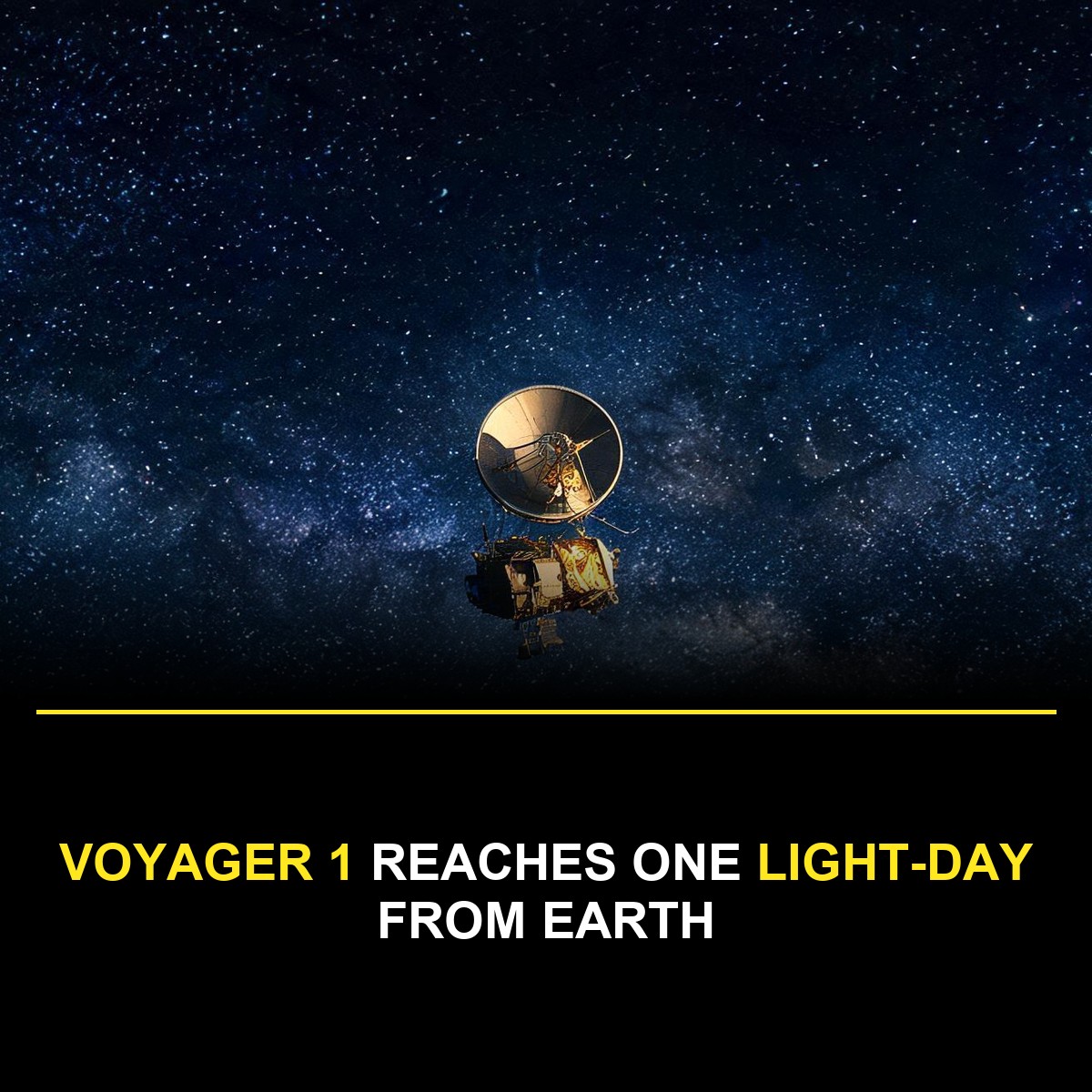
Sometime in mid-November 2026, Voyager 1, a spacecraft launched when disco was on the radio, will cross a line no human-made object has ever crossed. Voyager 1, cruising through interstellar space at roughly 38,000 miles per hour, will reach a distance of one light-day from Earth, the distance light itself covers in 24 hours, about 16.1 billion miles. The milestone moment lands on Wednesday, November 18, 2026, at 5:16 a.m. EST, and it took 49 years, two months, and 11 days of continuous travel to get there.
The number is worth sitting with. Light crosses the Earth-Moon gap in 1.3 seconds and the Sun-Earth distance in about eight minutes. Voyager 1, the fastest-moving object humanity has sent on an outbound trajectory, needs a full day for its radio signals to make the one-way trip home. A command sent from Earth arrives a day later; the confirmation returns another day after that. Two full days minimum for the simplest possible conversation.
This article explains what a Voyager 1 light-day actually measures, why the milestone is more than trivia, what the communications delay means for the mission's remaining years, and how a spacecraft built with 1970s technology keeps making history from 16 billion miles away.
What a light-day measures and why it is the right yardstick
A light-day is a distance, not a duration: 16,094,799,096 miles, exactly as far as a photon travels in one day through vacuum. Nothing in the universe outruns light, which is why light-distances are the only rulers that make cosmic gaps legible.
The familiar examples shrink instantly against Voyager 1's mark. The Moon is 1.3 light-seconds away. The Sun is 8.3 light-minutes. Neptune, the outermost planet, sits four light-hours and ten light-minutes from Earth, a distance that took Voyager 2 twelve years to cover at 35,000 miles per hour. One light-day is nearly six times the Earth-Neptune gulf. The nearest star system, Proxima Centauri at 4.24 light-years, is more than 1,500 light-days away, which is the scale against which Voyager's record looks both monumental and microscopic: after half a century of flight, the farthest human artifact has covered less than one fifteen-hundredth of the gap to the very next star.
That double character, a record and a reminder, is what makes the Voyager 1 milestone resonate. One light-day is the farthest reach of anything humans have built, and it is also the clearest demonstration of how empty the universe is. Voyager 1 will cross the mark heading toward Gliese 445, an obscure star in Ursa Minor that it will pass within 1.7 light-years of, in about 40,000 years.
The yardstick also reframes the mission's achievement in engineering terms. Voyager 1's velocity, about 61,000 kilometers per hour, sounds enormous on Earth and is a crawl relative to light, roughly 0.0057 percent of light speed. The gap between what rockets can do and what physics allows is the wall every future interstellar mission still faces, and the light-day mark measures that wall directly.
The two-day conversation with the deepest machine
The communications delay is the practical face of the Voyager 1 milestone, and it changes what operating the spacecraft means.
At one light-day, the round-trip light time between Earth and Voyager 1 approaches 48 hours before accounting for scheduling and processing. Every interaction with the spacecraft is now a two-day commitment: a command transmitted by the Deep Space Network's giant antennas reaches the ship a day later, executes, and its confirmation crawls back across another light-day of vacuum. There is no real-time diagnosis, no interactive debugging, no quick question. The mission team flies the spacecraft the way one plays correspondence chess, each move planned in advance, each consequence observed days later.
That constraint collided with reality in October, when the Deep Space Network failed to detect Voyager 1's signal during its scheduled attempts on October 18 and 19. Contact had been lost before, memorably in 2023 when a malfunctioning computer nearly ended the mission and took five months to fix from 15 billion miles away. This time the silence resolved itself: the spacecraft had apparently turned off a transmitter, and on October 20, after 48 hours, communication resumed on its own before the team even sent corrective commands, with engineers concluding the probe's fault protection had switched it to a backup mode and its autonomous systems managed the recovery.
The episode is a preview of the mission's endgame. As the spacecraft's plutonium power supply fades, roughly a few watts per year, the team progressively shuts down instruments and heaters, and each subsystem off becomes a calculated bet that the remaining hardware can hold. At a two-day conversation latency, every anomaly now tests automation designed in the 1970s, and every recovery is a race between autonomous fault protection and a repair conversation that takes days just to say hello.
What Voyager 1 is still doing out there
The milestone spacecraft is not a fossil; Voyager 1 still returns interstellar data, and the science it gathers has no substitute.
Voyager 1 crossed the heliopause in 2012, the boundary where the Sun's constant wind yields to the interstellar medium, and its particle and wave instruments have been reporting interstellar conditions ever since, with Voyager 1 now the reference point for all such data. Every plasma oscillation, cosmic ray flux measurement, and magnetic field reading from beyond the boundary is the only in-situ data of its kind. The two Voyagers are, effectively, humanity's only weather stations in the interstellar void, and their slow drift through it maps a region no telescope can probe remotely with equivalent fidelity.
The probe's trajectory carries it toward Gliese 445 at a closing speed that will bring no encounter; the star is moving toward the spacecraft as much as the reverse, and the 40,000-year flyby will be silent and dark. Long before that, the mission's active science will end as power fades, with engineers expecting meaningful operations to wind down sometime in the 2030s. After that, the spacecraft becomes a message rather than an instrument: the Golden Record, its gold-plated disc of Earth's sounds and images, rides along for billions of years toward a star no one chose for its habitability, because the point was never arrival.
That framing, science ending but presence continuing, is what gives the light-day milestone its emotional weight. On November 18 the record will note the farthest conversation humans sustain, and the day the conversation finally ends is already visible on the power budget's horizon.
The record that will stand for a long time
Nobody is catching Voyager 1, and the reasons are instructive about the current limits of spaceflight.
Voyager 1's advantage is not speed but head start and direction. Any future spacecraft, even one dramatically faster, must first overtake 16 billion miles of accumulated distance, and nothing on any agency or private roadmap does. The fastest outbound object planned, a future solar-observe-and-relay concept or an interstellar precursor mission, remains in study phases, while current operational craft like New Horizons, itself beyond Pluto and still healthy, trail Voyager 1 by billions of miles. Voyager 2, the twin that took the scenic route past Uranus and Neptune, will reach its own light-day mark in November 2035, nine years behind.
The overtaking math is brutal because rocketry scales poorly against distance. Even a spacecraft traveling twice Voyager 1's speed would need decades just to close the gap, and no mission at that speed exists. The practical result is that Voyager 1's record will likely stand into the 22nd century, held by a machine with less computing power than a car key, built by engineers who tested its systems with oscilloscopes and paper printouts.
There is a quiet lesson in that. The farthest reach of human engineering is not the product of the most advanced technology available but of a simple design built to last, pointed reliably in one direction, given enough time to compound. Voyager 1's light-day record is as much a monument to durability engineering as to propulsion, and it argues that in exploration, longevity is a speed of its own.
The 1970s engineering that refuses to quit
The Voyager 1 milestone is also a tribute to how the spacecraft was built, and the design choices behind its longevity are worth listing because modern engineering has drifted away from them.
Voyager 1's computers have no operating system in the modern sense, just hand-optimized code burned into memory, with triple redundancy on the critical paths. The attitude control system keeps the antenna pointed at Earth using pulses from thrusters that have fired millions of times, and the autonomy, minimal by today's standards, was built to handle exactly the class of problem that October's transmitter scare showed it still handles: detect a fault, switch to backup, protect the mission core, wait for instructions that will take a day to arrive.
The power source is the ticking clock. Voyager 1 and its twin run on plutonium-238 decay in radioisotope thermoelectric generators, which lose about four watts of output per year. The mission has managed that decline deliberately for years, shutting down heaters, then instruments, hoarding every watt for the experiments that matter most. Each shutdown is a small funeral with a spreadsheet attached, and the remaining budget determines how many more years of interstellar data the baseline can fund.
The materials angle compounds the achievement. The spacecraft's wiring, connectors, and joints have cycled through decades of thermal swings, and its moving parts, especially the scan platform and the tape recorder, have long since been retired or frozen out of use. What remains flying is the subset of the machine that needed no maintenance and no moving parts, which is a design lesson in one sentence: everything that survives is everything that could not break.
Modern probes carry redundancy through software intelligence rather than simplicity, and that trade has bought capability at the price of complexity. Voyager's half-century is the counterargument that simplicity, pointed outward, compounds into immortality.
What the milestone means for the rest of us
Beyond the engineering, the light-day mark offers a genuinely useful mental model for thinking about scale, and a rare shared moment of perspective.
For anyone teaching or explaining space, the light-day is the most intuitive large-distance unit yet: everyone knows what a day feels like, and everyone knows light is fast, so the collision of the two, a full day of light-speed travel to reach our farthest machine, lands in a way that light-years never do. NASA's own outreach has leaned on exactly that framing, with a live countdown to the moment and real-time odometers for both spacecraft.
The milestone also lands in a week of contrasts: Apple launched touchscreen Macs, AI models traded benchmark records, and the tech world sprinted through refresh cycles measured in months. Against that pace, a 49-year-old spacecraft crossing a light-day is a useful corrective. The most distant extension of human presence runs on 1970s silicon, communicates in whispers that take days to arrive, and will outlast every product mentioned in this publication this year.
For readers who want the hardware side of humanity's far-reaching technology, the machines pushing compute to its limits on Earth are covered in our Vera Rubin bandwidth analysis, the AI systems now driving discovery science are examined in our FlashProve coverage, and the question of what durable engineering looks like in practice is a running theme in our Together Compiler analysis.
The team that still flies it
Behind the Voyager 1 milestone is a fact that surprises most people: the spacecraft still has a full-time operations team, and its working style is unique in spaceflight.
The Voyager mission operations group is small, measured in dozens rather than hundreds, and many of its members have served for decades, some since the planetary encounters. Their week is organized around Deep Space Network scheduling windows rather than meetings, their debugging happens across day-long message latencies, and their institutional knowledge includes hardware behaviors that were documented before most of the current aerospace workforce was born. When the 2023 memory fault struck, the recovery took months of creative archaeology through forty-year-old documentation, and the engineers who wrote the original code were retired; the fix came from people reading their work the way historians read manuscripts.
That team endures because the mission does. Every year of interstellar data strengthens the case for keeping the lights on, and the light-day milestone arrives while the spacecraft still produces science that motivates the budget line. The November 18 date will be marked, the odometer will roll past 16 billion miles, and then the team will go back to the slow work of stretching watts, the real currency of the mission's final act.
The human continuity is the part of the story that may be hardest to replicate. Future deep-space missions will be run by software and larger teams with turnover, and something specific is being lost when the last people who understand a machine by memory retire before the machine does. Voyager's longevity is a joint achievement of spacecraft and staff, and both records deserve the headline.
Questions readers are asking
When exactly does Voyager 1 cross one light-day?
Wednesday, November 18, 2026, at 5:16 a.m. EST, per NASA's countdown, after 49 years, two months, and 11 days of flight.
Does the two-day delay mean the mission is ending?
No, but it defines its constraints. The spacecraft still returns interstellar data; every interaction simply takes days. The mission's real end will come from declining plutonium power, likely sometime in the 2030s, not from the distance milestone itself.
Why does the delay matter so much?
At one light-day, a one-way radio message takes 24 hours, so any back-and-forth approaches 48 hours minimum. Diagnosis, repair, and even routine health checks all move at the speed of light-travel time, which the October transmitter scare demonstrated vividly.
Will anything ever overtake Voyager 1?
Nothing on any roadmap. Even a spacecraft twice as fast would need decades to close 16 billion miles, and no such mission is funded. The record is likely to stand for a century or more.
The twin, the successors, and the far map
The full picture of the light-day milestone includes the spacecraft behind it and the missions that will inherit its journey.
Voyager 2, launched sixteen days before its twin but taking the slower grand-tour trajectory past all four giant planets, sits billions of miles closer and crossed into interstellar space in 2018 through a different sector of the heliopause. Its nine-year lag to the light-day mark, arriving November 2035, means the next decade carries a second chance to celebrate the same threshold, and its instruments still return unique data from the other side of the boundary.
New Horizons, the Pluto flyby spacecraft, is the third human object in interstellar territory's outskirts, healthy and productive in the Kuiper Belt, but its slower escape trajectory and later launch leave it tens of billions of miles behind. The remainder of the far catalog is silence: Pioneers 10 and 11 went quiet decades ago, and nothing else launched since is on an escape trajectory with working transmitters.
What comes next is more interesting than what is chasing. The proposals with real momentum, solar-gravity-lens missions to 550 astronomical units and dedicated interstellar probes, all accept that flight times are measured in decades and design for it, which is Voyager's true legacy: the demonstration that a mission can outlive its makers, its politics, and its budget cycles if it is built simply and aimed truly. Until one of those successors launches, November 18 belongs to a 49-year-old machine with the memory of a modern doorknob, and the gap between what it carries and what it represents is the widest in the history of engineering.
Sources
- NASA Science, “Voyager 1: What Is a Light-Day” with the official countdown: https://science.nasa.gov/mission/voyager/voyager-1/voyager-1-what-is-a-light-day
- NASA Voyager mission status and mission updates: https://science.nasa.gov/mission/voyager/
- NASA Deep Space Network: https://www.nasa.gov/directorates/somd/space-communications-navigation-program/dsn/
- NASA Voyager Golden Record overview: https://science.nasa.gov/mission/voyager/golden-record/