PAN 2: MBZUAI’s Open World Model That Simulates Actions
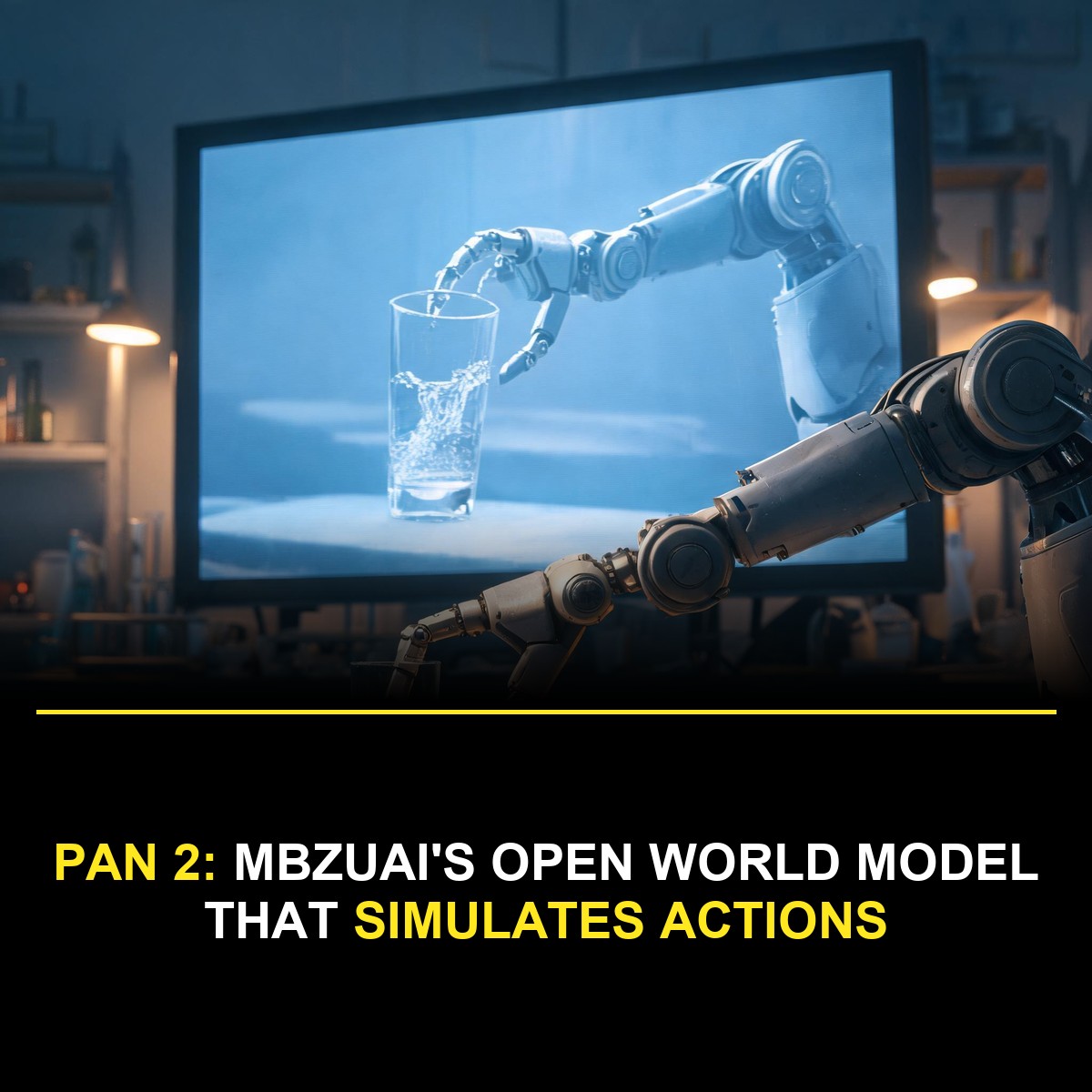
The Institute of Foundation Models, the research lab founded by MBZUAI, has released PAN 2. It is an open 29-billion-parameter world model that takes a scene and an action written in words, and returns a video of what it predicts will happen next. The weights, the training code and the inference code are all published under the Apache 2.0 license. That makes PAN 2 one of the very few world models ever released with its full training pipeline.
The idea behind it is called simulative reasoning, and IFM's founder Eric Xing frames it with a swimming analogy. A language model learns the world as it has been written down, which is book knowledge, and you cannot learn to swim from a book. Physical intelligence begins when a system can simulate what its actions would do before acting. A language model predicts the next word. A world model predicts the next world.
That framing matters for agents. An AI agent that can ask what happens if I do this, and see a simulated answer before acting, can learn and plan without costly, slow or irreversible real-world trials. PAN 2 is IFM's foundation for that idea, and its release raises two questions: how good is it, and what does an open world model change? This article draws on IFM's press release and an independent fact-check that read the model card and code repository against the announcement.
What PAN 2 is, and how it works
You give PAN 2 a starting point, which is a text description and optionally an image, and an action in text, such as pouring juice from one glass into another. It returns a video of the predicted outcome, up to 20 seconds long at 704 by 1248 resolution and 24 frames per second.
Inside, two models work in sequence. The first is a language model, which reads the scene and the action and writes a structured, time-stamped description of what happens next: who acts, at which second, and how the camera moves. The second is a 29.2-billion-parameter video diffusion model, trained from scratch on hundreds of millions of videos annotated for physical dynamics rather than visual appeal, which turns that description into video. The diffusion model is what the release contains.
The architecture builds on Generative Latent Prediction, or GLP, an approach pioneered by Xing and IFM researchers that predicts change in an internal representation and then reconstructs what an observer would see. That design matters because it keeps the prediction grounded: predictions can be checked against the real world rather than judged only by how plausible they look.
The results, with the honest breakdown
IFM evaluated PAN 2 across six core dimensions of physical simulation: physical consistency, causal coherence, entity persistence, constraint satisfaction, viewpoint invariance and objective dynamics. On those, PAN 2 placed just behind MiniMax-H3, another open model, and ahead of four other systems including closed ones.
The multi-step result is the headline. IFM built its own test of 100 everyday tasks seen from a first-person view, run with and without a starting image for 200 prompts and 456 steps total. A judge model checks every step, and a plan counts as complete only if every step in it is carried out. PAN 2 completed 75.1 percent of individual steps and 34.0 percent of whole plans, which IFM describes as the highest full-plan completion among the models studied. MiniMax-H3 follows at 32.5 percent.
Two honest details sit next to that headline. The gap to MiniMax-H3, 1.5 points, is smaller than the spread between runs, which the model card gives as 3.61 points for PAN 2. And on single steps, MiniMax-H3 is ahead by 0.02 points. The full-plan lead is real but fragile, and IFM's own model card states the weakness plainly: about two in three simulated plans contain at least one step that is not carried out.
On public benchmarks, PAN 2 scored 49.38 on Physics-IQ Verified with Claude Opus 5.5 as the language model in front, which would rank first among open-weight models and third overall on that leaderboard. Run in each model's own default setup, PAN 2 scores 37.48 against MiniMax-H3's 42.91, a reminder that the language model in front is doing real work.
The language model matters more than you would expect
The clearest finding in IFM's own evaluation is about the division of labour, and it is easy to miss in the coverage.
IFM kept the diffusion model fixed and changed only what happened in front of it. With no language model at all, not one multi-step plan completed. With a language model that merely reformatted the prompt into the required structure, full-plan completion reached 27.8 percent. With a language model that actually reasoned about the task and then wrote the structured description, it reached 34.0 percent.
That ladder tells you where the intelligence lives in this system. The 29-billion-parameter diffusion model is a renderer of physical dynamics, not a planner. The planning happens in whatever language model sits in front. IFM tested four: Claude Opus 5.5, GPT-6 Astra at medium effort, Kimi K3 and Qwen 3.8 Flash, with Kimi K3 used in the main studies. The release ships a prompt, an agent skill for coding agents, and a script for running a local model in that seat, with the note that any instruction-following LLM can be used.
For anyone deploying a world model, that is the architecture lesson: the video model is a simulator, and the reasoning model is the experimenter. Quality in one does not compensate for quality in the other.
How PAN 2 was trained, and what that costs
The training story is part of the release. The 29.2-billion-parameter diffusion model was trained from scratch on hundreds of millions of videos. The annotation pipeline matters as much as the scale: the videos were chosen and annotated for physical dynamics rather than visual appeal, in the structured format the model expects.
That design choice explains one of the model's strengths. Because the training captions described physical outcomes in a consistent, time-stamped format, the model learned the relationship between described actions and observed dynamics rather than the relationship between captions and pretty footage. A video model trained on cinematic data would learn camera language and spectacle. PAN 2 was built to learn what happens.
The release also includes the training code itself, which is the rarest part. Teams can reproduce the training pipeline, study the data selection, and retrain with different corpora. IFM notes that few world models are released with their full training code, and the claim is verifiable: the repository holds it under Apache 2.0 alongside the weights and the inference stack.
For researchers, that opens the kind of work closed models never allow. A robotics lab can fine-tune PAN 2 on its own manipulation footage. A simulation group can study how the GLP architecture handles domains beyond everyday video. A safety team can probe where the physics shortcuts appear, using the same failures IFM documents. Open training code turns a model release into a research platform, and that is the strongest argument IFM makes for its approach.
What the release actually contains, and what it takes to run
IFM released the video model weights, the full training code, the inference code, a technical blog and documentation, all Apache 2.0. IFM notes that few world models are released with their full training code, which matters for reproducibility: researchers can check how the model was built, not just what it outputs.
Running it is a serious undertaking. The Hugging Face repository held about 86GB of files, roughly 67GB of that for the diffusion model itself. The inference guide says each worker holds the full 29-billion-parameter model, with one worker per GPU, and a setting exists to move parts of the model off the GPU when it does not fit. No minimum memory figure or time per clip is published.
The prompts need rewriting into the structured format before the diffusion model will accept them, with a hard limit of 1,536 tokens per caption. Free text goes through the language model first. And IFM recommends running a separate guardrail. In its own tests the guardrail cut the share of harmful text requests that produced an unsafe video from 33.9 percent to 1.5 percent, while also stopping 11.5 percent of harmless requests. The model card is direct about the trade: the guardrails reduce, but do not eliminate, the risk of harmful outputs.
What PAN 2 cannot do yet
The limitations section of the model card is unusually specific, and it is the most useful part of the release for anyone planning to build on it.
PAN 2 is sensitive to wording. IFM says the showcase examples beyond the training data relied on hand-refined prompts, which means the demo quality depends on prompt craft that the pipeline does not provide. Long scenes drift: each clip starts from one frame and text, so the look of things changes across clips. Fine hand movements are described only roughly in text. And the model can take shortcuts, reaching the requested end state while breaking physics on the way; IFM's example is pasta appearing in the colander before it has been drained.
The test design has a gap too. It covers plans designed to succeed, and how PAN 2 handles a plan that ought to fail has not been measured. That matters for the agent use case, because the value of simulation is precisely in catching the plans that would fail. IFM's own blog shows an agent using PAN 2 to work out which cap on a tube is glued shut, and it needed six attempts, misreading the second simulation as a success.
The model card closes with the sentence that should frame every use of this system: PAN 2's simulations are predictions, not records of real events.
Why an open world model matters
World models are the infrastructure layer for physical AI, and until now they have been mostly closed. A robot planning an action, a household agent checking whether a cup will break, or a policy tester validating a manipulation sequence all need a simulator, and simulators built by hand are expensive and narrow. A learned world model that runs from text and images changes that, if it is good enough.
The open release changes who can work on the problem. With weights, training code and inference code public, any lab can reproduce the results, test the limits and build on the architecture, rather than consuming a world model through an API. IFM's Hector Liu, director of the Silicon Valley lab, framed the intent: researchers should be able to test PAN 2's capabilities, understand its limits, and build on it.
IFM is an unusual player in this space. Launched in May 2025 by MBZUAI, it operates labs in Abu Dhabi, Silicon Valley and Paris. Its portfolio includes the K2 series of fully open-source language models and Jais, the most advanced Arabic LLM, alongside PAN. The institute has made open release a consistent strategy, and PAN 2 extends it from language into physical simulation.
The competitive landscape is moving quickly. MiniMax-H3, also open, competes directly on these benchmarks. Google's Genie 4 renders steerable worlds in real time from a different angle. The open ecosystem now has a world model it can dissect. CellCog's independent fact-check of the release read the blog post, model card and code repository against each other, and shows exactly what that scrutiny finds.
What the fact-checking found
An independent read of the release by CellCog found material details that the announcement does not surface, and they are worth stating because they sharpen the picture.
The release contains the diffusion model but no language model, so the system as deployed is a pair, and the pair changes depending on which LLM you choose. IFM's blog post and its model card give different figures for two of the compared models, Cosmos 3 Super and LTX 2.5. All six differing figures are lower in the blog post, and neither page explains the difference. PAN 2's own figures do not change between the two documents. And every number in the release is IFM's own; no independent results exist yet, the technical paper has not been posted, and no hosted version or price has been announced.
None of that undermines the release. It defines it: PAN 2 is an open research artefact with real limitations, published early and thoroughly, rather than a finished product. The model card's projection that raising step completion from 75 to 90 percent would roughly double full-plan completion is a forecast from six data points, and IFM labels it as such.
For context on the broader open-model trend, our coverage of Meta's Muse Spark running on consumer hardware and efficient inference for small models shows the same direction across modalities. Frontier-adjacent capability is moving into open weights, and Qwen-derived experimentation builds on permissive bases. PAN 2 extends that pattern into physical simulation.
Questions readers are asking
What is PAN 2?
An open, general-purpose world model released on 10 November 2026 by the Institute of Foundation Models at MBZUAI. Given a text description, an optional image and an action written in text, it returns a video of up to 20 seconds showing what it predicts will happen next. The release includes weights, training code and inference code under Apache 2.0.
Is PAN 2 open source?
The weights, training code and inference code are published under Apache 2.0, which permits commercial use and modification. The text encoder and video decoder come from other teams under their own licenses. Open-weight plus open training code is the accurate description, and it is rare: few world models ship their training code.
How good is PAN 2 at simulating plans?
On IFM's own test of 200 prompts and 456 steps, PAN 2 completes 75.1 percent of individual steps and 34.0 percent of whole plans, the best full-plan result among the models studied. The model card states that about two in three simulated plans contain at least one step that is not carried out, and MiniMax-H3 scores higher on single actions and in blind human preference.
Can I run PAN 2 myself?
Yes, with significant hardware. The release holds about 86GB of files on Hugging Face, and the 29.2-billion-parameter diffusion model wants a full GPU per worker. You also need a language model in front of it to produce the structured prompts. All figures for its performance are IFM's own, and the technical paper has not yet been posted.
What could PAN 2 be used for?
IFM points to robotics planning, where an agent tests manipulation sequences in simulation before executing them, and education, where students can see physical outcomes of described scenarios. The model can also simulate situations absent from its training data, such as an egg dropped onto a range of surfaces. The honest caveat runs through all of it: simulations are predictions, not records of real events, and one in three plans still fails somewhere.
The bottom line
PAN 2 is the most complete open release in world modelling so far: weights, training code, inference code and documentation, published under a permissive license by a lab that has made openness a strategy. It simulates actions with real physical grounding, leads on full-plan completion in its own tests, and ranks first among open models on the public Physics-IQ leaderboard in its best configuration.
It is also, by its own model card's account, a system that fails two thirds of multi-step plans, drifts across long scenes, takes physics shortcuts, and depends heavily on which language model sits in front of it. That combination is not a contradiction. It is what an honest open research release looks like, and it gives the field something closed world models cannot: a baseline everyone can test, reproduce and argue with. Physical intelligence is now something the open community can build, one failure mode at a time.