Night Shift Sleep: How to Rest When You Work Nights
At ten past seven on a Tuesday morning, a nurse at the end of her fourth night shift pulls into her driveway. She puts on the sunglasses she remembered to bring. Then she walks into a house that is already loud with other people's daytime: curtains shut, heating on, a mower two doors down. She has ninety minutes before the school run. Her body has just been told, at precisely the wrong moment, that the day has begun.
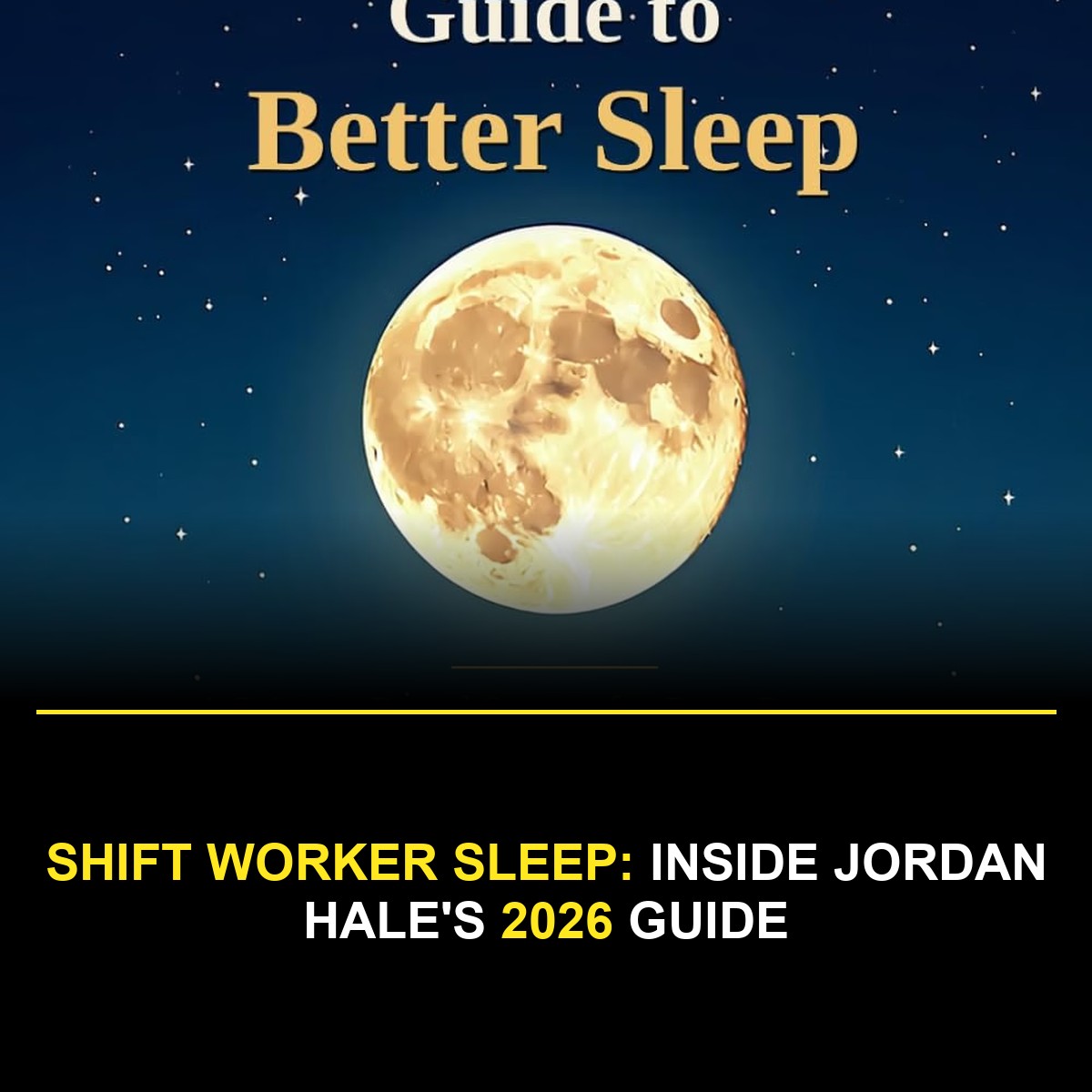
That scene is not a discipline problem. Treating it as one is why so much sleep advice fails the people who work the night shift. Jordan Hale's The Shift Worker's Guide to Better Sleep, published on Amazon on 22 November, begins from the opposite premise. Rest around a night shift routine is something you build, not something you summon. The book runs to 294 pages across 26 chapters, and almost none of them tell you to try harder.
What follows is a walk through the contents. It covers the physiology the book leans on, the playbooks for specific rosters, and the advice that admits its own limits. It also covers the moments where the book sends you to a clinician instead of selling a fix, and the places where a book of this kind cannot help.
If your roster is already the problem, the paperback is 16.99 dollars on Amazon, with the Kindle edition listed on the same page.
Why night shift sleep fights you
Sleep runs on two systems. In a normal week they agree with each other. In yours, they argue.
The first is sleep pressure. From the moment you wake, a chemical called adenosine accumulates in the brain. The longer you stay awake, the harder it becomes to stay awake, and sleep clears the debt. The second is circadian timing. That is an internal clock which runs on light and expects alertness through the daylight hours. It does not know what your employer scheduled, and it will not be reasoned with.
On a day shift the two systems point the same way. Pressure is high by late evening, the clock is winding down, and you fall asleep because both are telling you to. A night shift inverts that relationship. At five in the morning you are carrying roughly nineteen hours of accumulated pressure. Meanwhile the clock, having passed its lowest point a few hours earlier, has started pushing alertness back up. The last stretch of the night shift is therefore the hardest part of the day. The drive home is the part most likely to hurt you.
That is why Hale treats the commute as part of the shift. It is also why the book keeps returning to one uncomfortable idea. Drowsy driving after a night shift is not an accident of schedule. It is the predictable output of a body that has been awake too long while its clock begins to wake it up.
The most useful idea in the first fifty pages is a refusal. Plenty of sleep content promises that you will adapt to a permanent night shift if you follow the protocol exactly. Hale does not. Full circadian inversion takes consistent, repeated exposure, and a rotating roster never gives it the chance to settle. So the target becomes a workable seam between blocks of night shift. That is more honest than a permanent state of night shift physiology that most workers will never reach. Readers who have spent years feeling like failures for not adapting will notice how much weight that reframing removes.
What this book is, and what it refuses to promise
Jordan Hale writes about sleep, health and the hidden costs of modern work. The approach is research-led rather than clinical. The examples are composites, the medical disclaimer is printed plainly, and the author does not claim a practice. That matters less than you might expect. The value here is assembly rather than original research. The book gathers material scattered across occupational health guidance and sleep science, then puts it in the order you need on a bad week.
The structure follows that logic. Part I explains why the clock fights odd hours. Part II builds the toolkit of light, timing, environment, routine, naps, caffeine, food, movement and a master sleep schedule. Part III supplies playbooks for night shift blocks, early starts, rotation, transition days and irregular work. Part IV handles the cases where sleep still will not come. Part V covers the long game: food across shifts, mental health, relationships and a staged reset. The back matter is unusually practical for a general-interest book. It includes quick-reference checklists, a seven-day reset, a glossary, and answers to common questions that do not send you back to chapter one.
What it refuses is just as telling. There is no supplement protocol, no promise that the night shift becomes effortless, and no single bedtime imposed on every reader. Hale argues instead that damage becomes more predictable and recovery becomes more repeatable. The social costs, he suggests, become something you can negotiate with a household rather than absorb in silence.
You can check the chapter list before you spend anything on the Amazon listing for The Shift Worker's Guide to Better Sleep, which is also where the edition and format details live.
Light is the lever, but the drive home comes first
Of the four pillars the book builds on, light does the most work. The clock reads light and almost nothing else. That makes the timing of brightness a schedule signal rather than a matter of comfort. Bright light early in a night shift pulls the clock later and keeps you functional through the small hours. Darkness on the way home stops the morning from resetting you before you have slept.
That part is standard. What is less standard is where Hale places the safety line. A light protocol that sends you home from a night shift without sunglasses is a bad protocol, whatever the plan says about morning brightness. The book states this plainly. Avoiding morning light should never outrank getting home safely. A reader who follows the light chapter to the letter and crashes on the way is not a good student of the method. The method has failed.
That ordering decision tells you the author has watched people do this job rather than read about it. It also sets the tone for the rest of the book. Again and again, Hale prefers the achievable version of a technique to the perfect version nobody sustains.
Build the cave before you buy the gadgets
Chapter 8 is about the room, and it makes an argument that costs almost nothing to act on. A bedroom that suits a normal night is often unusable when you come off a night shift at seven in the morning. Daylight leaks around the curtains, the house is at its warmest, and the street is at its loudest. The sleep you get is lighter and more fragmented than night sleep, even when the hours look adequate on paper. Core body temperature is still elevated after a night shift, stress hormones can remain high, and the architecture of the sleep itself can be compressed.
The fix is unglamorous. Blackout comes before gadgets, a cool room beats a warm one, and noise is handled at the source where possible. What makes the chapter useful is the frame around it. Hale treats the bedroom as a controlled environment with an entry procedure. The same actions happen in the same order, every time. The point is to stop negotiating with your own body at eight in the morning, when you have no negotiating power left.
Chapter 9 extends that into a twenty-minute wind-down. Hale's observation is that the hardest part of the day is often not the night shift but the twenty minutes after it. The door closes, and the mind is still running the handover. Twenty minutes is deliberately short. A ninety-minute ritual is a plan you abandon by Wednesday. A short sequence survives a bad night and can be repeated at any hour.
Naps and caffeine are tools with clocks on them
Caffeine has a half-life of roughly five hours, with wide individual variation. On a night shift, that means a substantial fraction of an early morning coffee is still circulating when you try to sleep. A dose at seven in the evening is still measurable at midnight. Hale does not argue for abstinence. He argues for arithmetic. Place the dose where you need the lift, and stop early enough that the clearance curve finishes before your main sleep begins.
Naps follow the same logic, because a nap spends the sleep pressure you need later. The working rule is to keep naps five to six hours before your main sleep and to shorten them as you get closer. Placement matters as much as length. The natural dips fall in the early afternoon and in the two to five in the morning trough. A nap taken during the wake maintenance zone, when the body is already alert, mostly wastes the opportunity.
The coffee nap gets its own treatment, because it sounds like a novelty and behaves like engineering. Caffeine takes roughly twenty to thirty minutes to absorb and reach the brain. Sleep onset takes about the same time. Drink quickly, lie down immediately, set an alarm for twenty minutes or less, and the two arrive together. The book is careful about the boundary conditions. A four in the morning coffee nap halfway through a night shift is a mistake when bedtime is eight. The caffeine will still be working when you try to sleep. Use it early in the shift, not at the end.
Hale is equally careful about sleep inertia, the grogginess and dulled judgement that follow waking. It is worse when you are pulled out of deep sleep. For anyone driving a truck, operating a press, or carrying a radio on a ward, the recovery time after a nap is part of the nap. No fixed buffer guarantees a clean wake-up, and the book says so instead of promising one.
The best illustration is a bottling plant worker called Marcus. He spent months taking his three in the morning break in a plastic chair, scrolling, then fighting heaviness for the remaining five hours of a midnight to eight night shift. Twice he caught himself drifting on the drive home. The change was small. A 2:50 alarm for a 3:12 wake-up, no coffee, and a folded jacket on the floor of a quiet corner. That level of specificity is the difference between a principle and something you can do at three in the morning.
Playbooks for the rosters people actually work
General advice collapses at the roster. That is why Part III is the section most readers will use first. Permanent night shift work, early starts, forward and backward rotation, transition days and on-call work all get separate treatment. The failure modes are not the same. Someone on a permanent night shift is managing one long adjustment. A rotator is managing a series of them. Direction matters too, since the clock tends to run slightly longer than twenty-four hours. Forward rotation works with that tendency rather than against it.
The swap day is an operation, not a rest day
Transition days get treated as their own problem rather than leftover time. A day between blocks of night shift is not rest if it is spent in the wrong light, at the wrong meals, with no plan for the nap that decides whether the next shift starts from a deficit. The book gives transition days their own light, food and nap rules. It also accepts that some of them will be lost causes. Planning for the ones that are not is the whole point.
If you want the playbook that matches your roster, including the swap day and on-call material, the guide is listed on Amazon in print and Kindle.
When the problem is not a habit
Part IV is what separates this book from productivity writing. Insomnia gets cognitive behavioural tools adapted to rotating anchors rather than a single fixed bedtime. That detail is what makes the tools usable by people whose schedule moves. Sleep apnea and restless legs get a chapter, because both are common in night shift populations and neither responds to better curtains. Rumination gets one too, since the three in the morning brain is a different problem from an inability to fall asleep. Pain and reflux, which tend to cluster on particular shifts, get their own treatment.
The boundary is explicit. Witnessed pauses in breathing, unrelenting headaches, sleepwalking behaviours and sleep attacks during the day are reasons to see a clinician. They are not reasons to buy a better pillow. Treating a disorder as a discipline failure wastes months, and the book says so directly.
For anyone who reads a great deal about improving their life without changing much, there is a useful parallel in this site's piece on turning information overload into action. Reading a manual is not the same as running one experiment for a week.
The 90-day reset, phase by phase
Chapter 26 is where the book stops describing and starts sequencing. Days one to fourteen cover assessment and environment. You record what you actually do across a full night shift cycle, then fix the room. Days fifteen to thirty move to light and timing, protecting sleep opportunities and building routines that match the shift in front of you. Days thirty-one to sixty add naps, caffeine, meals and hydration. Days sixty-one to ninety consolidate and troubleshoot, with the expectation that some of it will not have worked.
The sequencing matters more than it looks. Most people attempt the whole system at once, fail at one element, and abandon the rest. The staged version gives each change a week or two of evidence before the next one lands. It also builds in the assumption of relapse. A bad week is data, not proof that the approach is wrong. The maintenance instruction is to restart the highest-leverage pillar rather than rebuild from nothing.
If you want the chapter-level detail behind that sequence, including the timelines and checklists, the print and Kindle editions are on Amazon.
Who should read it, and who should skip it
The audience named on the cover is broad, and the book holds up to it. Nurses, paramedics, police and firefighters on the night shift will recognise their schedules. Warehouse and factory teams, drivers, hospitality staff, security officers and on-call engineers will find their patterns described accurately. Gig workers with irregular blocks get a chapter of their own, which many sleep books skip entirely. The book is also useful for the people who live with a night shift worker. A household that understands the sleep window negotiates differently from one that treats a closed door as rejection. Employers, HR teams and occupational health staff get a plain-language account of why fatigue belongs in a safety conversation.
There are readers who should skip it. Anyone looking for a seven-day cure will be disappointed, because the book is honest about timelines. Anyone who suspects sleep apnea should see a doctor before buying a book about routines. Anyone who wants a memoir about surviving night shifts will find a reference manual instead. The value on offer is structure, not story.
Why employers should care more than they do
Night shift work is not a niche arrangement. Hospitals, transport networks, manufacturing plants, utilities, data centres and emergency services all run on people who are awake when the clock says otherwise. The International Agency for Research on Cancer rates night shift work as probably carcinogenic to humans. That classification reflects long-term disruption rather than any single bad night. Road safety agencies have treated drowsy driving as a persistent crash factor for years.
A book can give an individual worker better tools. It cannot give them a roster with recovery built into it, and Hale does not pretend otherwise. His argument in the final part is that personal strategies complement safe scheduling rather than replacing it. Fatigue from a badly designed night shift belongs in the same risk conversation as any other hazard on the floor. That framing is more useful to a manager than another wellness poster.
Questions readers ask
Is this book only for hospital staff? No. Hale writes for anyone whose paid hours do not match solar time, including logistics, security, hospitality, aviation, call centres and irregular freelance work. The playbooks are organised by schedule type rather than by industry.
Do I need to read all 26 chapters before changing anything? No. The introduction routes common problems to specific chapters. A night shift worker can open the night playbook first, and a rotator can start with transition days.
Does the book promise full adaptation to nights? No. It argues for partial adaptation and honest seams between blocks of night shift, which is more realistic than a promise most rosters cannot keep.
How does it compare with free sleep advice online? Free content rarely connects light timing, nap placement, caffeine clearance, household negotiation and medical red flags in one system. Fewer still account for the night shift you actually work. The book's value is in the connections.
Is the medical advice reliable? The book is educational rather than clinical, and it says so. It cites published sleep science and public health guidance, includes a disclaimer, and directs readers with red-flag symptoms to a qualified professional.
Where to get it
The Shift Worker's Guide to Better Sleep is available on Amazon in paperback at 16.99 dollars, with a Kindle edition and a hardcover also listed. The print edition runs to 294 pages at 6 by 9 inches. It was independently published on 22 November 2026 and carries ISBN 979-8144799706. Formats and prices change with promotions, so check the listing before you order.
Order The Shift Worker's Guide to Better Sleep on Amazon and keep it where the roster lives, not in a folder you open once.
Sleep on a night shift does not become effortless because you read a book. It becomes less random, which is the part you can control. Pick one pillar, run it for a week of night shift against a written log, and let the evidence decide what to change next. That is the method the book teaches, and it is the reason it is worth the shelf space.
Order The Shift Worker's Guide to Better Sleep on Amazon
Sources
- Jordan Hale, The Shift Worker's Guide to Better Sleep, independently published, 2026, 294 pages, ISBN 979-8144799706, ASIN B0HSL935DH.
- International Agency for Research on Cancer, IARC Monographs Volume 124 on night shift work: https://www.iarc.who.int/news-events/iarc-monographs-volume-124-night-shift-work/
- U.S. National Highway Traffic Safety Administration, drowsy driving: https://www.nhtsa.gov/risky-driving/drowsy-driving
- U.S. Centers for Disease Control and Prevention, NIOSH work schedules and worker health: https://www.cdc.gov/niosh/topics/workschedules/
- Further reading on health and performance at softtechhub.us health coverage and productivity coverage.