The New Organic Growth Stack for 2026
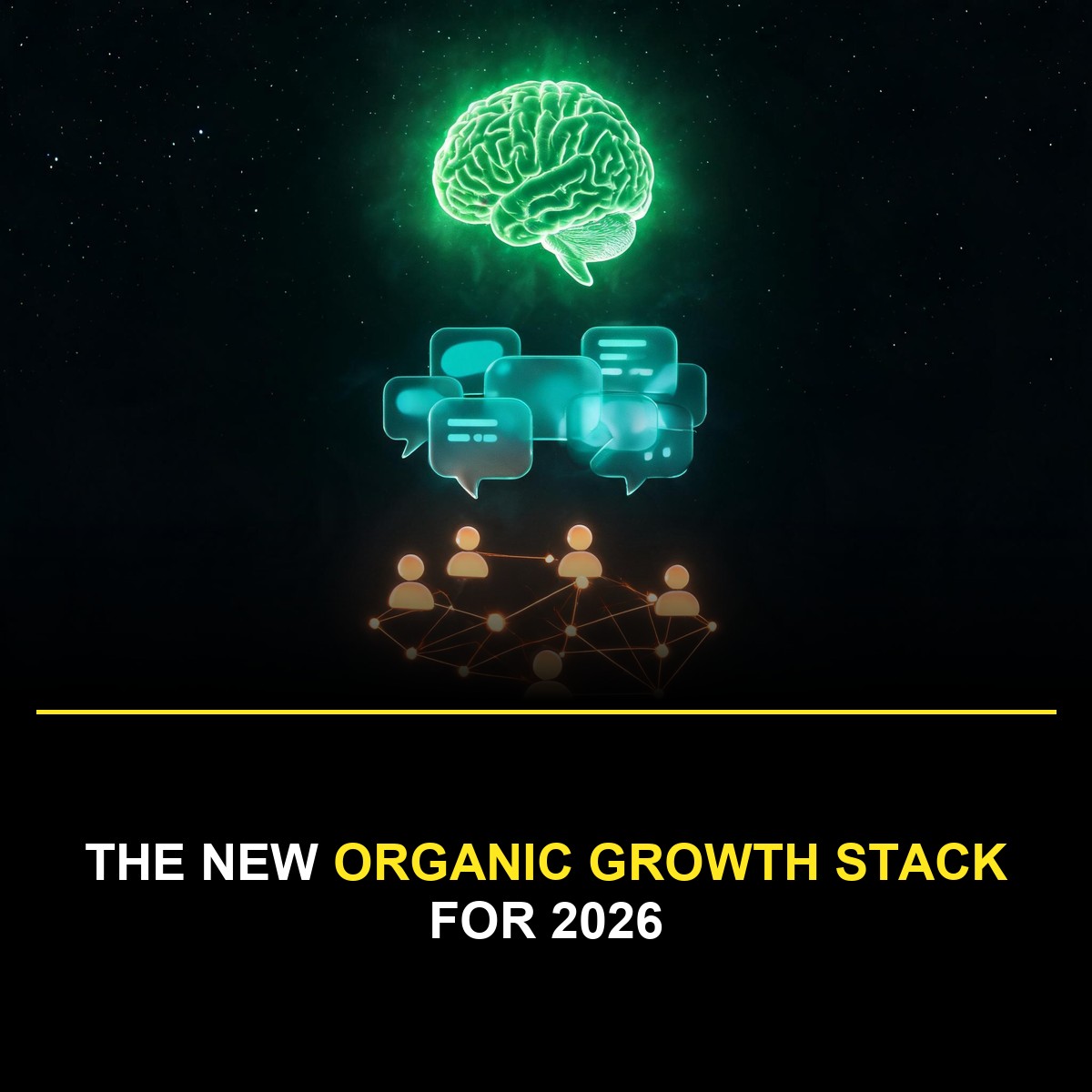
The organic growth playbook that carried brands through the last decade no longer matches how discovery works, and the new organic growth stack replaces it. In the first four months of 2026, 68 percent of Google searches ended without a click, AI assistants answer questions from a web most users never visit, and community platforms outrank vendors in the categories they discuss. Search still matters, but it now captures demand rather than creating it, and the creation has moved to social feeds, community threads, video, and the AI answers assembled from all of them.
That shift reorganizes organic growth strategy into a stack rather than a channel: search remains the foundation that AI systems draw from, social platforms and communities build the awareness and trust that make people search in the first place, and AI surfaces sit on top, synthesizing everything into the answers that increasingly start the journey. Brands still optimizing only the bottom layer are feeding a machine whose output they no longer receive.
This organic growth guide covers the data behind each layer, how the layers feed one another, the public-evidence concept that ties the stack together, the measurement problem the new funnel creates, and the working allocation for teams replanning organic growth this year.
The zero-click reality underneath organic growth
The numbers establish why the old organic growth model broke, and they come from clickstream panels rather than projections.
Roughly 68 percent of US Google searches ended without a click in early 2026, up from about 60 percent in 2024 and 49 percent in 2019, the fastest acceleration of zero-click behavior in a decade, driven by AI Overviews, which appear on a fifth or more of searches and cut click-through rates on the results beneath them by around 60 percent when present. Of every thousand US searches, only a few hundred clicks now reach the open web at all. Independent panels corroborate the direction: an aggregate tracker of tens of thousands of professionally marketed sites recorded a 22 percent drop in the share of traffic Google sends over a single year.
The causes are structural rather than temporary. Google answers questions directly because direct answers increase return usage and ad revenue, and its AI surfaces, including a billion-user AI Mode, are designed to keep the journey in-platform. Meanwhile, search behavior itself has fragmented: one analysis of search across major sites found traditional engines carrying about 80 percent of search activity, commerce sites 10 percent, social platforms 5.5 percent, and AI tools 3.2 percent, meaning search is a behavior that happens everywhere, not a channel you optimize once.
The consequence for planning is the reframe that zero-click advocates have been making for years: traffic is no longer the honest KPI for organic work. A brand can lose half its organic sessions while its influence over buyers grows, because the influence now flows through answers, mentions, and recommendations that analytics cannot attribute cleanly.
Search as the organic growth foundation, not funnel
Search is not dead in the new organic growth stack; its role has changed from destination to source material, and that distinction drives what still works.
AI answers draw extensively from what ranks well in web search, so ranking remains the upstream input to AI visibility even when the ranking earns no click. The support article published so an AI Overview gets the facts right, the product page structured so assistants can quote its specifications, the comparison guide that assistants synthesize for buying questions: these earn influence whether or not anyone visits them. SEO skills matter as much as ever; they just pay out in citation currency rather than session currency.
The categories where clicks still concentrate are worth respecting: branded searches, local intent, and high-urgency transactional queries still send searchers to sites at meaningful rates, which is why conversion-focused pages and brand-demand pages retain direct value. The content types losing clicks are informational and comparison queries, precisely the ones AI surfaces answer directly, and precisely the ones that matter most as AI training and retrieval material.
The practical search posture is therefore dual-purpose: optimize the page for the human who arrives, and optimize the same page for the machine that never will. Answer-first structure, extractable facts, clean headings, schema that matches visible content, and self-contained passages that make sense without site context serve both audiences from one artifact. Writing separately for humans and machines doubles the work; writing for the cited-and-clicked case serves both from one asset.
Social and communities as the organic growth demand engine
The awareness layer of the organic growth stack has moved decisively toward social platforms and communities, and the evidence is both behavioral and algorithmic.
Behaviorally, search happens on social platforms at meaningful scale, with younger cohorts treating video platforms and community sites as their first research stops for products, how-tos, and opinions. Product discovery now splits across YouTube, TikTok, Instagram, and Reddit alongside Google, and the pinball journey a buyer takes, a LinkedIn post, a podcast appearance, a peer's Slack recommendation, a Reddit thread, and only then a branded Google search, is invisible to last-click analytics, which is why social's contribution is systematically undercounted.
Algorithmically, community content has become the evidence layer that both traditional and AI search surfaces cite. Community platforms rank above vendors on huge shares of category and comparison keywords, and long, specific searches, the highest-intent kind, go to community discussions at near-total rates in several verticals. AI assistants cite community threads heavily for experience-based questions because firsthand accounts are exactly the evidence a recommendation requires.
The working implication splits by platform type. On social platforms, the winning content is native to the platform: short-form video, platform-specific formats, and presence in the formats people actually browse, rather than links back to blog posts nobody clicks. On communities, the winning posture is credible participation: answering questions accurately in the subreddits and forums where your buyers gather, because contributions there become the third-party evidence AI systems quote. Both are zero-click organic growth channels by design, judged on influence produced rather than sessions earned.
AI surfaces as the organic growth synthesis layer
The AI layer sits on top of the organic growth stack, synthesizing search rankings, social presence, and community discussion into the answers that increasingly start the buyer journey.
What the models recommend is assembled from the layers below: web content for facts and specifications, community and review content for trust and experience, and the brand's own pages for authoritative claims. The brand-mention data makes the weighting clear: the large majority of brand references in AI answers originate on third-party pages rather than the brand's own site, which means an organization cannot cite-optimize its way to visibility; it has to exist credibly across the sources the models read.
Two properties of the AI layer shape strategy. First, it is volatile: citation sets rotate substantially month to month, so visibility is a maintained condition rather than an achieved rank, requiring continuous measurement and refresh rather than a one-time optimization. Second, it is correctable: a documented case showed a recurring negative claim in AI answers traced to thin review-site evidence, debunked by publishing real data that assistants cited immediately, and the correction held as long as the evidence stayed fresh and faded when it aged. Publishing proof points is how the record gets fixed; leaving them trapped in internal systems leaves the narrative to whoever publishes.
For commerce brands, the AI organic growth layer increasingly carries prices and buy links, which turns recommendation absence into revenue absence and makes catalog data quality part of organic strategy. For everyone else, the AI layer is where research journeys begin, and the practical question, does the assistant describe your brand accurately and favorably when asked, is answerable only by asking it, regularly, across platforms.
The public-evidence concept of organic growth
The thread connecting every organic growth layer is the shift from ranking pages to influencing the public record, and the concept deserves a precise definition.
Your public evidence is the body of crawlable, citable material about your brand: your website, yes, but also reviews, forum threads, community discussions, video, third-party mentions, structured data, and the snippets and answers derived from all of it. Ranking systems, AI models, and the buyers who research across platforms all consume this record. The organizations that manage it deliberately, publishing proof, correcting errors, participating where buyers discuss, compound advantage; the ones that treat everything off-site as unmanageable noise leave their narrative to competitors and critics.
Managing the organic growth record has three motions. Publish the proof your buyers and the models need: retention data, benchmark numbers, methodology, real specifications, the material that distinguishes claims from marketing. Guide the conversation: participate accurately in the communities and threads where your category is discussed, because absence is also a position. Keep the record fresh: citations age, models re-verify, and yesterday's published proof decays into silence, so evidence has an expiration date that content calendars should respect.
The organic growth measurement frame that fits this concept is correlation rather than attribution: track branded search volume, AI answer presence, community mention share, and direct traffic as a correlated dashboard, because the channels create demand that another channel captures, and pretending otherwise misallocates budgets toward whatever reports last click.
The organic growth working allocation for teams
The organic growth stack converts into a planning allocation, and the proportions matter less than the completeness: most organizations are running one or two layers and none at all on the others.
Foundation: keep the organic growth search layer fully maintained, because it feeds everything above it. Technical health, crawl access for AI agents, structured data synced with page truth, and the high-intent content types that still earn clicks.
Extraction layer: make key pages quotable. Answer-first structure, extractable facts and statistics, original data the models can cite, and schema that matches visible content. This is the work that pays in citation currency.
Distribution layer: a real organic growth presence on the two or three social platforms and the communities where your buyers actually research, resourced properly, native formats for social, accurate participation for communities, and judged on influence metrics rather than referral traffic.
Synthesis layer: continuous multi-platform organic growth tracking of AI visibility with monthly cadence, prompt sets built from real buyer questions, and a correction workflow for wrong or missing brand claims, including publishing evidence when the record is thin.
Measurement layer: an organic growth correlation dashboard replacing last-click attribution as the KPI system, tracking branded search, AI presence, community share, and direct traffic together.
The organic growth compounding logic is the argument for completeness: search rankings feed AI citations, community credibility feeds both recommendations and conversions, social presence feeds branded search, and every layer reinforces the others. Teams running the full organic growth stack do not just collect more channels; they build a self-reinforcing evidence base that each layer amplifies, which is why the organizations that started in 2026 will be difficult to catch by the time the majority notices the funnel moved.
For readers building on this shift, the AI-shopping layer of the stack is covered in our AI shopping errors guide, the crawl foundation underneath AI visibility is explained in our ChatGPT search visibility piece, and the 2027 outlook for the agentic layer is analyzed in our agentic AEO piece.
The organic growth funnel, layer by layer
A concrete buyer journey makes the stack tangible, and tracing one purchase through the layers shows where organic growth actually happens now.
The journey starts in discovery, a short video on a social platform, a newsletter mention, a podcast, or a community thread where a peer describes solving the problem the buyer has. Nothing is clicked; the brand name is simply absorbed. It continues in research: the buyer asks an AI assistant for the best options in the category, and the assistant composes an answer from ranking pages, community discussions, and review sites, mentioning three brands with reasons. The buyer probes deeper in conversation, comparing the brands on price, integrations, and reputation, still without leaving the chat.
Only then does search enter: the buyer searches the two surviving brand names, and here the search layer finally earns clicks, because branded and high-intent queries still convert to visits at meaningful rates. The site's job at that moment is confirmation: proof the claims the AI made are true, specifications, pricing, and a path to buy. The journey ends in a purchase or a signup that analytics will attribute entirely to branded organic search, wiping out every upstream layer that created it.
Each organic growth layer has a distinct job in that journey. Discovery layers create the mental shortlist; the AI layer narrows it with reasons; search captures it; the site converts it. A brand absent from discovery never enters the AI shortlist; a brand absent from the AI shortlist never receives the branded search; a brand whose site cannot confirm the AI's claims loses at the final step. The organic growth funnel is not gone; it is distributed, and the work of organic growth is now to be present, accurate, and credible at every stage a buyer passes through before analytics notices them.
The organic growth staffing implication follows: the old model funded one channel team, search, because that channel reported the conversions. The new model requires owned-content, social, community, and measurement capability, and the budget case rests on tracing journeys like the one above, because the layers that create demand will never show up in a last-click report no matter how well they perform.
Revisit the layer priorities whenever the buyer journey data shifts, and let the evidence, not habit, decide where the next quarter of effort goes.
One closing discipline ties the stack together: review it quarterly, because every layer moves. Assistants update, community platforms change ranking behavior, zero-click rates climb, and the questions buyers ask shift with markets. The organizations treating the stack as a living system, measured monthly and rebalanced quarterly, keep compounding; the ones that set it once and revisit next year will find the layers drifting apart beneath them.
Questions readers are asking
Is SEO still worth investing in?
Yes, but as the foundation layer of a larger stack. Rankings feed AI answers and still capture branded, local, and high-intent clicks; what has ended is SEO as a standalone traffic strategy, since most informational searches now end without a click.
Why do communities outrank vendor sites?
Buyers trust firsthand experience over marketing, and both Google and AI assistants reward that preference: community threads match long, specific, high-intent queries and supply the experiential evidence AI systems need to make recommendations.
How do I measure organic growth without traffic?
Track a correlation dashboard: branded search volume, AI answer presence across platforms, community mention share, and direct traffic together. Last-click attribution systematically credits the channel that captured demand rather than the ones that created it.
What is the fastest fix for wrong AI answers about my brand?
Publish real evidence on your own site: assistants cite new data quickly, and documented cases show a negative AI narrative correcting within days of a credible data post, provided the evidence stays published and fresh.
Sources
- SparkToro, In 2026, less than one third of Google searches still send a click (data via Similarweb): https://sparktoro.com/blog/in-2026-less-than-one-third-of-google-searches-still-send-a-click
- SparkToro, If search captures demand, public evidence creates it: https://sparktoro.com/blog/if-search-captures-demand-public-evidence-creates-it
- McKinsey, New front door to the internet: winning in the age of AI search: https://www.mckinsey.com/capabilities/growth-marketing-and-sales/our-insights/new-front-door-to-the-internet-winning-in-the-age-of-ai-search
- Passionfruit, AI search statistics updated monthly: https://www.getpassionfruit.com/blog/ai-search-statistics-the-numbers-marketers-need-updated-monthly